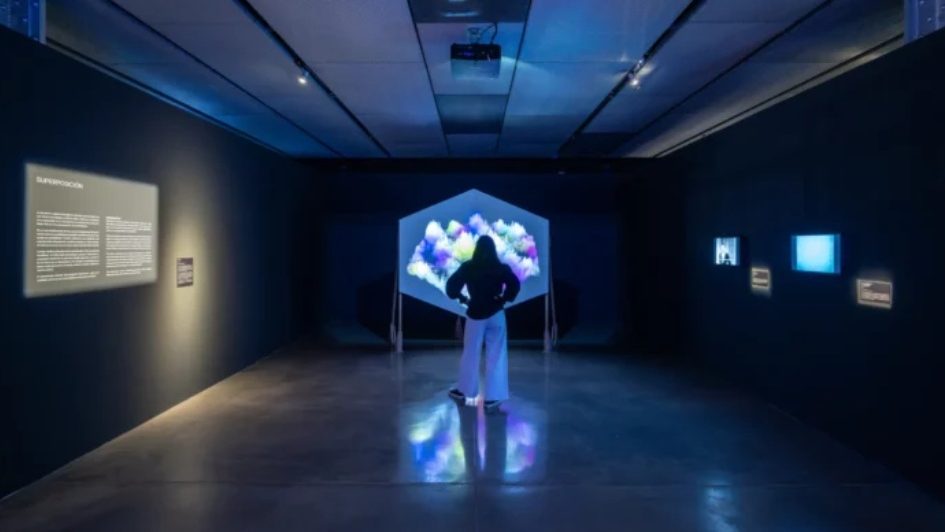

A few days ago, I was invited to the opening of the exhibition Quantum Revolution at the Fundación Telefónica Space in Madrid, where I was lucky enough to hear from Sonia Fernández-Vidal, a PhD in Information and Quantum Optics and science communicator, and Fernando Cucchietti, head of the Data Analysis and Visualisation group at the BSC, alongside María Brancós, head of exhibitions at Fundación Telefónica.
A wonderful conversation took place there. I didn’t leave with definitive answers, but with my head full of questions. So much so that I began to connect things that seemed to be disconnected. Something very quantum, by the way.
Science tells us that, in the world of the infinitesimal—where particles are so small that we cannot see them directly—reality does not behave as we might expect. I am not a physicist, and I apologise in advance for oversimplifying. But I find the idea fascinating: when we measure, when we observe, when we try to understand, the act of observing does not seem to be entirely separate from what is being observed.
And that, beyond physics, I find very inspiring.
One of the things that caught my attention most was seeing how science and art come together in the exhibition. Scientists draw on artists, visual languages, installations, historical artefacts, videos and interactive elements to try to explain something that cannot be understood in a simple way. For me, coming from the world of creativity, that union between science and art really strikes a chord.
This connection, in reality, is not new. Science and art have always intersected. Many of history’s great scientists were also connected to other forms of knowledge and creation. Leonardo da Vinci was an artist, anatomist, engineer and inventor. Galileo Galilei, as well as being a physicist and astronomer, was a true music lover and loved literature and philosophy. Isaac Newton, a mathematician and physicist, was also interested in alchemy, theology and natural philosophy.
Until relatively recently, knowledge was not as fragmented as it is today. Science, art, philosophy and spirituality shared the same human need: to understand reality from every angle.
And this is where my reflection goes a step further.
Perhaps art and science do not merely touch upon one another. Perhaps they also touch upon philosophy and the search for a broader meaning.
For some time now, I have observed that more and more people are seeking that deeper meaning, an inner connection that in many parts of the West seemed to have been lost. I am not talking about religion in the conventional sense, but rather a need to understand who we really are, how we relate to the world, how we relate to ourselves, and what place consciousness occupies in our experience of reality.
And it turns out that, nowadays, in many forms of introspection, personal growth or the search for meaning, quantum physics keeps cropping up.
It appears when people talk about Buddhism, Hinduism, Kabbalah, mindfulness, contemporary Stoicism or even new interpretations of Christianity. Many traditions seem to find in quantum physics not a scientific demonstration of their beliefs, but a new language to express ancient intuitions: that reality transcends our perception, that things are more connected than they seem, and that absolute certainty may not be the most honest way of looking at the world.
All of this connected me to the famous Schrödinger’s cat experiment, which also featured in the presentation. This thought experiment illustrates some of the paradoxes of quantum mechanics and helps us to imagine, in a fairly intuitive way, the idea of superposition: the possibility that something, in this case the cat, can be in several states at the same time, until it is observed.
I don’t want to force the analogy. Schrödinger’s cat does not suggest that our mind magically creates reality. But it does serve as a powerful image to remind us that reality, when we look at it closely, is far less simple than it might seem. And that the observer, in one way or another, ultimately determines reality.
But of course: we must be careful.
I am not saying that quantum physics proves spirituality.
Quantum physics does not turn a mystical intuition into a scientific law. It cannot be used as a magical explanation for everything. But I do believe it reminds us of something very valuable: the more we study the subject, the less solid, less simple and less obvious reality becomes.
In line with all this, there is a book that fits very well with this reflection: Letting Go: The Path to Freedom, by David R. Hawkins.
From my point of view, it is a fairly secular reference within what we might call the ‘inner search’, although its language also has spiritual overtones. What interests me most about this book is that it proposes something simple and transformative: observing thoughts and emotions, ceasing to resist them, and allowing that energy to lose its force.
I find a very powerful connection there. Not because Hawkins needs to rely on quantum physics, but because he refocuses attention on the observer. Not as someone who creates reality at will, but as someone who can transform the way they interpret it, navigate it and experience it.
And who is that observer?
That is, perhaps, the unresolved question.