
- Her most notable invention is the Mechanical Encyclopaedia, patented in 1949, with improvements and updates that led her to file a new patent thirteen years later.
To mark Girls in ICT Day, we are going to take a closer look at some leading figures in this field, such as Ada Lovelace and Hedy Lamarr.
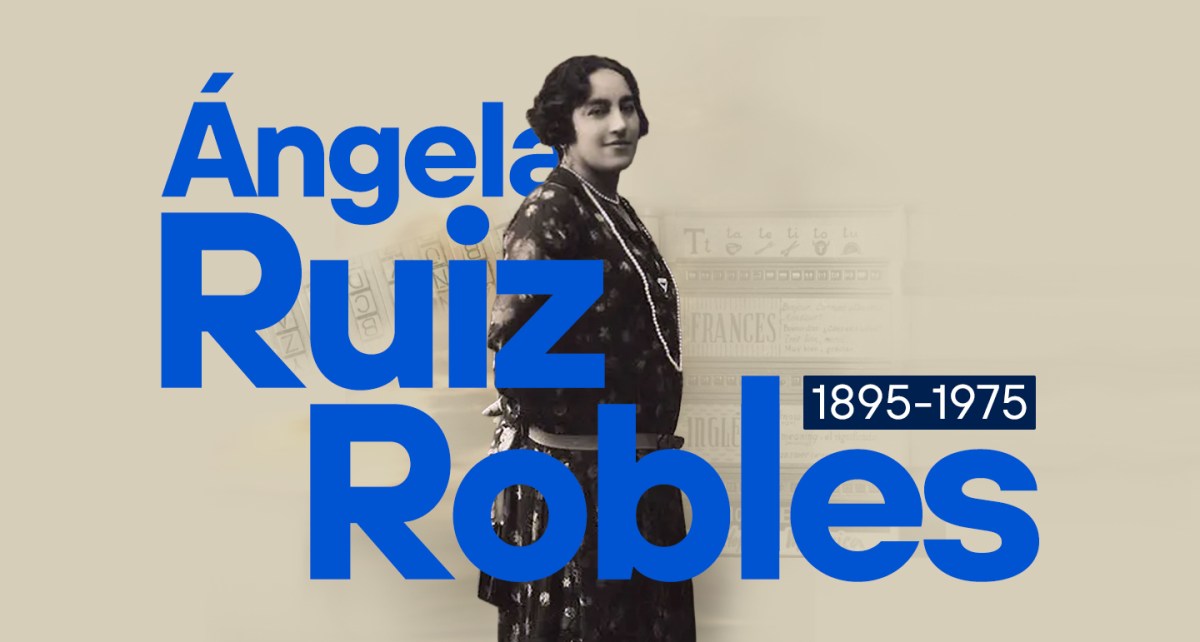
In this case, we are going to learn more about Ángela Ruiz Robles (1895–1975), one of the Spanish inventors who have made history.
Ángela Ruiz Robles’s origins and childhood
Ángela Ruiz Robles was born in the town of Villamanín, in the Spanish province of León, on 28 March 1895.
She grew up in a well-off family; her father, Feliciano Ruiz, was a pharmacist and her mother, Elena Robles, a housewife.
Ángela Ruiz Robles’s education and early teaching career
Ruiz Robles completed her higher education at the León Teacher Training College, known at the time as the Escuela Normal de Maestras.
At this institution, she obtained, with top marks, qualifications in Shorthand, Typewriting and Commercial Accounting in 1915, subsequently teaching precisely these subjects at the same college.
It was during this period – in 1916 – that Ruiz Robles created her first invention, a shorthand system which she herself refined and developed in the 1940s, as we shall see later.
In the late 1910s, she secured a teaching post through the National Teaching Competitive Examinations in a village in A Coruña near Ferrol.
Inventions by Ángela Ruiz Robles
In addition to her best-known invention, the Mechanical Encyclopaedia, which we shall explore in greater detail later, this teacher and educationalist from León is also the creator of other inventions whose purpose was equally educational.
The Shorthand Typewriter, from 1944, was designed to facilitate both teaching and learning by simplifying and speeding up shorthand writing through mechanical mechanisms. A device that sought to modernise education.
Also dating from the 1940s is the Linguistic-Grammatical Atlas, an educational resource that broke new ground by presenting grammar, syntax and spelling in a visual, interactive and detailed manner.
Based on meaningful learning and self-study, this fold-out book was designed to lighten the weight of the schoolbags that pupils had to carry to school.
This atlas is considered the precursor to what would become Ruiz Robles’s best-known invention, the Mechanical Encyclopaedia.
Mechanical Encyclopaedia
In 1949, she registered her first patent with the Spanish Patent and Trademark Office (under number 190,968) under the title ‘mechanical, electrical and pneumatic procedure for reading books’.
An invention that was the seed of the Mechanical Encyclopaedia, with which the inventor hoped to resolve the problems of conventional encyclopaedias, such as their excessive bulk or the imbalance between the length and comprehensibility of the content.
A mechanical encyclopaedia that was divided into two parts which opened and closed like any other book, and whose operation is summarised as follows on the SPTO website:
“On the left-hand side were automatic alphabets for forming syllables, words or short phrases using mechanical push-buttons which, when pressed lightly, activated a mechanism consisting of ratchets and serrated wheels which, in turn, moved a wheel bearing the complete alphabet that rotated letter by letter, displaying them through a small window. Beneath these alphabets, there was provision for a plastic surface where the pupil could write, draw or perform mathematical operations”.
As for the right-hand side, it is explained that “it had a pair of cylinders situated on opposite sides. In one of them, a vertically unfolding reel was inserted, containing the subject and its lessons divided into sheets that could be moved manually or mechanically (as in ancient papyri or modern photographic film reels) from one cylinder to another behind a transparent screen with magnifying properties or optically graduated to facilitate understanding and assist pupils with visual impairments. Each subject was housed in its own corresponding reel, making them interchangeable and allowing them to be stored in the case. Similarly, the encyclopaedia was designed to incorporate electric lighting or text in phosphorescent ink for use at night.
The aim of lightening the physical load of the materials that children had to carry was combined with the educational objective of facilitating study.
Advances in the invention led to the filing of a new patent for it in 1962.
This device, made of zinc, wood and bronze, was never actually marketed, but has gone down in history as a precursor to the e-books that would become hugely popular decades later.
As a point of interest, we might add that the prototype of the Mechanical Encyclopaedia is currently on display at the National Museum of Science and Technology (MUNCYT) in A Coruña.
Frequently asked questions
She was born on 28 March 1895 in the town of Villamanín, in the province of León, Spain.
Ruiz Robles died in Ferrol (in the province of La Coruña, Spain) on 27 October 1975 at the age of 80.
For creating what is known as the Mechanical Encyclopaedia, considered the precursor to the e-book.
One of the inventions that paved the way for the e-book is Ángela Ruiz Robles’ Mechanical Encyclopaedia.