
- The Top Secret Rosies were a group of mathematicians and scientists who worked in secret for the US military.
- Recognition of their work came decades after their contributions during the Second World War.
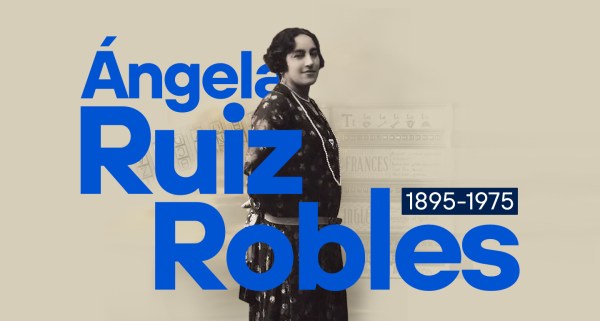
To mark Girls in ICT Day, we are going to take a closer look at some female role models in this field, such as Ada Lovelace, Hedy Lamarr and Ángela Ruiz Robles.
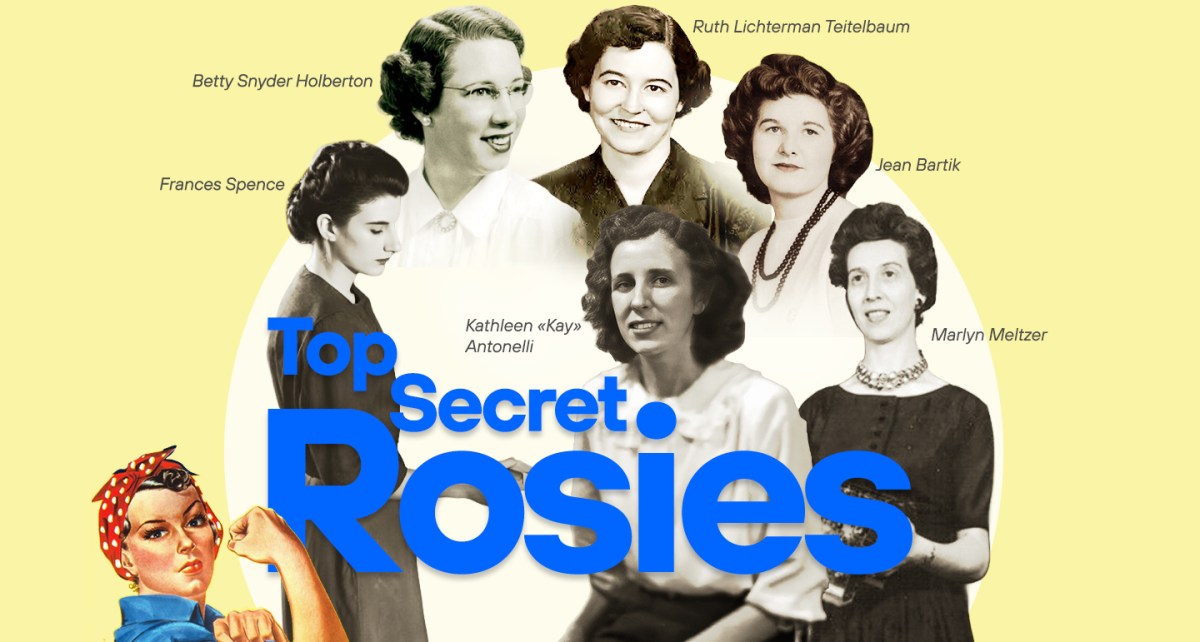
In this article, we are going to talk about Betty Holberton, Jean Bartik, Kathleen McNulty, Marlyn Wescoff, Ruth Lichterman and Frances Spence. But who were these six women?
They were a group of female mathematicians hired by the US Army during the Second World War to programme the ENIAC, one of the first digital computers and an acronym for Electronic Numerical Integrator And Computer.
Their work proved crucial for ballistic calculations, although it remained secret, underestimated and unknown for decades.
Who were the Top Secret Rosies?
Before examining the roles they played during the Second World War, let’s briefly meet each of these six computer scientists.
- Betty Snyder Holberton (1917–2001) is also known for developing the first statistical analysis package used for the US census (1950) and for designing the first generative programming system. She also helped develop the UNIVAC and BINAC computers.
- Kathleen ‘Kay’ Antonelli (1921–2006) is the only one of the Top Secret Rosies not born in the United States, having been born in Ireland with the surname McNulty.
- Marlyn Meltzer (1922–2008), unlike some of her colleagues who continued their professional careers in science, devoted herself exclusively to her family and voluntary work from 1947 onwards.
- Frances Spence (1922–2012), like Meltzer, left her career in science to devote herself to her family.
- Ruth Lichterman Teitelbaum (1924–1986) was another of the original ENIAC programmers. She was the only one who had already passed away by the time they were recognised in the Women in Technology International Hall of Fame in 1997.
- Jean Bartik (1924–2011) led the development of subroutines and programming logic for the ENIAC, enabling it to perform complex calculations efficiently.
What did the Top Secret Rosies do?
This group of women went down in history for programming the ENIAC, the first general-purpose digital computer, during the Second World War, as we mentioned at the start of the article.
Specifically, their contributions were used to calculate complex ballistic trajectories and highly complex differential equations that served to improve the accuracy of Allied artillery, drastically reducing manual calculation times.
As historical context, the US Army began recruiting female mathematicians to perform ballistic calculations following the Japanese attack on Pearl Harbour.
The secret mission carried out by this group of mathematicians and scientists involved performing ballistic calculations, as mentioned earlier, to the extent that they were also known as ‘human computers’.
Although their work was considered minor at the time, their contributions laid the foundations for modern computer programming.
Where does the name ‘Top Secret Rosies’ come from?
The name derives from ‘Rosie the Riveter’, a cultural icon in the United States during the Second World War, referring to the millions of women who went to work in factories due to the shortage of male labour.
The name ‘Top Secret Rosies’ is a technological adaptation of this group that operated in secret.
Belated recognition of the work of the Top Secret Rosies
The secret nature of the work they carried out in the 1940s, combined with the sexism of the era, meant that their work was banished from the collective consciousness for decades.
Added to this was the fact that their presence in the project’s photographs was attributed to their roles as administrative staff or models.
Their inclusion in the Women in Technology International Hall of Fame in 1997 helped to secure their place in history and ensure they were recognised for what they actually did.
The 2010 documentary Top Secret Rosies: The Female “Computers” of WWII, which focused on the role of women in computing during the Second World War and featured some of the Top Secret Rosies as protagonists, also played a part in reviving the memory of these women.
Frequently asked questions
A group of female mathematicians hired by the US Army during the Second World War to program the ENIAC, one of the first digital computers.
The names of the six Top Secret Rosies were as follows: Betty Holberton, Jean Bartik, Kathleen McNulty, Marlyn Wescoff, Ruth Lichterman and Frances Spence.