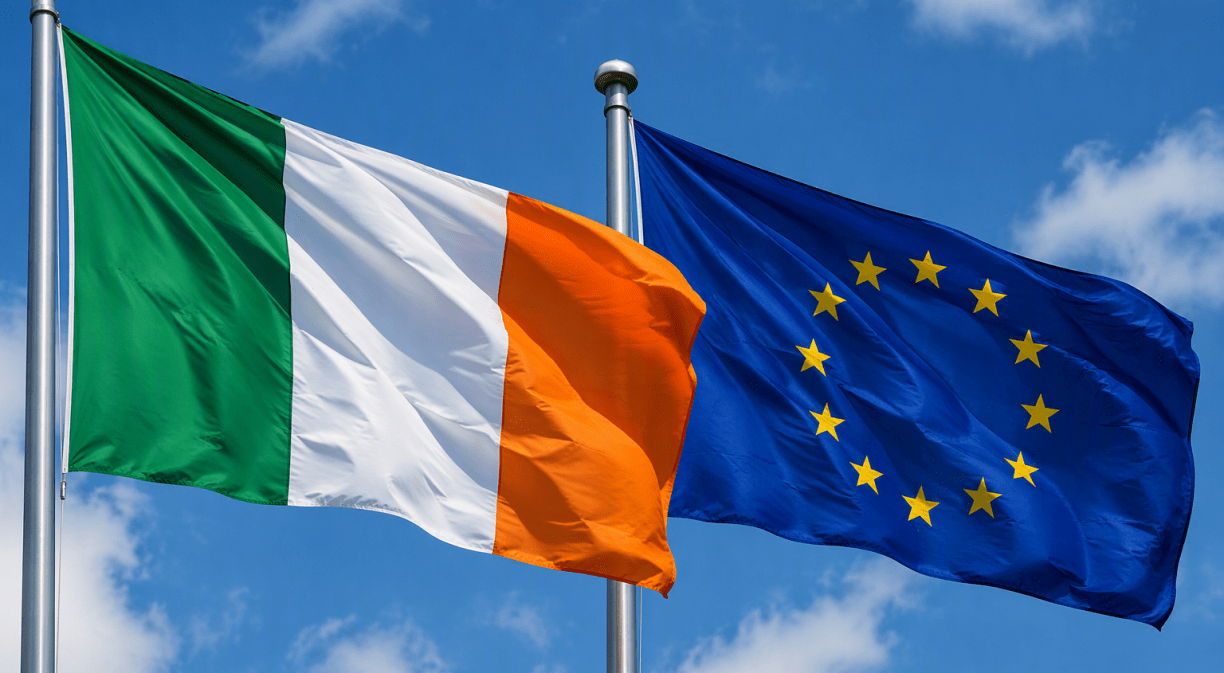

In its role, Ireland will chair council meetings, advance EU legislation, become a broker for compromises among Member States, represent the Council in negotiations with other EU institutions, coordinate and communicate Council work and ensure continuity of the EU agenda.
The Irish Presidency has made the “One Europe, One Market Roadmap” a central element of its competitiveness agenda. According to the Presidency programme, Ireland views the roadmap as the blueprint for strengthening Europe’s economic performance and completing the Single Market.
Key priorities under “One Europe, One Market”
The Irish Presidency intends to advance measures aimed at:
– Deeping the EU Single Market, including reducing barriers that still fragment cross-border business activity.
– Improving European competitiveness and productivity to close the gap with major global competitors.
– Regulatory simplification and burden reduction, making EU rules easier for businesses to implement while preserving policy objectives.
– Strengthening digital transformation and innovation, including work on key technology and digital-market initiatives.
– Mobilising investment and deeper capital markets, notably through measures linked to the Savings and Investments Union and broader market integration.
– Supporting strategic resilience and economic security, ensuring that competitiveness, security and values reinforce each other.
If achieved, these would be promising developments.
Political framing
Competitiveness is Ireland’s leading economic priority. For the telecoms and digital sector, the competitiveness focus is expected to support discussions on market integration, digital infrastructure, simplification, investment, and measures designed to strengthen the EU’s global competitiveness.
In particular, Ireland will aim at strengthening Europe’s digital economy and technological leadership advancing work on Artificial Intelligence implementation and innovation; data policy and the forthcoming Digital Omnibus simplification package; reducing regulatory complexity for digital businesses; and supporting research, innovation and digital investment.
Of particular relevance to the telecom sector will be the work that the Irish Presidency will undertake on the Digital Networks Act, where the Presidency will work towards a compromise on several of the articles included in the proposal.
Further to the Tech Sovereignty package adopted by the European Commission in June, the Presidency will steer discussions among Member States on Europe’s dependence on non-EU technology providers; cloud, data and critical digital infrastructure resilience; and secure connectivity, satellite communications and strategic digital supply chains.
Under the Presidency’s security pillar, attention will focus on cyber resilience, the protection of critical infrastructure and integrating digital security as part of broader European security and defence efforts.
Ireland is also expected to facilitate discussions on fair digital markets, consumer protection online and in particular on measures concerning minors’ access to social media and platform accountability.
Overall, Ireland’s approach is strongly focused on competitiveness, simplification, investment, AI, digital infrastructure and tech sovereignty, making the second half of 2026 particularly relevant for the future EU telecom framework.
During the European Parliament plenary debate on 7 July 2026, following Taoiseach Micheál Martin’s presentation of the Irish Presidency programme, members welcomed the programme and were broadly supportive. While political groups highlighted different priorities, they expect Ireland to deliver on over the next six months.
Many members agreed with Ireland’s emphasis on European competitiveness, innovation and strengthening the Single Market, seeing these as essential to maintaining the EU’s global position. These themes had already featured prominently in discussions between Parliament’s political leaders and the incoming Irish Presidency before 1 July.
Members broadly encouraged Ireland’s commitment to continued support for Ukraine and to advancing the EU enlargement process. These issues were repeatedly identified as key expectations for the Presidency.
Several political groups stressed the importance of achieving progress on negotiations for the next Multiannual Financial Framework (MFF), viewing Ireland’s Presidency as taking office at a decisive moment for the Union’s future financing.
Members were generally receptive to Ireland’s commitment to safeguarding European values, democracy and the rule of law, particularly in the context of enlargement and external challenges facing the Union.
Trio Presidency Structure
Ireland works within an 18‑month Trio Presidency programme together with Lithuania (2027) and Greece (2027) to provide continuity in the Council’s work.
The three Member States cooperate on a common programme to ensure continuity, consistency and effective management of the Council’s legislative and policy agenda.
Under the “A Prosperous and Competitive Europe” pillar of the Ireland–Lithuania–Greece Trio Presidency Programme (1 July 2026–31 December 2027), the Trio aims to strengthen the EU’s economic competitiveness, productivity and resilience while accelerating the twin digital and green transitions.
Moving Forward
In the months ahead, Ireland’s Presidency of the Council of the EU is centred on strengthening European competitiveness through its “One Europe, One Market” agenda, which aims to deepen the Single Market, reduce regulatory burdens, boost investment, and accelerate digital transformation. Many of the decisions made will have important effects on the telecomunications sector.
Key priorities include advancing AI and data policies, progressing the Digital Networks Act, promoting tech sovereignty, improving cyber resilience, and supporting digital infrastructure and innovation. Ireland will also play a leading role in discussions on the EU budget, enlargement, security, and continued support for Ukraine.
Working within the Trio Presidency alongside Lithuania and Greece, Ireland seeks to reinforce the EU’s economic resilience, technological leadership, and global competitiveness while ensuring continuity in the Union’s legislative agenda.