


Europe shifts from making rules to enforcing them
The European Commission has published the State of the Digital Decade 2026 report. The document acknowledges the progress achieved so far but warns that Europe needs to accelerate its efforts to meet its 2030 targets.
Its main conclusion marks an important shift compared to previous years: the foundations of Europe’s digital transformation are now in place, but the focus must move towards achieving greater scale, speed, and consistency
The geopolitical context is also very different from the one that surrounded the launch in 2021 of the Digital Decade 2030 programme, the European Union’s roadmap for strengthening digital capabilities across skills, infrastructure, business digitalisation, and public services. Since then, Europe has developed a comprehensive digital regulatory framework and made progress in connectivity, public services, digital skills, and technology adoption. However, the gap with other regions in some strategic technologies has widened, while geopolitical competition has intensified.
The report reflects this shift in priorities. Digital transformation is no longer seen solely as a race for innovation. It has also become a matter of competitiveness, security, resilience, and strategic autonomy. Compared with previous years’ emphasis on setting targets and developing new regulations, the message in 2026 is much more focused on execution.
Technological sovereignty moves to the centre of the digital agenda
In this new context, technological sovereignty plays a central role. The report highlights that Europe continues to face significant dependencies in several critical areas.
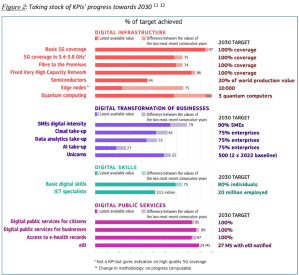
The European Union accounts for only 9% of the global semiconductor market and remains heavily dependent on external providers in cloud computing, artificial intelligence, cybersecurity, and other critical technologies.
These dependencies are not merely economic. They can affect Europe’s ability to protect its infrastructure, ensure the continuity of essential services, and respond effectively to crises or changes in the international environment. To address this challenge, integrating digital capabilities with cybersecurity and defence has become increasingly urgent, as it will be difficult to build a truly resilient and strategically autonomous Europe without it.
Reducing these dependencies does not mean closing Europe’s economy. Rather, it means strengthening domestic capabilities, diversifying suppliers, and ensuring that Europe can make independent decisions and act autonomously in strategic areas.

Investment is essential to close gaps and achieve scale
The report stresses that meeting the 2030 objectives will require maintaining and expanding investment efforts. Europe has mobilised substantial resources in recent years, but the challenge is far from complete.
The gradual phase-out of extraordinary NextGenerationEU funding represents a turning point. A significant share of the public funding included in national roadmaps is scheduled to end after 2026, despite the fact that major investments still need to be made.
At the same time, demand for connectivity, computing power, and data storage will continue to grow. The expansion of artificial intelligence and data-intensive services will increase requirements for capacity, security, and efficiency.
In this context, the Commission points to the need to mobilise long-term private investment. Achieving this requires stable and predictable frameworks capable of supporting projects at sufficient scale.
Scale is not an abstract objective. It enables costs to be shared, strategic technologies to be developed, and services to be delivered across a broad and competitive European market.
Simplification and the Single Market can accelerate delivery
The report also highlights the need to simplify and better coordinate digital policies. After years focused on defining objectives and adopting new regulations, the priority is now their effective implementation.
The accumulation of regulatory requirements and differences between Member States can delay projects, increase costs, and limit innovation. Reducing fragmentation is essential to move faster.
Strengthening the Digital Single Market is therefore critical. A more harmonised environment facilitates cross-border investment, enables companies to grow, and helps create capabilities on a European scale.
Simplification does not mean lowering standards. It means making them clearer, more coherent, and more results-oriented.
In this context, the Digital Networks (DNA) could play an important role. The Commission notes that regulatory simplification in this area is necessary to accelerate connectivity and suggests that the DNA should maintain its ambition in key areas for attracting investment, including indefinite or very long-duration spectrum licences. Its goal of harmonising procedures and providing greater predictability could help speed up the deployment of digital infrastructure and services.
Networks underpin the new digital economy
Connectivity occupies a central place in this renewed approach. Basic 5G coverage now reaches 96.8% of European households. However, the report notes that the deployment of fibre and other very-high-capacity networks must accelerate.
This need reflects a broader transformation. Artificial intelligence, cloud computing, edge computing, and advanced digital services require secure, resilient networks and infrastructure at scale, capable of handling ever-growing volumes of data.
Networks are not simply another layer of the digital ecosystem. They are the infrastructure that enables the deployment, connection, and use of all other strategic technologies.
Different national starting points illustrate the scale of the challenge. The report recognises that Spain has particularly advanced connectivity infrastructure, although it must do more to leverage this strength to drive business digitalisation. Germany, meanwhile, stands out in semiconductors and quantum technologies but needs to accelerate the rollout of very-high-capacity networks. Both cases demonstrate the need to better combine Europe’s strengths.
The Digital Decade enters its decisive phase
The 2026 report does not lower the ambition of the Digital Decade. Instead, it explains how that ambition must adapt to a more demanding economic, technological, and geopolitical environment.
Europe has built a solid foundation in regulation, infrastructure, and capabilities. The challenge now is to move forward with greater scale, speed, and coherence.
The next phase must focus on execution, investment, and strengthening strategic capabilities. It must also improve policy coordination, reduce fragmentation, and fully leverage the potential of the Single Market.
The Digital Decade is therefore entering its decisive stage. Europe has already defined much of its vision and objectives. The task now is to create the conditions needed to achieve them.