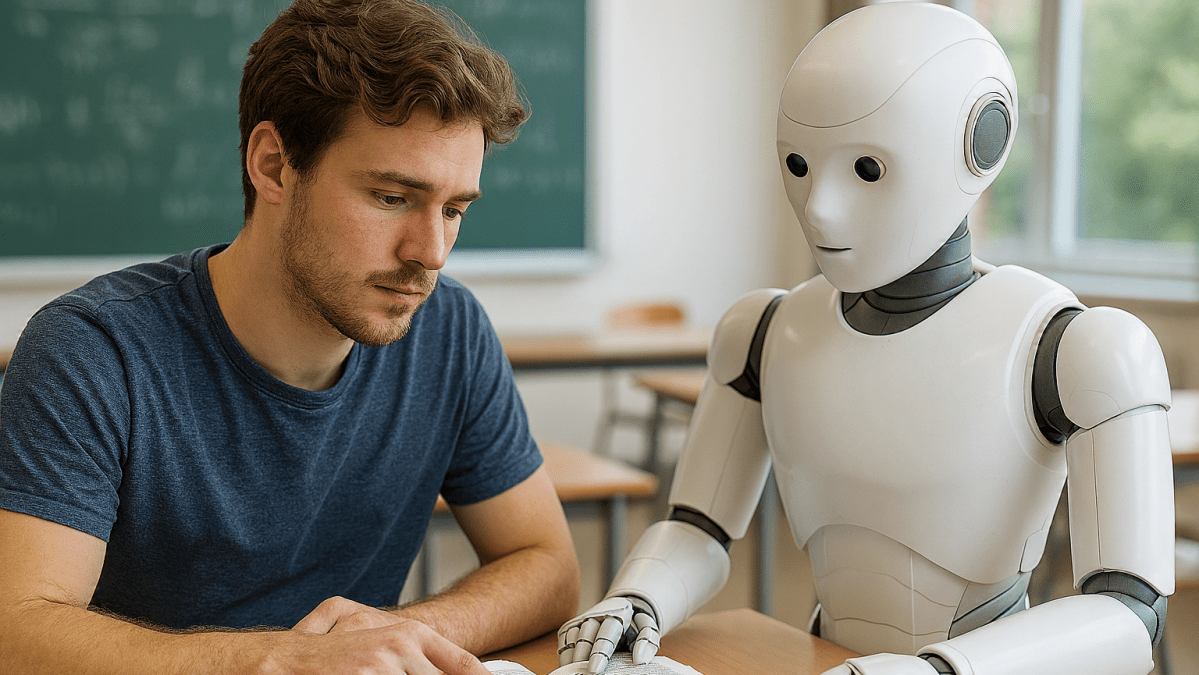

The paradox of artificial intelligence in education: higher performance, less learning
The rapid integration of generative artificial intelligence into learning and work is creating a paradoxical situation. The most recent studies show that the use of tools such as ChatGPT can improve immediate performance by up to 127 per cent, but can also reduce the same person’s performance by 17 per cent when they attempt to complete a task without assistance.
The OECD has termed this phenomenon the ‘performance-learning paradox’: a situation in which observable results improve whilst the actual acquisition of knowledge weakens. In other words, we appear to know more, but we have learnt less.
This paradigm shift poses a key challenge for businesses, universities and education systems: how to integrate AI without undermining the capacity to learn.
Cognitive debt: the great hidden risk of artificial intelligence
The concept of ‘cognitive debt’ explains this phenomenon precisely. The use of AI offers an immediate benefit — less effort, greater speed — in exchange for a deferred cost that accumulates in the form of a progressive loss of independent thinking ability.
This debt does not disappear automatically. Those who continually delegate tasks to AI experience:
- Reduced analytical capacity
- A reduction in working memory
- A loss of creativity and original thinking
- Difficulty in applying knowledge to new contexts
The key lies not in the technology, but in how it is used.
The real problem is not AI, but how we adopt it
Adopting artificial intelligence is not simply a matter of buying a tool and expecting results. It involves aligning technology, people and learning around a plan.
It is not enough to introduce AI into classrooms or businesses; learning processes need to be redesigned.
The organisations and education systems that are most successfully adopting artificial intelligence are not those that incorporate the most technology, but those that follow a structured approach.
How to integrate artificial intelligence into education without compromising learning
The evidence suggests that the solution is not to restrict AI, but to change how it is used.
Think before using AI
Structuring tasks so that the learner formulates an initial response before consulting the AI maintains the cognitive effort required for learning.
Use AI as a tutor, not a substitute
When focused on the process (explanation, comparison, reasoning), AI enhances learning rather than replacing it.
Measuring genuine learning
It is essential to assess skills both with and without AI to distinguish between performance and understanding.
Fostering metacognition
Learning to think about how we think enables us to spot mistakes, improve decision-making and avoid technological dependence.
From technological adoption to cultural change
One of the biggest mistakes is to think that transformation through AI is purely technological.
Artificial intelligence is not, and never will be, merely a technological project. It is, above all, a human endeavour.
This implies that in education and business, the key lies in three elements:
- A culture of learning
- Continuous professional development
- Responsible use of AI
Resistance to change, a lack of skills or the uncritical use of technology are greater barriers than the tool itself.
The new role of learning in the age of artificial intelligence
The advent of AI is changing the role of students and professionals:
- From carrying out tasks → to supervising them
- From producing content → to interpreting it
- From memorising → to understanding and making decisions
The key skills are no longer technical, but cognitive:
- Critical thinking
- Creativity
- The ability to learn continuously
- Judgement and decision-making
The future of education with artificial intelligence
We are at a turning point. Artificial intelligence can democratise access to knowledge, accelerate learning and personalise education.
But it can also reduce cognitive autonomy, create dependency and homogenise thinking.
The difference will depend on how it is integrated.
Conclusion: learning better will be the true competitive advantage
Artificial intelligence is not responsible for cognitive debt. It is the way in which we choose to integrate it into our processes.
When used well, it frees up time for higher-value tasks: creativity, judgement, innovation. When used poorly, it replaces thinking and undermines learning.
That is why, in the age of AI, the competitive advantage will no longer lie with those who know the most, but with those who learn best.
Learning faster than change continues to be a decisive advantage. But learning well is even more so.
In this context, the challenge of educating and learning in the age of artificial intelligence ties in directly with Telefónica’s value proposition: to take on the challenge of becoming the best gateway for citizens to digital technologies, offering the best and most comprehensive range of services and a network that provides access to the most innovative technology. This involves not only facilitating access to AI, but doing so whilst guaranteeing quality, trust and the development of talent, and promoting responsible use that enables people to make the most of technology without compromising their cognitive abilities. Thus, education in the age of AI is not just a question of tools, but of building an environment in which innovation, learning and trust go hand in hand.