


This post launches a series focused on the Digital Networks Act, in which we will delineate Telefónica’s vision on how to ensure the regulatory framework helps drive innovation and growth in the European Union’s telecomunications sector.
Spectrum is the essential resource that enables mobile networks to function. As connectivity depends on access to spectrum, the way it is assigned directly determines the quality, speed, resilience and reliability of Europe’s networks. Efficient and predictable spectrum policy is therefore critical to unlock investment and innovation in next-generation infrastructure and services and better serve customers.
A unique opportunity to strengthen Europe’s digital framework
Spectrum policy sits at the heart of Europe’s digital future. As discussions on the Digital Networks Act (DNA) move forward, Europe has the opportunity to improve its spectrum framework by strengthening investment incentives and reinforcing the telecoms markets across the EU.
The DNA already contains some of the most ambitious and forward-looking spectrum provisions proposed in recent years, particularly on licence duration, prices, and yearly fees. If preserved, they can significantly improve regulatory certainty and create better conditions for long-term investment.
The DNA Proposal introduces key improvements to spectrum policy
– A clear move towards indefinite licences and renewal by default, marking a significant step forward compared to the current Electronic Communications Code framework. This brings the long-term predictability needed to support sustained investment and innovation by the licence holders in next generation networks.
– Stronger guidance on yearly fees and reserve prices, aligned with pro-investment principles, with the EU adopting reccomendations on a common methodology.
– Greater consistency and convergence in the the spectrum assignment across Member States reinforcing EU guidance, including an EU level spectrum strategy, and roadmaps.
Together, these measures would create a more predictable, coordinated and investment-friendly spectrum framework to support Europe’s connectivity and competitiveness.
Indefinite licences and renewal by default foster innovation – they do not hinder it
It is worth reiterating one key positive element, which merits particular emphasis: the move towards indefinite licences and renewal by default proposed in the DNA.
An indefinite licence does not confer unlimited rights or remove regulatory oversight. Regulators retain full powers to enforce licence conditions, ensure the efficient use of spectrum, and intervene where necessary in the public interest.
Contrary to some concerns raised, longer and more predictable licence terms give operators the predictability to commit the investment needed to meet growing consumer and business demand. The DNA does not eliminate innovation and long-term investment incentives; rather it preserves them by enhancing certainty of tenure for licences and by fostering a more liquid secondary market.
The availability of multiple spectrum bands already enables effective competition, regardless of whether operators use the same or different bands. Simultaneously, the proposal also introduces safeguards to prevent hoarding and ensure efficient use, and the broader set of safeguards proposed by the Commission.
These ensure that there is neither a regulatory vacuum nor free rein for operators, but rather a framework of regular oversight. This approach does not weaken competition and innovation, but instead supports a more continuous, efficient and market-driven use of spectrum across the Union.
Indefinite licences in the UK
The UK provides a good example. Most mobile spectrum licences are granted on an indefinite basis, subject to an initial term of 20 years, while remaining fully subject to regulatory oversight. For spectrum management reasons, Ofcom may revoke a licence, provided it gives at least five years’ notice. Any such decision must be objectively justified, non-discriminatory, proportionate, and consistent with the licence holder’s legitimate expectations. This framework demonstrates that indefinite licences can provide long-term investment certainty while preserving the regulator’s ability to manage spectrum effectively in the public interest.
Where operators have made substantial investments and are using spectrum efficiently, non-renewal can destroy the value of those investments and require a new entrant to replicate them within a very short timeframe. In practice, the likelihood of attracting a new investor under such circumstances is low, while the risk of disrupting existing services and undermining investment incentives is high. Past experience, such as the case of Tele2, illustrates that this approach can lead to poor outcomes for both the market and consumers.
Key Aspects that still need to be addressed in the DNA
While the DNA represents a major step forward, two elements could still undermine its full potential.
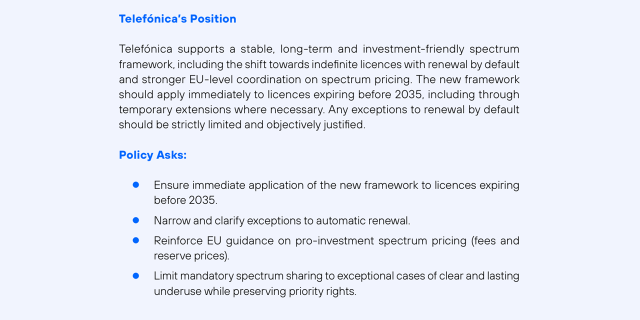
First, the seven-year transition period for licences expiring before 2035
To be effective, the proposal should be amended to ensure its immediate application to licences expiring before 2035 and to limit exceptions to automatic renewal. The impact would be significant: more than 500 licences would be affected – representing, more specifically, 66% of assigned MHz in low-bands, and 58% in mid bands in Europe.
This situation risks fragmenting the internal market, weakening confidence in renewal processes, and discouraging investment due to unnecessary and costly re-auctions.
A better approach would be to avoid this transition period and introduce a temporary extension of existing licences, allowing for a coordinated EU-wide assessment if there is a grounded justification for departing from the principle of automatic renewals in a consistent and coordinated manner across the EU.
Second, the current proposal introduces too many broad and open-ended exceptions to the “automatic renewal” rule.
Exceptions to the licence renewal rules create legal uncertainty and should be clearly defined, narrowed, and reduced in scope to preserve legal certainty and maintain strong investment incentives based on cost efficiency and improved profitability.
Building a spectrum framework to promote long-term investment
Building on the need to strengthen legal certainty and investment incentives, the DNA also introduces important improvements in spectrum assignment and pricing.
Greater consistency across the EU, and clearer pro-investment principles are welcome developments that should facilitate the scale that is essential to support efficient investment. In particular, the higher burden of proof for market-shaping measures, together with the European Commission’s oversight, contributes to a more balanced and coherent approach.
Within this context, Member States should retain the flexibility to designate the competent authority responsible for market-shaping measures, considering national circumstances and balancing relevant policy objectives.
Finally, EU-level spectrum assignments may support pan-European services where there is clear demand, provided they do not distort competition or undermine investment in national markets.
Shaping the future spectrum policy framework now lies in the hands of co-legislators.
As the Digital Networks Act is finalised, it will be essential to reflect the perspective of telecom operators. As the companies that invest in and operate Europe’s digital infrastructure, they have both the strongest incentive and the greatest responsibility to ensure the efficient use of spectrum while delivering high-quality connectivity.
A spectrum framework that provides certainty, promotes investment and enables efficient spectrum use will strengthen Europe’s competitiveness, resilience and digital leadership.
In the next post we will examine access regulation and copper switch-off, with an emphasis on guaranteeing the provision of a competitive wholesale access product.