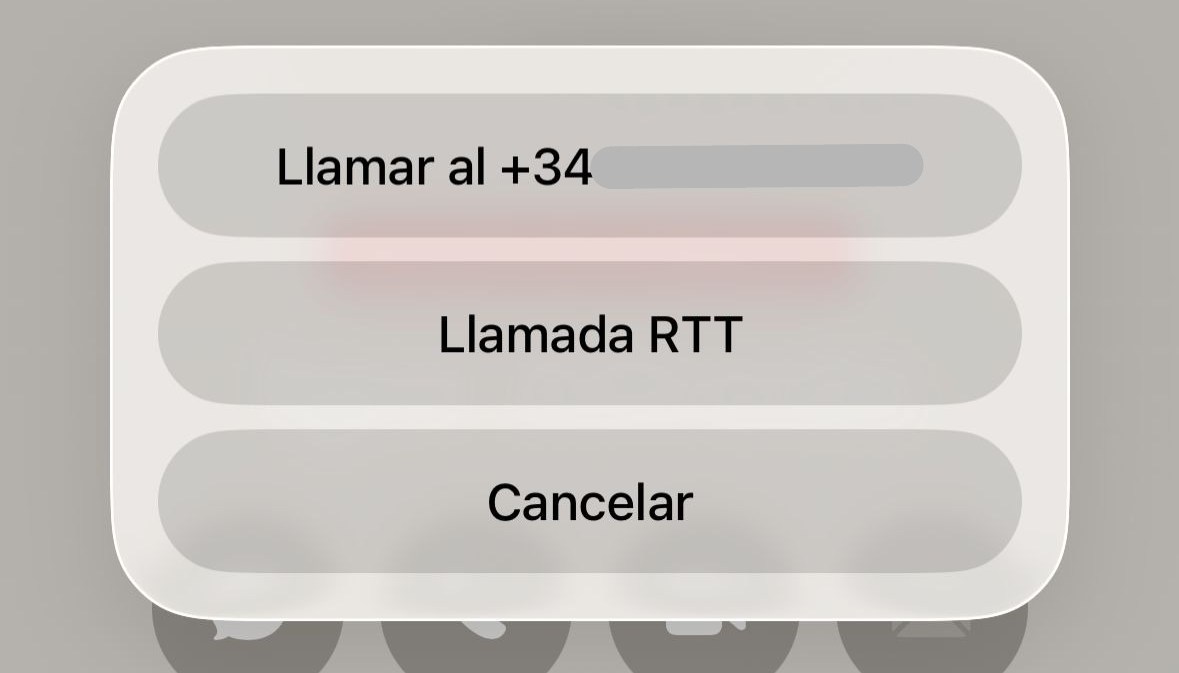

RTT, which stands for Real Time Text, is a call feature designed primarily for people with hearing impairments, hearing loss or speech difficulties. The idea is simple: whilst you’re talking on the phone, you can also type text that appears on the screen in real time.
Telefónica was the first operator to activate this feature in Spain for its Movistar customers, making it one of the earliest roll-outs of RTT in Europe. The new feature works on 4G, 5G and Wi-Fi networks and is supported by the operator’s IMS server, without using up mobile data.
RTT is neither a chat service nor an external app; it forms part of the voice call itself. When you type, the text appears immediately for the other person, even if you correct or delete something before finishing the sentence. This makes the conversation much more natural than in an SMS or traditional messaging service, where you have to type, send and wait for a reply. With RTT, voice and text coexist within the same call, simultaneously.
The feature was originally developed as an accessibility tool, replacing the old TTY (Teletypewriter or “text telephone”) systems, which allowed people with hearing or speech impairments to communicate by telephone using text. RTT modernises this concept and brings it into today’s mobile environment, offering a much simpler and more native experience. It also avoids the need for an additional device and allows communication from a standard mobile phone, without special equipment.
It is also useful in emergency situations, such as a robbery, where the victim cannot speak to avoid making noise. With RTT, it is as simple as typing during the call instead of speaking. It is also practical in everyday situations where typing is more comfortable or effective than speaking. For example, to share addresses, codes, number plates or precise details without errors, or to communicate in noisy environments.
During the call, the user can activate RTT from the phone itself and start typing in a specific window. The person receiving the call receives the text instantly and must accept the invitation to join the RTT conversation. It is also possible to continue speaking via audio at the same time, mute the microphone and use emojis, though not images.
RTT is available on many recent Android mobiles, particularly those with the Google Phone app, and also on iPhones compatible with iOS 15.6 or later. Brands mentioned by the press and by Movistar’s own channels include Samsung, Xiaomi and OPPO.
On Android, the option is usually found in the Phone app, under Settings > Accessibility > Real-time Text (although the exact path may vary depending on the brand). On iPhone, the path is Settings > Accessibility > RTT.
For now, it is available to Movistar users, and for it to work correctly, both parties must have VoLTE or VoWiFi enabled, as well as the RTT feature.
The introduction of RTT in Spain aligns with the regulatory and technological push brought about by the European Accessibility Act, which came into force in June 2025 and mandates the promotion of more accessible services across the EU.
Beyond the technical innovation, the value lies in the approach: communicating not only better, but in a more inclusive way. RTT does not replace the traditional call, but it does extend it so that more people can use it without barriers.
In a sector where much of the news focuses on speed, coverage or capacity, RTT reminds us that innovation can also be measured by its human impact. This feature transforms a call from being merely a voice connection into a more flexible, precise and accessible conversation.
Put simply: with RTT, telephony takes a step towards becoming more like the people who use it.
In this context, initiatives such as RTT directly reinforce Telefónica’s value proposition: to take on the challenge of becoming the best means for citizens to access digital technologies, offering the best and most comprehensive range of services over the best network to access the most innovative technology. This involves not only driving technical progress, but also ensuring that these services are accessible, inclusive and people-centred, where quality is measured by customer trust. Thus, innovations such as RTT consolidate a model in which technology not only connects but also integrates, ensuring that no one is left without access to digital communication.