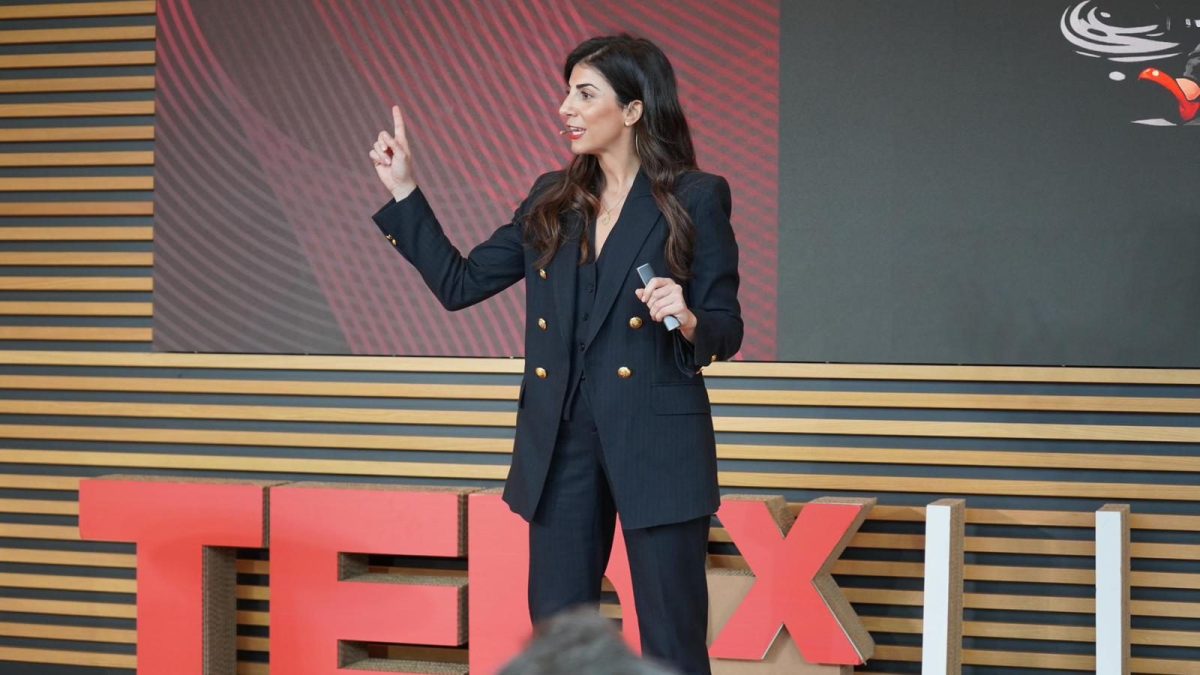

In my case, the invitation came about quite naturally via LinkedIn, with a private message that began like this: “I’m not a robot and this isn’t spam”.
From there, they told me they were looking for people capable of inspiring a generation about to enter the world of work, for an edition with international reach that was also open to all kinds of audiences. Quite a challenge, isn’t it?
They’d come across my profile whilst searching for women in marketing, and my career spanning over 15 years at Telefónica—from intern to executive—caught their eye. And they told me: “We think you have a story to tell.”
That message confirmed something I believe in deeply: building a personal brand isn’t about posting for the sake of posting, but about establishing a point of reference so that when someone searches, they find you. In this other post, I’ve shared the keys to standing out in content creation in 2026.
From there, and after a couple of meetings, the adventure began with a question that ended up being the core of my talk: how to build a professional career with purpose and passion without rushing, in a world that’s in a hurry.
Ambition vs haste
The red circle impresses and demands in equal measure. It’s not enough to give an inspirational talk; it has to be useful, so that what you say can be taken home in the form of real decisions.
That’s why I chose to start with something that runs through any professional career, whether you’re just starting out or have been at it for years: ambition and haste.
Because that’s where the trap and the problem lie: there are people who confuse ambition with haste.
- Ambition drives you towards a goal.
- Haste pushes you towards speed.
It helps me to think of it as a video game: every project is a level, every team and every boss is a level. There are levels that motivate you, others that overwhelm you, and levels that exhaust you and even sap your energy. But the aim isn’t to rush through the game, nor to get through more levels faster; the important thing is not to lose your way.
Years ago, on a work trip to Brazil, I decided to return early because of a personal relationship that was important to me at the time. And someone told me: “You have no ambition; you won’t grow like this, you won’t renew your scholarship.”
Those words stuck with me and, at the time, even made me doubt myself. But today, having come part of the way, I see it from a different perspective. In professional life (and in personal life), the key is to feel capable of learning, of growing, of building things that make an impact, without rushing.
Ambition, understood as the motivation or desire to achieve something, drives you to build. Haste is an overwhelming sense of urgency. And often, without realising it, haste becomes the criterion: we’re in a hurry to prove ourselves, in a hurry to fill a position, in a hurry to ‘be somebody’.
In 2015, at the age of 26, I had already spent a couple of years in a senior role where I felt completely confident. Suddenly, my manager went on sick leave. This opened up the opportunity for me to lead the entire project and was a great chance to grow. I had worked hard to get that far, and yet the role was given to someone else.
At that moment, my ambition kept telling me that I was the best-prepared person for that role and that I wanted it with all my heart. The rush infuriated me and completely took over my mind: “you have to put in more hours”, “be more available”, “prove yourself more”, “be more” … and all this, for what?
Over time, I came to understand that this first ‘setback’ I experienced in my professional career led my ambition to seek alternative paths to the one driven by haste, enabling me to develop skills that I might never have developed otherwise: influencing without a title, building alliances, reading the room, exercising strategic patience, supporting the team, managing day-to-day operations…
The first major lesson in building without haste in a hurried world is that building a solid and fulfilling professional career isn’t about running around all the time.
Ambition isn’t about running; ambition is about building, and building involves making choices.
Human relations and the ability to influence
The next major lesson I’d like to share with you is that in a professional career, what matters is being clear about what you devote your time to.
Imagine your first day at work in a multinational. Nerves course through your body just as much as the enthusiasm and excitement with which you start the job.
And in that context, imagine that one of the first comments you receive is the typical “you’re not here to make friends”. At the time, I was 21 and that phrase left me frozen.
Today, 16 years later at the same multinational, I’m certain my response would be: “I’m here to work, but I’m also here to build relationships. Because it’s not incompatible; it’s essential.”
Because no matter how much technology, strategy or performance there is… work remains a team sport. And here we need to raise the bar, because this isn’t about being “nice”. It’s about being effective.
In a professional career, alongside well-managed ambition, there is another skill that will open or close the thousand and one doors you’re bound to have to knock on: it’s called the ability to influence.
Influence means people trust you. That they listen to you. That they follow you when there’s uncertainty. That you can get things done without needing the title. Influence means you pick up the phone and the problem gets sorted.
Here’s a practical example that could happen in any office in the world:
Same situation. Two ways of asking for a document you need with some urgency:
- “How’s that thing I asked you for coming along?” (and you can already feel the clock ticking)
- “How can I help you?” (and suddenly you can stop, breathe and think)
They are two phrases, but they represent two cultures.
The first is usually understood in the context of haste and creates pressure.
The second brings shared responsibility, and the emotion it generates is one of trust.
And here’s an important nuance: the ability to influence that opens doors isn’t about manipulating others; it’s about helping them become the best version of themselves.
You’re no better just because you work for a multinational. Nor are you any less just because you work in a shop. You’re no more valuable just because you’re a manager. Nor are you any less just because you’re an intern. In professional life, as in life itself, there are stages and there are circumstances.
That’s why your career isn’t determined solely by what you know. It’s determined by how you interact with people, and by the relationships you build.
When you’re just starting out, it seems that growing means climbing a hierarchy: having a degree, receiving external validation that your decisions and career path are a success in the eyes of others.
And what do we usually do to achieve professional success and the approval of everyone around us? Saying yes to everything, or almost everything: yes to endless hours, yes to skipping lunch, yes to working non-stop…
Here is the third lesson from this life experience:
In a working life driven by purpose and passion, you have to work hard. There are stages of great responsibility and high demands. But if you just say yes, a day will come when you are no longer choosing your career: it is chosen by inertia, it is chosen by the ‘no’s’ of others.
There is a huge difference between ‘moving up’ and ‘being promoted’: moving up means moving upwards or increasing something. Being promoted means rising to a higher rank, level or position.
The difference is very subtle, but decisive for professional success, and if your goal is to be promoted, you must learn as soon as possible to say no.
- No to roles that take you away from your values.
- No to empty leadership.
- No to hierarchies that ask you to step on others to get ahead.
- No to “yeses” that ruin your life.
And mind you, this isn’t about not working hard or being rebellious. It’s about learning to use your judgement. About having your “non-negotiable NO’s”.
How do you discover them? Instead of asking yourself “Will this get me promoted?”, ask yourself these three questions:
- Does this build me up?
- Does this bring me closer to, or further away from, who I want to be?
- What am I sacrificing if I say yes? (time, health, relationships, values)
Because over the years you realise that the most important power you can have in your life is the ability to choose. And choosing is something you learn by making decisions. Not by letting haste or others make them for you.
In a world as fast-paced and demanding as the one we live in, building a professional career without rushing may seem like mission impossible. But that is precisely why building a career isn’t about getting there quickly:
- It’s about not losing yourself along the way.
- It’s about choosing the people.
- And it’s about being clear about your non-negotiables.
So that you can choose where, and above all, with whom you want to enjoy your professional life.
Preparing a TEDx talk isn’t just about having something to say and that’s it. It’s about scripting, editing, rehearsing until it fits the time limit, and keeping the message steady when nerves kick in.
In my case, there was also a plot twist: I was asked to open the event when that wasn’t the original plan. And that’s when your self-imposed pressure takes to the stage with you: there are moments of blankness, forgotten lines… and yet you carry on.
In the end, the greatest achievement isn’t ‘giving a talk’. It’s that what you share helps someone, even if it’s just one person.