
How can service design help to improve the response to a cardiac emergency?
Using the service blueprint technique, at Telefónica we analyse and optimise each of these layers to ensure that people, processes and technology work in sync when they are needed most. This approach demonstrates how service design can deliver real value at times when every second counts.
Key steps for responding in critical situations
Service design is a discipline that enables the planning, coordination and optimisation of all elements involved in an experience, from internal processes to user interaction. In critical services, such as cardiac care, its aim is to ensure that this coordination is flawless at the MoTs, or moments of truth, when a person’s life is at risk. In Spain, sudden cardiac death claims an average of more than 82 lives a day, and according to the Spanish Society of Cardiology, taking action within the first few minutes can triple the chances of survival.
This July, at the Plaza Loranca 2 Shopping Centre, Beni, with the help of a cardiac emergency response service and thanks to their swift action, saved a life.
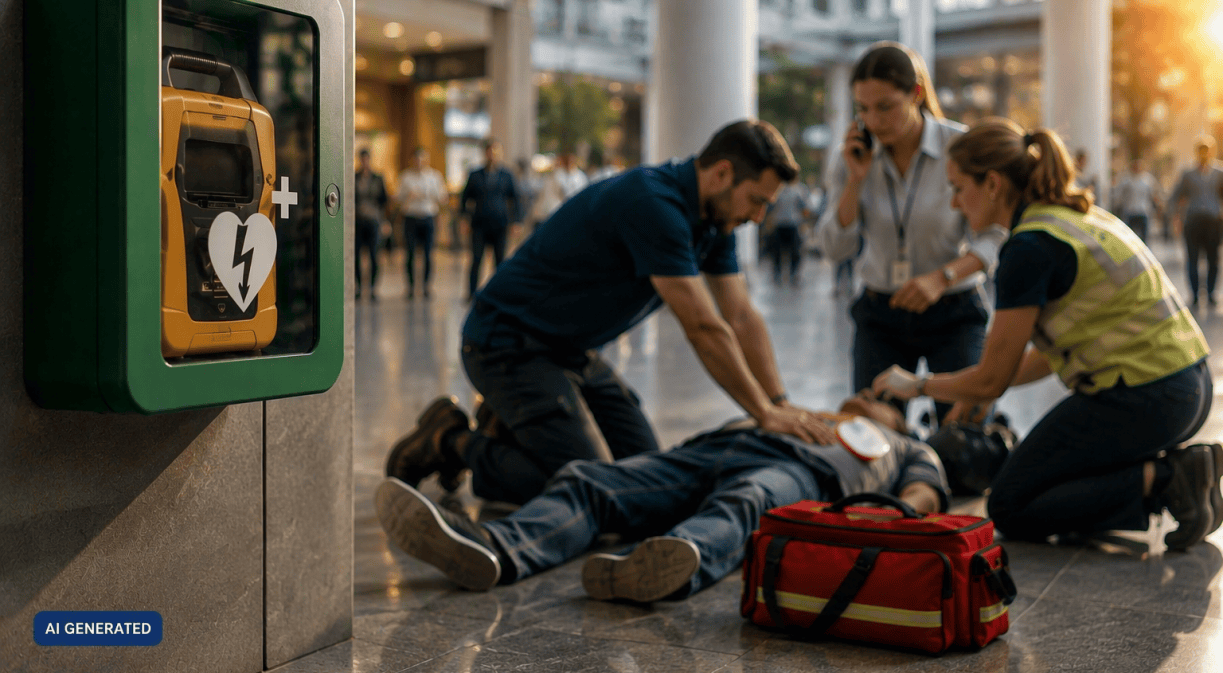
At 13:28, a man collapsed at a petrol station. His heart stopped beating. For four minutes, everything depended on people, devices, protocols and connectivity functioning exactly as they were meant to.
Beni, the centre’s security manager, reacted quickly. He alerted the security guards to fetch the defibrillator and began chest compressions. In a situation like this, there is no room for improvisation: every second counts, every step matters and every decision has an impact.
As he took the defibrillator out of the display cabinet, the system triggered an emergency call. At the same time, several people at the scene were also dialling 112. Beni placed the electrodes following the device’s voice prompts. First shock. The emergency services arrived. Second shock. The police arrived. Third shock. And on the fourth, the heart started beating again.
That July morning, Beniamin did something extraordinary. But there was also something else, less visible, that enabled him to do it: a service designed from start to finish to respond at the critical moment.
That end-to-end design has a lot to do with the groundwork that goes into it. My colleague Sergio, Head of Cardioprotection at Telefónica, defined the service with that holistic view: not just thinking about the defibrillator, but about everything that needs to happen for the response chain to work when someone needs it. And just as I’m helping him map out the service’s blueprint to identify improvements and continue developing it, Beni’s story came to light. A story that really drives home why this work matters.
Why simply installing a defibrillator isn’t enough
A holistic approach to leading an effective response
When we talk about cardioprotection, it’s easy to focus solely on the device: the defibrillator, the display cabinet, the signage. But a critical service cannot be sustained by simply having a piece of equipment mounted on a wall.
For a solution like this to work when it’s really needed, not only must there be a product behind it, but a service with a design—many layers must be well designed simultaneously: the location of the equipment, visibility, training for first responders, maintenance, monitoring, connectivity, emergency calls, response times and coordination with the teams that intervene afterwards.
This is where service design ceases to be merely a discipline and becomes a means of reducing risk. Because it is not just about designing a good experience under normal conditions. It is about designing for the moment when something goes wrong, when nerves are on edge, the pressure is on, the cognitive and emotional load is high, and nobody has time to think too much.
What a service blueprint brings to critical services
Service blueprint: connecting people, processes and technology
A service blueprint is a visual representation that helps us understand how users, employees, processes, systems and technologies interact throughout a service, identifying dependencies, risks and opportunities for improvement.
At Telefónica, we work with service blueprints to map this type of service from start to finish. In cases such as this, the blueprint helps to ground and organise decisions: what happens before, during and after each interaction; what the person sees; what the frontline team does; what processes are triggered behind the scenes; which systems must respond; and which dependencies cannot fail.
In a case like this, the visible user might be Beni. He listens to the defibrillator’s instructions, places the electrodes, follows the steps and makes decisions under pressure. But beneath that visible surface lies much more: equipment installed in a carefully chosen location, connectivity that enables the call to be made, monitoring that helps ensure the device is operational, maintenance that reduces the risk of failure and a network of stakeholders ready to intervene.
The blueprint serves precisely this purpose: to prevent us from viewing the service as a collection of separate parts. It forces us to see the complete system. And in critical services, that end-to-end perspective is key, because even a small disconnect between layers can have enormous consequences.
How connectivity improves the response in critical situations
Connectivity as a support for decision-makers
In cardiac care, connectivity is not a technical extra. It is an integral part of the service. It ensures that the equipment is not merely an isolated device, but an active link within a response chain.
When a connected defibrillator is activated and can make an emergency call, pinpoint its location or be monitored remotely, the service gains an extra layer of security. It does not replace the people taking action at the time, but supports them. It takes some of the burden off them. It ensures the system works alongside them.
And that is important: technology does not save lives on its own. People save lives. But a well-designed solution can increase those people’s chances of acting effectively, in time and with support.
What should a leader bear in mind when designing a critical service?
Key considerations for designing reliable experiences in emergency situations
Some services are used every day, whilst others, hopefully, are never used. But when they are used, they must work. Cardioprotection falls into the latter category.
That is why designing this type of service requires asking very specific questions:
- Can the equipment be located quickly?
- Does anyone know what to do?
- Are the instructions clear?
- Is the emergency call triggered seamlessly?
- Is the device operational?
- Who is notified if something goes wrong?
- What happens after the incident?
- Where might the chain break if the back-end systems fail?
- How is information passed from one person or system to another?
These questions may seem operational, but they are fundamentally about design. Because the experience is not just what someone sees on a screen or hears in a voiceover. The experience is also about the service being understandable, available and reliable at a time of stress.
The service blueprint helps to organise all of this. It makes the invisible visible. It connects people, processes, technology and responsibilities. And, above all, it enables us to identify earlier where the service might break down.
Frequently asked questions about leadership, service design and cardiac care
What does service design bring to cardiac care?
It enables the coordination of people, processes and technology so that the response to an emergency is more effective and reliable.
What is an end-to-end perspective?
It is a comprehensive view of the service that takes into account all interactions, dependencies and processes from the start to the end of the experience.
Why is connectivity important in a defibrillator?
Because it can facilitate functions such as remote monitoring, triggering alerts or integration with established response protocols.
What role does a service blueprint play?
It helps to visualise the complete operation of a service, identify risks and prioritise improvements, but it also helps teams to align their approaches, representations and future planning. It acts as a bridge between the more technical details and the experiential aspect.
Leadership in critical moments: the lessons to be learnt from this story
Beni’s story is moving because there is a life behind it. A person who collapsed. A team that sprang into action. A chain of events that was set in motion. A heart that started beating again.
But it also reminds us of something very important for those of us who design services: good design isn’t always obvious. Often, it’s most noticeable precisely when it doesn’t get in the way, when it guides without complicating matters, when it connects what needs to be connected, and when it enables a person to do the right thing at the right time.
Designing end-to-end isn’t about sketching out a pretty process. It’s about understanding what needs to happen for the service to truly work. Even when there’s pressure. Even when there’s fear. Even when there’s no second chance.
In cardiac care, that design can make the difference between arriving too late and arriving in time.
And when we’re talking about lives, arriving on time changes everything.
In line with Telefónica’s aim to “become the best gateway for citizens to digital technologies”, initiatives like this show how technological innovation, connectivity and people-centred design can help create services that are more reliable, accessible and ready to respond when society needs them most.