

One of the greatest challenges associated with large-scale infrastructures, characterized by their complexity in virtualization and automation, is the management of the software products deployed within them. These products enable the correct implementation of the different architectures that support various network domains and processes.
The VIVO team is advancing towards autonomy across all network planes. Within the Telco Cloud domain (V.T.C. – VIVO Telco Cloud), the Smart VTC platform has been developed to drive the automation of operational processes and software asset management. This initiative is part of the company program: ANJ – Autonomous Network Journey.

The integration of artificial intelligence opens up new possibilities for improvement in terms of efficiency and scalability, particularly in those Smart VTC processes involving the compatibility and interoperability analyses required for software updates. Consequently, Smart VTC is being equipped with intelligent capabilities to manage the software of VIVO’s Telco Cloud platform in a more secure, controlled, agile and proactive manner. These capabilities form the Software Management solution called: ClaudIA.
Identified Need
The Smart VTC project highlighted the need to manage recurring updates across multiple components of the Telco Cloud environment, taking into account both software and hardware resources and covering key products from strategic manufacturers in the telecommunications industry.
The technological diversity of the environment, with hundreds of instances and their deployed software products, demands precise and automated management to ensure version compatibility, operational security and efficiency in maintenance processes.
Implementation Challenges
Implementing artificial intelligence in a large-scale environment such as this presents multiple challenges. One of the most critical is achieving autonomy in the Telco Cloud within telecommunications applications that are in production, where zero downtime is required.
The Cloud + AI Solution: ClaudIA
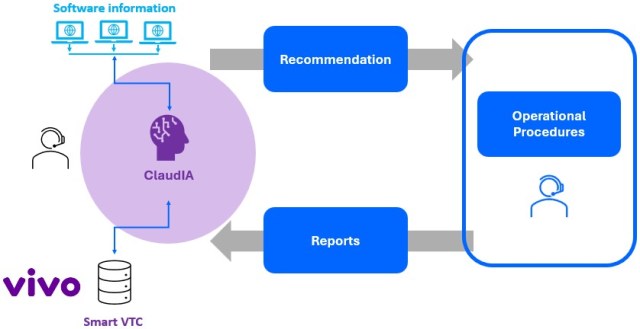
The ClaudIA solution uses product/component-specific workflows to collect software documentation. It applies AI with customised instructions and maps interoperabilities, correlating versions and products within the Telco Cloud infrastructure. It generates version matrices, which it uses to correlate dependencies for each manufacturer and compare them with the Configuration Management Database (CMDB), enriched with hardware data.
Based on AI analysis and the compatibility matrix, the system recommends new software versions and validates the prerequisites for planning the update. Its main features are:
- Generation of update recommendations for all components of the Telco Cloud platform. The ClaudIA solution generates these update recommendations, primarily by comparing the information available on each manufacturer’s websites with the versions included in the CMDB inventory.
- Standardisation of the preparation of update operational procedures. By identifying the technical update requirements for each product, ClaudIA provides full control over the components necessary for the successful installation of the new software.
- Automated post-update verification reports. ClaudIA feeds the post-update processes with pre-verification and post-verification requirements to collect network data and generate automated reports analysing the instances involved in the update process.
The benefits for VIVO
The main benefits following the development and deployment of these features are as follows:
- Reduced time for the preparation and deployment of new software versions.
- Reduced risk through automated validation that eliminates human error.
- Improved real-time visibility of the network status and the impacts following any software update.
- Greater efficiency and assurance that updates and patches meet VIVO’s current standards.
In the words of Samuel Schmalfuss Weege, Solutions Architecture Manager on the VIVO team:
“ClaudIA is increasing automation and autonomy in the assurance and change management processes for VTC infrastructure software, thereby transforming complexity into clarity and effort into a measurable impact. The system enables the departments involved to operate more efficiently. The digital transformation we are implementing is an important step on the path towards autonomous networks”.
With this solution, VIVO Brazil not only improves the efficiency of the update process for all software within the Telco Cloud environment, but also makes it more secure by reducing potential errors associated with the manual validation of the multiple software products that make up this environment. It also represents a further step towards network autonomy.