

– Europe needs to transform its talent and industrial base into technological capabilities with global scale.
– Óscar López highlighted the role of Telefónica and connectivity in Spain’s digital sovereignty.
– Telefónica advocated for a framework that fosters investment, innovation and the growth of European companies.
– Business representatives identified shared priorities: scale, investment, infrastructure and reducing critical dependencies.
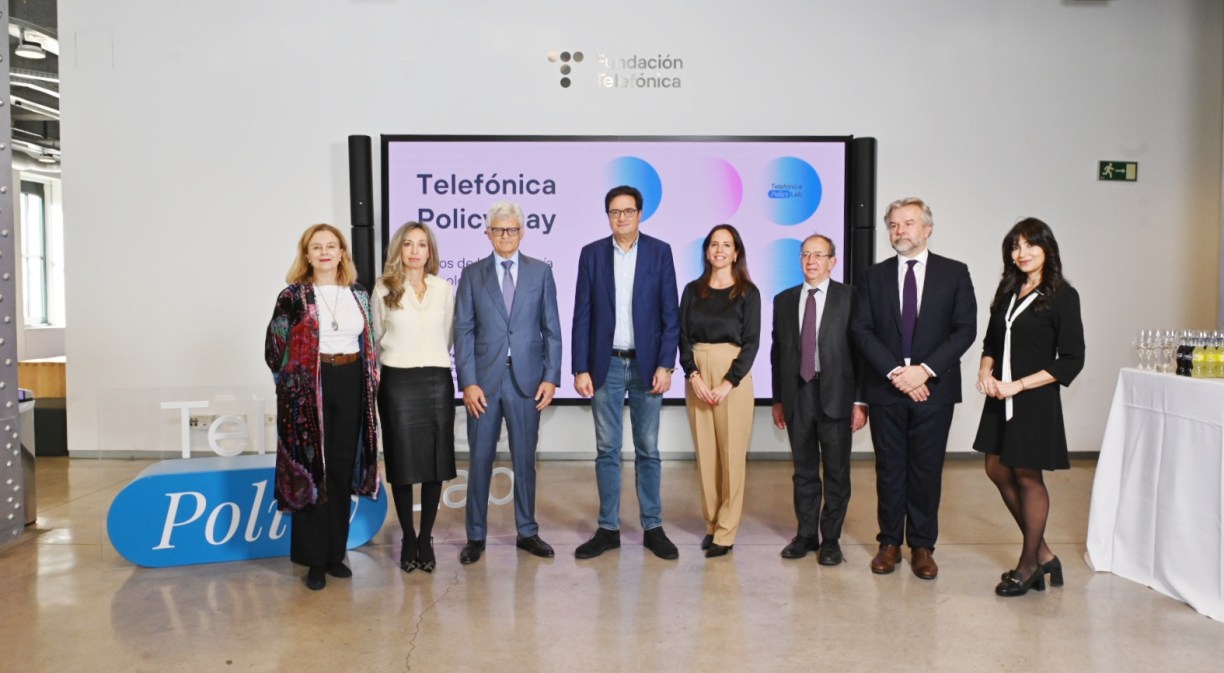
On 23 October, Espacio Fundación Telefónica hosted “Challenges of European technological sovereignty: A business perspective”, a new edition of Telefónica Policy Day. The event connected public policy priorities with the experience of companies in the telecommunications, energy and aerospace industries.
The event featured the participation of Óscar López, Minister for Digital Transformation and Civil Service. Representatives from Telefónica, Iberdrola, the European Round Table for Industry (ERT) and Airbus also contributed the business perspective on the challenges of European technological sovereignty.
Against a backdrop of accelerating technological change and global uncertainty, the event addressed the conditions Europe needs to innovate, achieve scale and compete. The discussion combined public policy priorities with the experience of different sectors to identify how connectivity, innovation and an appropriate regulatory framework can strengthen European capabilities.
Isabel Salazar, General Manager of Fundación Telefónica, opened the event, which was moderated by journalist Marta Fernández. Her remarks framed a challenge that ran throughout the discussion: turning Europe’s talent, research and industrial capabilities into competitive projects.
How can technological sovereignty be strengthened in an open economy?
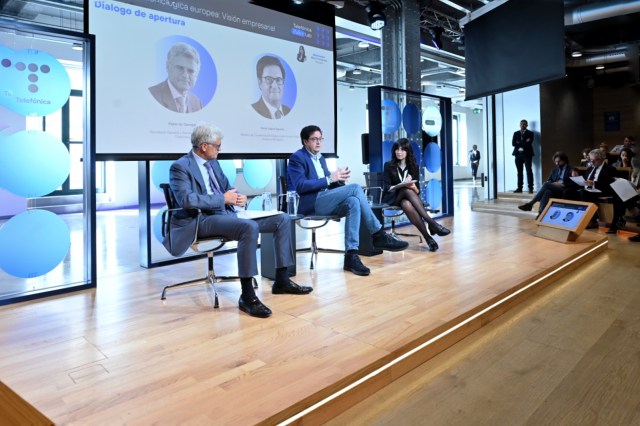
Technological sovereignty was addressed as Europe’s capacity to make its own decisions, develop strategic technologies and reduce critical dependencies while maintaining international cooperation. This approach featured prominently in the dialogue between Óscar López, Minister for Digital Transformation and the Civil Service, and Pablo de Carvajal, Secretary General and Director of Public Affairs and Regulation at Telefónica.
López highlighted Telefónica’s role as a company that is “key to Spain’s digital sovereignty.” He underscored the contribution of fibre and 5G deployment to the country’s technological preparedness.
The Minister advocated for autonomy that is compatible with interdependence and cooperation with other countries. He also expressed support for tackling business fragmentation and simplifying administrative procedures, while distinguishing such simplification from deregulation.
For his part, De Carvajal argued that Europe needs to produce more of its own technology while ensuring access to other technologies through trusted partners, explaining Telefónica’s position on digital sovereignty.
Achieving scale to sustain investment and innovation
The size and scale of European companies was one of the central issues discussed. Pablo de Carvajal linked fragmentation in the telecommunications sector to a reduced capacity to invest in networks and develop new technologies.
From this perspective, he called for an evolution of the regulatory framework and competition framework that takes into account investment and future innovation. He also highlighted the potential of public procurement to strengthen European technological capabilities, particularly in critical services.
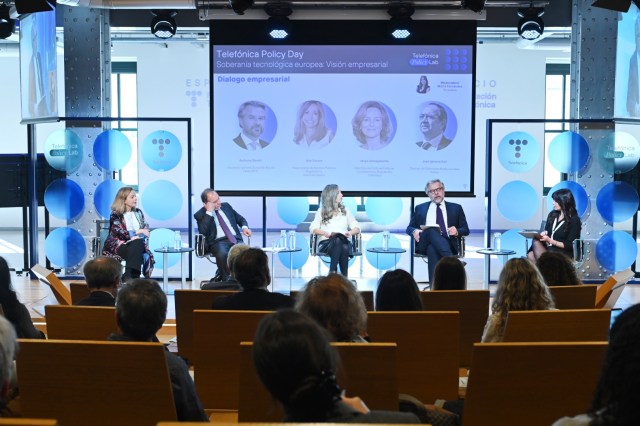
Idoya Arteagabeitia, Director of Public Policy, Competition and Regulation at Telefónica, returned to this issue during the business panel. She argued that competition decisions should take into account their industrial implications and the efficiencies that companies can generate over the medium term.
Her remarks highlighted the role of networks as critical infrastructure for the development of cloud computing, artificial intelligence and data centres. Technological autonomy requires a comprehensive approach encompassing connectivity, energy, data management and service continuity.
She also pointed to open source and standards as tools to promote interoperability and reduce dependence on specific providers.
Technological dependencies are already influencing business decisions
The practical implications of technological sovereignty were reflected in the contributions of Anthony Gooch, Secretary General of the European Round Table for Industry (ERT); Ana Cerezo, Head of Regulatory Public Affairs at Iberdrola España; and Juan Ignacio Sell, Director of Institutional Relations at Airbus.
Gooch explained that companies are incorporating an increasing number of factors into their technology decisions. Alongside price and performance, they consider service continuity, control over data, intellectual property and the costs of switching providers.
Sell presented Airbus as an example of the capabilities that can emerge from European cooperation, scale and innovation. He stressed the importance of preserving strategic capabilities in areas such as cloud computing, industrial artificial intelligence and semiconductors.
Cerezo focused on energy grids and supply chains. She warned that replacing suppliers too hastily can generate costs and operational risks. Strengthening autonomy requires planning and investment capable of supporting electrification and digitalisation.
From diagnosis to the conditions needed for progress
The closing discussion reflected a shared call to move forward quickly with European initiatives and to involve companies as partners. Arteagabeitia advocated for strengthening capabilities developed in Europe and in collaboration with Europe.
Telefónica embraces the clear challenge of becoming the best gateway to digital technologies for citizens, businesses and public administrations. Its contribution to European technological sovereignty involves promoting advanced networks and an environment that enables investment and innovation.
The event left one clear message, summarised directly by De Carvajal: “Without scale, you cannot invest.” Creating the conditions for that investment will be essential to transform Europe’s strengths into technological capabilities and competitiveness.
Watch the full event
The event was streamed publicly and is available to watch on demand. Revisit the institutional dialogue and the contributions from the business panel in the full recording.