
In less than five minutes, it is now possible to clone a person’s face and voice using Artificial Intelligence.
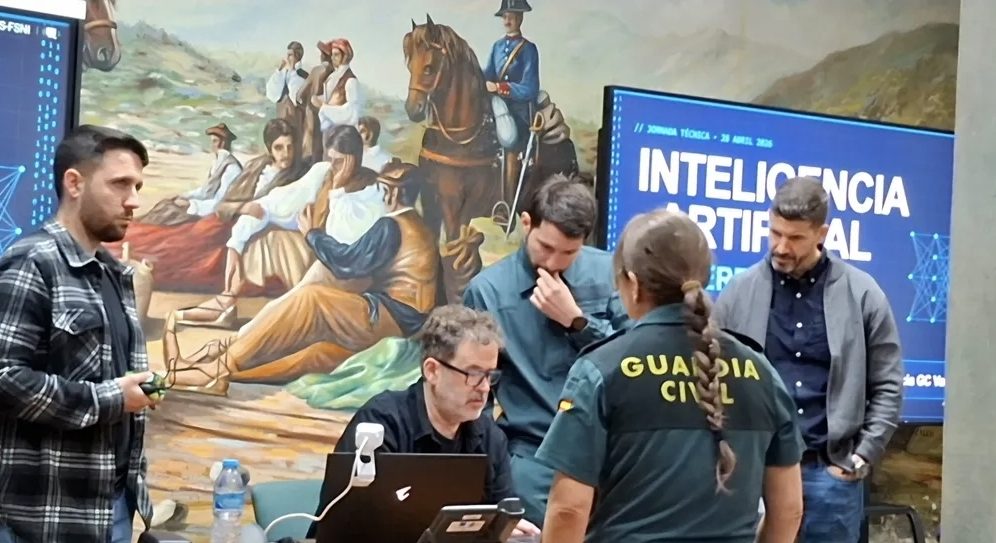
This idea, which just a few years ago seemed like something out of science fiction, was one of the central topics at the cybersecurity training day recently held by the Civil Guard in Valencia. There, officers from Team @ —specialised in cybercrime— worked on a scenario that is already part of the present: a new generation of AI-driven threats.
The session featured the participation of Telefónica, which contributed expert knowledge on how these technologies are transforming both cybercrime and the strategies used to combat it.
A Change of Pace in Digital Threats
One of the main challenges that Artificial Intelligence introduces to cybersecurity is acceleration.
Changes no longer occur over months, but in a matter of days. Tools evolve rapidly and, with them, so do attack techniques. This forces a rethinking of traditional defence models, which have historically been more reactive.
Furthermore, AI has significantly reduced barriers to entry. Activities that previously required advanced knowledge or substantial technical resources can now be carried out by a single person from a computer. This multiplies the potential scale of the attacks.
Deepfakes: The Challenge of Identity
Within this new context, deepfakes have become one of the main sources of concern.
The ability to generate synthetic content — voice, image, or video — with a high degree of realism introduces a new level of complexity. Identity theft is no longer a rudimentary attempt, but rather a simulation that is difficult to detect, even for experienced users.
This scenario has direct implications in areas such as customer relations, identity verification, and fraud protection.
Anticipation as a Strategy
In light of these developments, cybersecurity needs to move towards more proactive models.
Artificial Intelligence itself, when applied correctly, can improve threat detection, identify anomalous patterns and strengthen response capabilities. But beyond the technology itself, it is essential to understand how these systems operate in order to anticipate and anticipate their malicious use.
In this regard, training plays a vital role. Initiatives such as the one developed in Valencia by Telefónica enable specialist knowledge to be passed on to frontline teams, improving their ability to identify and dismantle increasingly sophisticated scams.
A Challenge That Goes Beyond Technology
The evolution of cybercrime has strategic implications for organisations.
Cybersecurity directly impacts trust, business continuity, and the ability to operate in complex digital environments. In a context where identities can easily be replicated, ensuring the authenticity of interactions becomes paramount.
Another topic discussed was the use of Artificial Intelligence in local environments, without the need to rely on the cloud, as a way to strengthen privacy, protect sensitive information, and apply these capabilities more securely.
For this reason, cybersecurity is increasingly being integrated as a central part of business strategy rather than merely as a technical function.
Collaboration to Address an Increasingly Complex Environment
The scale of the challenge makes collaboration essential.
Cooperation between public and private bodies enables knowledge sharing, improves prevention, and strengthens the response to constantly evolving threats.
Telefonica’s participation in initiatives of this kind reflects that commitment: helping transform technological knowledge into real protection capabilities for society.
Preparing for What Lies Ahead
Artificial Intelligence will continue to accelerate the transformation of the digital environment. Along with it, threats will continue to increase as well.
The key will be our ability to adapt. It also lies in understanding that cybersecurity is no longer just a technical issue, but an essential element in building trust in the digital economy.
And, above all, in the ability to anticipate a scenario in which distinguishing the real from the artificial will become increasingly difficult.