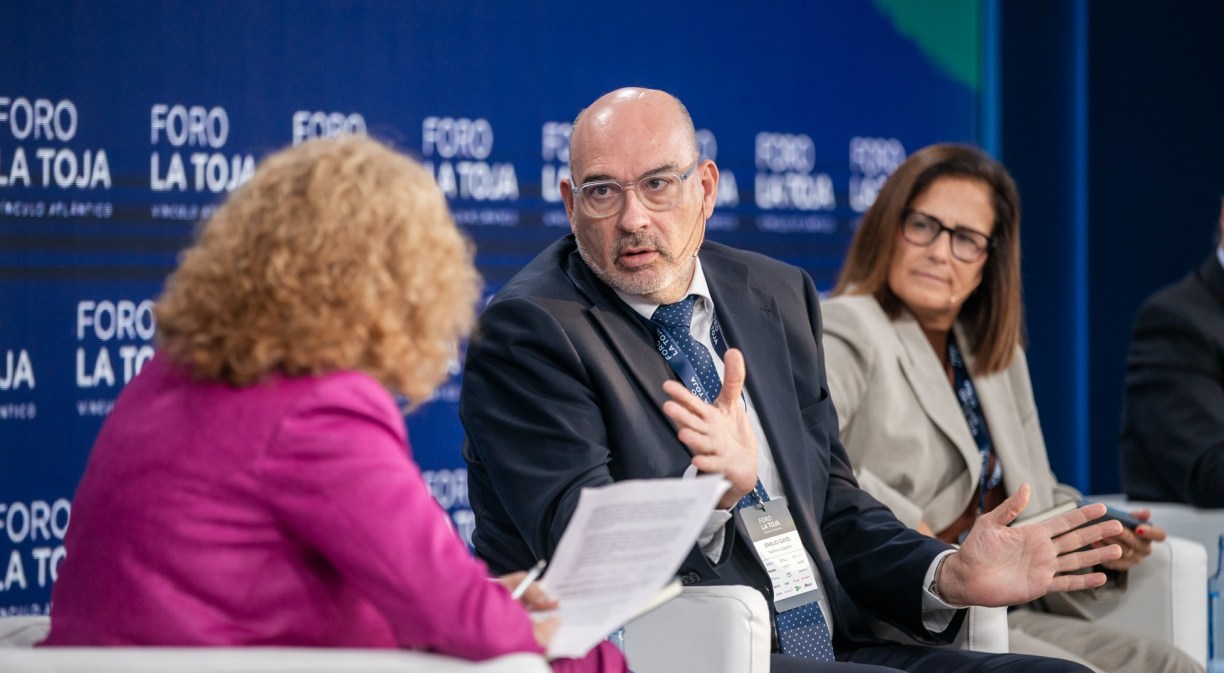
Emilio Gayo, Telefónica’s COO, today highlighted the strength of Spanish networks at the La Toja Forum and argued for the need to move towards a more flexible regulatory framework, adapted to the new digital reality, in order to attract investment and strengthen sovereignty in a context marked by profound technological transformations.
During his speech at the round-table discussion ‘The Spanish economy and its future challenges’ held at the La Toja Forum – which also featured Ana Torrens (Chair of Deloitte Spain), Mario Ruiz-Tagle (CEO of Iberdrola Spain) and Josep María Recasens (CEO of Indra), Gayo emphasised the essential role played by telecommunications in the functioning of the economy and society. “The telecommunications sector is at an interesting juncture, with numerous disruptions, but it remains vital because everything that happens in the world passes through the telecoms networks,” he stated.
The executive also highlighted Spain’s leading position in digital infrastructure. In this regard, he pointed out that fibre-optic coverage reaches almost 100 per cent of households and that 5G coverage exceeds 96 per cent of the population. “There are no networks like these anywhere else in Europe,” he stated.
However, Gayo warned that maintaining this level of excellence requires continued significant investment. “This is a highly capital-intensive sector and, for this investment to continue, regulations must allow the business we generate to translate into results that make it possible to keep investing,” he said.
In this regard, he has called for the regulatory framework to evolve in a way that supports economic growth and helps to translate that growth into greater productivity, business development and social wellbeing. “The sector in Spain is ready to provide the services the economy needs, but the regulations must adapt and the country’s growth must translate into productivity,” he added.
Regulation and technological sovereignty
During his speech, Emilio Gayo also addressed the debate on European technological sovereignty, an issue of growing importance in the current geopolitical and economic context.
As he explained, sovereignty does not mean controlling 100 per cent of the elements that make up the technology chain, nor does it mean manufacturing everything we produce, but rather ensuring certain levels of autonomy and decision-making capacity over the most critical components. To this end, he raised three fundamental questions: who controls the data, who operates the technology platforms that manage that data, and what alternatives exist amongst the available technology providers. “We must have alternatives for the critical elements of the technological value chain,” he stated.
He also identified three major challenges to making progress in this area: having regulations in place to accelerate the development of digital sovereignty; achieving the scale necessary to compete efficiently; and ensuring that companies have the capacity to implement this strategy.
Despite the challenges, Emilio Gayo expressed optimism about the evolution of the European regulatory environment. “We are beginning to see signs of progress. For the first time in a long while, there is a strong political drive across various European spheres to undertake this regulatory evolution,” he concluded.