The Juan XXIII Foundation, Nokia and Telefónica are collaborating on the project “Immersive Supervision for People with Intellectual Disabilities”, a social innovation initiative aimed at improving the independence, safety and quality of life of this group through immersive telepresence technologies, thereby alleviating feelings of unwanted loneliness.
The initiative forms part of Nokia’s commitment to developing technological solutions that generate a positive social impact, putting innovation at the service of inclusion, accessibility and the reduction of digital divides. Through this project, the company has driven the design, roll-out and evaluation of an immersive telepresence solution in real-life independent living settings, working alongside the Juan XXIII Foundation and Telefónica as ecosystem partners to validate its impact on people’s lives.
As an organisation responsible for independent living programmes, Fundación Juan XXIII has facilitated the roll-out of the initiative in three of its supervised flats, where people with intellectual disabilities are leading increasingly independent lives, as well as in its training flat for independent living. As a result, the technology has been integrated into real-life settings and evaluated in everyday usage scenarios, enabling an analysis of its impact on the daily lives of 16 service users and the professionals who support them.
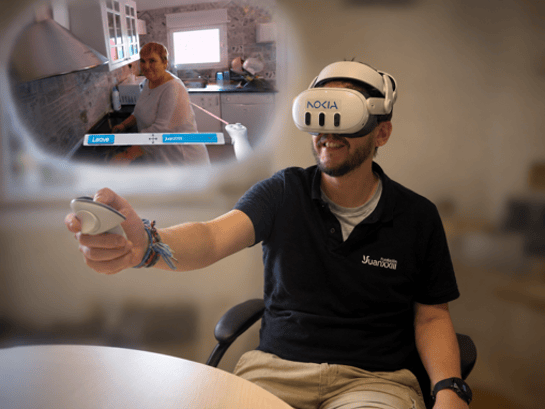
In the words of Jose Luis, a project participant: “I’m happy when I speak to Nacho at the weekends. My flatmates go home and I stay in the flat. He helps me sort out the fridge, prepare what I’m going to eat, and I also tell him if I’m feeling unwell.”
The Nokia eXtended Reality Lab team, which has been collaborating with the Foundation for years to design technological solutions based on the principles of accessibility and inclusion, has rolled out the Snowl immersive telepresence solution, which combines 360° video, two-way audio and an immersive avatar-based interface to facilitate remote monitoring and support.
Nokia has also led the installation of the equipment, the technical training of the organisation’s staff, and research into user experience, accessibility and perceptions of telepresence. The lessons learnt contribute to the development of future extended reality and artificial intelligence solutions designed from a people-centred perspective and aimed at promoting digital inclusion.
Álvaro Villegas, head of XRLab: “For Nokia, and particularly for the XRLab research team, this project has been especially rewarding because it has allowed us to see how next-generation networks and the immersive communications applications we have developed for them are not limited to the laboratory environment but are proving to be applicable in the real world, effectively helping to achieve the ultimate goal of our work: improving people’s lives”.
The experience of the professionals involved confirms this transformative potential of the technology in real-life support situations.
In the words of Ignacio Moratinos, an independent living educator at the Juan XXIII Foundation: “It is incredible to see how people at our centre have been able to use such advanced technology thanks to the adaptations we have developed in collaboration with Nokia. Furthermore, the people we support have been able to feel our presence closely, whilst easily working on their independence without us having to travel.”
The project participants who have already tried Snowl highlight the excellent experience they’ve had interacting with this technology. In the evaluation carried out, all participants stated that they had felt the presence and support of their support worker without difficulty, whilst also experiencing greater autonomy in carrying out activities of daily living. Users emphasise that they felt safe and comfortable knowing they had the support of their designated professional connected at all times, whilst also experiencing a greater sense of freedom, independence and responsibility in carrying out tasks for themselves. Furthermore, they all agree in recommending Snowl to others who wish to progress in their learning journey towards a more autonomous and independent life.
Ensuring participants’ privacy, security and control is essential when using audiovisual communication technologies in the home. In this regard, as Marta Orduna Cortillas, a researcher at Nokia’s XRLab and project coordinator, states, “the privacy and autonomy of participants are guaranteed through encrypted video transmission, access restricted exclusively to remote support staff, and full control of the device by each participant, who can start or end the call and physically switch off the device at any time”. As a result, all participants have felt supported without feeling monitored.
Furthermore, Telefónica has provided the fixed and mobile connectivity required for these immersive experiences and has utilised advanced capabilities of its 5G network, via standardised APIs from CAMARA – a global initiative within the telecoms sector that enables the integration of network capabilities into digital applications and services – to prioritise data traffic during telepresence sessions.
As a result, a stable, high-quality connection is guaranteed, reducing delays and interruptions and allowing people to interact more naturally and realistically, even when they are thousands of kilometres apart.
Antonio Guzmán, Director of Future Exploration Innovation at Telefónica, emphasises that “at Telefónica, we believe that technology realises its full value when it helps to improve people’s lives. This project reflects our commitment to society beyond our business activities and our desire to put connectivity and innovation at the service of greater autonomy and inclusion. Working together has enabled us to explore how technology can respond to real needs and help people pursue their life goals with greater autonomy and independence”.
The close collaboration between the Juan XXIII Foundation, Nokia and Telefónica has made it possible to create a unique innovation environment in which social knowledge, immersive technology and advanced connectivity converge to offer new tools to support people in vulnerable situations.
The project is an example of how digital transformation can be harnessed to promote inclusion, fostering greater independence, safety and social participation amongst those who stand to benefit most from the potential of new technologies. For Nokia, the aim is not merely to support social initiatives, but to contribute technology, expertise and collaboration to design, test and scale solutions that help bridge the digital divide and strengthen the resilience of communities.
“We must continue to explore how this technology can help people living independently to access the support they need – both with daily tasks and on an emotional level – by enabling professionals to ‘teleport’ into their homes,”says Esther Molpeceres, director of the Foundation’s day centres.