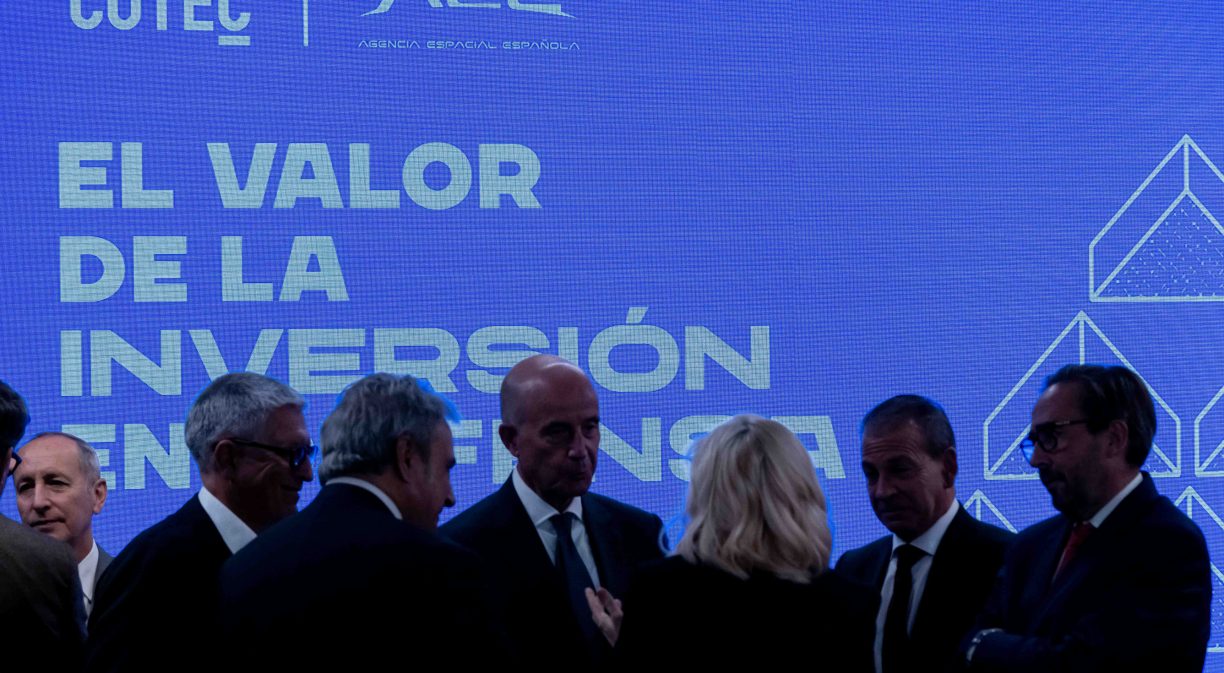


Investment in defence can strengthen Europe’s industrial and technological base, accelerate innovation and enhance the resilience of critical infrastructure. Telefónica participated in the Fundación Cotec working group that examined how to maximise its economic and social value.
Europe faces a challenge that goes beyond increasing its defence budgets: transforming this investment effort into lasting industrial, technological and strategic capabilities.
Security remains the fundamental objective of defence investment. However, Europe’s ability to protect itself is increasingly linked to its capacity to innovate, develop technologies and ensure the resilience of its critical infrastructure.
The telecommunications sector occupies a particularly important position: connectivity networks, secure communications, artificial intelligence, cloud and cybersecurity are essential both for the economy and public services and for security and defence.
The debate should therefore focus not only on how much Europe invests in defence, but also on what capabilities it develops and what value it generates for the economy as a whole.
A new way of measuring the value of defence investment
With this approach, on 4 November, Fundación Cotec presented the report and the “Defence Pyramid” tool, developed by its Security and Defence Working Group, led by SAPA and involving 41 organisations, including Telefónica.
This initiative comes against the backdrop of a rapid increase in Spanish defence spending, in line with commitments made alongside its European partners and allies. Defence spending reached 2% of Spain’s GDP in 2025, while defence-related R&D expenditure increased from €1.842 billion in 2024 to €6 billion in 2025.
The initiative analyses the value of investment across six dimensions: security, economy, industry, knowledge, infrastructure and geopolitics. It makes it possible to identify benefits for individuals, organisations, territories and the system as a whole.

This perspective complements traditional economic analyses: it is not only about accounting for resources, but also about understanding how investments generate capabilities, knowledge, skilled employment and long-term resilience.

Together, they form a matrix comprising 36 different types of value, whose relative importance varies for each organisation. Examples include quality employment, specialised skills, the creation of start-ups, the resilience of critical infrastructure and influence over international standards.
Dual-use technologies: where defence and innovation converge
The relationship between innovation and defence has evolved. Technology transfer no longer flows solely from the military to the civilian sphere: today, commercial technologies such as artificial intelligence, advanced communications and quantum computing also have strategic applications for security.
The potential of dual-use technologies lies in connecting security needs with innovation ecosystems that generate value for the economy as a whole.
This convergence opens up opportunities to make better use of investment and accelerate technological development, but it requires public-private collaboration. Against this backdrop, the Cotec working group examined how to promote these technologies through training, funding, collaboration and public procurement of innovation. Consequently, the Cotec event highlighted the role of dual-use technologies and the growing link between civil and military innovation.
Connectivity: a strategic capability for European resilience
Telecommunications networks underpin essential services, businesses, public administrations and critical systems. Their availability, security and resilience are essential both for everyday activities and for responding to crises.
Advanced connectivity, cloud, edge computing, artificial intelligence and cybersecurity provide capabilities with both civilian and defence applications. This dual dimension makes the telecommunications sector a relevant player in Europe’s economic and technological security.
Defence investment policies should therefore also consider the development of secure and resilient digital infrastructure and the industrial capabilities needed to make it possible.
From greater investment to greater strategic capability
Increased defence investment can simultaneously strengthen security, innovation and competitiveness, but these benefits are not automatic. They require a long-term vision and coordination between defence, industrial, innovation and digital policies.
The key is to direct resources towards lasting capabilities: technologies, resilient infrastructure, a strong industrial base, knowledge and talent.
Telefónica’s participation in Cotec’s work reflects its commitment to a vision of security that recognises the strategic value of digital technologies. As a provider of dual-use technologies and an operator of critical infrastructure, the telecommunications sector can help ensure that this investment translates into broader benefits for society as a whole. Because a more secure Europe also needs to be a more innovative, connected and technologically capable Europe.