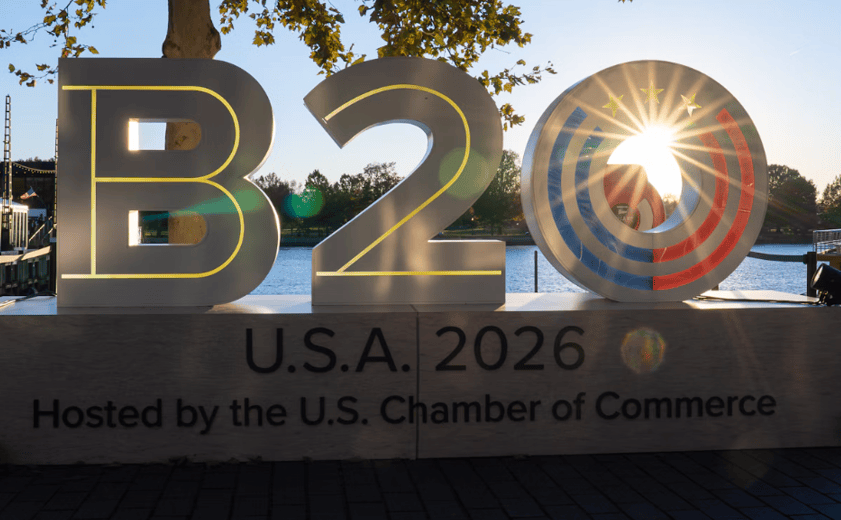

CEOE, Telefónica and other Spanish companies participated in B20 USA 2026, held in Washington from 9 to 11 November under the theme Accelerating Global Growth. The event, the first B20 to be held on US soil, brought together nearly 5,000 delegates with the aim of putting forward concrete recommendations to the G20 to drive growth, investment and innovation. For Europe, which is seeking to close its competitiveness gap with the United States and China, the forum also offered a mirror: where regulatory certainty and scale exist, capital flows.

Telefónica’s participation focused particularly on the Economic Growth and Innovation task forces, precisely the two areas in which the competitiveness of the digital economy is being decided today and where Europe’s position over the next decade is at stake.
The B20, the G20’s leading business dialogue forum, structured its 2026 recommendations around four areas: economic growth, innovation, trade and energy. Its conclusions are set out in the B20 Leaders’ Statement, an agenda aimed at removing barriers to investment, fostering innovation and harnessing the potential of new technologies.
If there was one idea running through the panels, it was certainty and trust, seen as decisive factors in accelerating global growth. Lord Bilimoria, from the International Chamber of Commerce, estimated the cost of uncertainty at around $300 billion. This assessment is particularly relevant to Europe, where operators invest tens of billions of euros in networks every year while earning returns below their cost of capital, under a framework that has prioritised short-term prices over long-term investment.

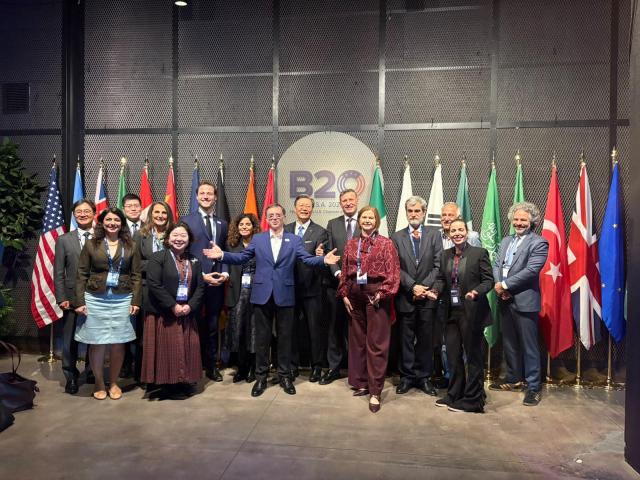
Third from the left, Marta Blanco, Director of International Affairs at CEOE, Women in B20
Networks, rules and AI: the foundations for growth that Europe still needs to secure
Among the Economic Growth task force’s recommendations, three stand out as directly relevant to the telecommunications sector.
First, the B20 calls for mobilising capital towards digital infrastructure. For Telefónica, this priority reinforces the need for policies that incentivise investment in advanced connectivity networks. In Europe, this means closing an investment gap that the European Commission estimates at around €200 billion to meet the Digital Decade’s connectivity targets. The discussions in Washington made one thing clear: much of the conversation around AI is, in fact, a conversation about infrastructure, namely data centres, energy and connectivity, and about the ability to deploy it in time. Networks are the link that connects this entire system.
Second, the Statement proposes modernising and harmonising regulation. This recommendation aligns with Telefónica’s call for a simpler, more predictable and investment-friendly regulatory framework, an essential condition for the European telecommunications sector to achieve the scale it needs to compete. According to the Draghi report Europe has 34 mobile operator groups compared with three in the United States and this fragmentation limits the sector’s investment capacity. The review of the European framework, with the Digital Networks Act at its core, is an opportunity to address this: a genuine single market for telecommunications, a competition policy that values scale and investment, and equivalent rules for all players in the digital ecosystem.
A third priority is to accelerate the adoption of artificial intelligence at scale. The B20 recommends reducing barriers to entry, facilitating its use by small and medium-sized enterprises and promoting applications that generate economic and social benefits. But the B20 also made clear that the challenge is not merely technological: trust is now the bottleneck preventing AI from being deployed at greater scale. Panellists also warned against preventive or fragmented regulation, which would ultimately benefit companies with greater resources to absorb compliance costs, and advocated outcome-based standards developed jointly by businesses and governments. This another area in which the Digital Networks Act could prove crucial.
For Telefónica, trust is also a matter of infrastructure: secure and resilient networks are a prerequisite for AI to reach all businesses and citizens.
R&D and trust: the engine of innovation
The Innovation task force has placed among its key recommendations the promotion of long-term investment in research and development, collaboration between companies and research centres, and the strengthening of innovation ecosystems.
Trust once again emerges as a key concept: the B20 emphasises the need to build trust in digital technologies through appropriate governance frameworks, enabling their benefits to be harnessed without creating unnecessary barriers to innovation.
The statement proposes advancing responsible artificial intelligence governance principles and strengthening the security of critical infrastructure against emerging technological threats, including those associated with quantum computing. Europe has an advantage here because of the strength of its scientific base in quantum technologies, but it needs to translate that strength into industrial deployment. The secure quantum communications networks being developed by European operators are a good example of this transition.
The European perspective: scale, investment and technological sovereignty
The discussions in Washington have direct implications for Europe, which is immersed in its own debate on competitiveness and technological sovereignty and faces key decisions about the future of its digital sector.
Telefónica advocates open technological sovereignty, based on strengthening strategic capabilities, reducing critical dependencies and preserving freedom of choice, without giving up international cooperation or access to the most advanced technologies. This sovereignty cannot be built solely on chips or AI models: it requires European operators with sufficient scale to invest, innovate and ensure the resilience of the continent’s critical infrastructure.
That is why strengthening investment in connectivity, enabling companies to achieve scale and simplifying regulation are not sector-specific demands, but conditions for Europe to compete and innovate in the global digital economy.
From dialogue to action
The challenge now is to ensure that these recommendations reach the G20 and translate into concrete policies, including in Europe, where the B20 agenda aligns to a large extent with the Draghi report’s diagnosis of competitiveness.
Through its participation in leading international forums, Telefónica will continue to promote an agenda that places connectivity, innovation and investment at the heart of economic growth, in which Europe is not merely a user, but also a builder, of the technologies that will define the next decade.