
Human–Machine Coexistence: Why We Need to Rethink Empathy
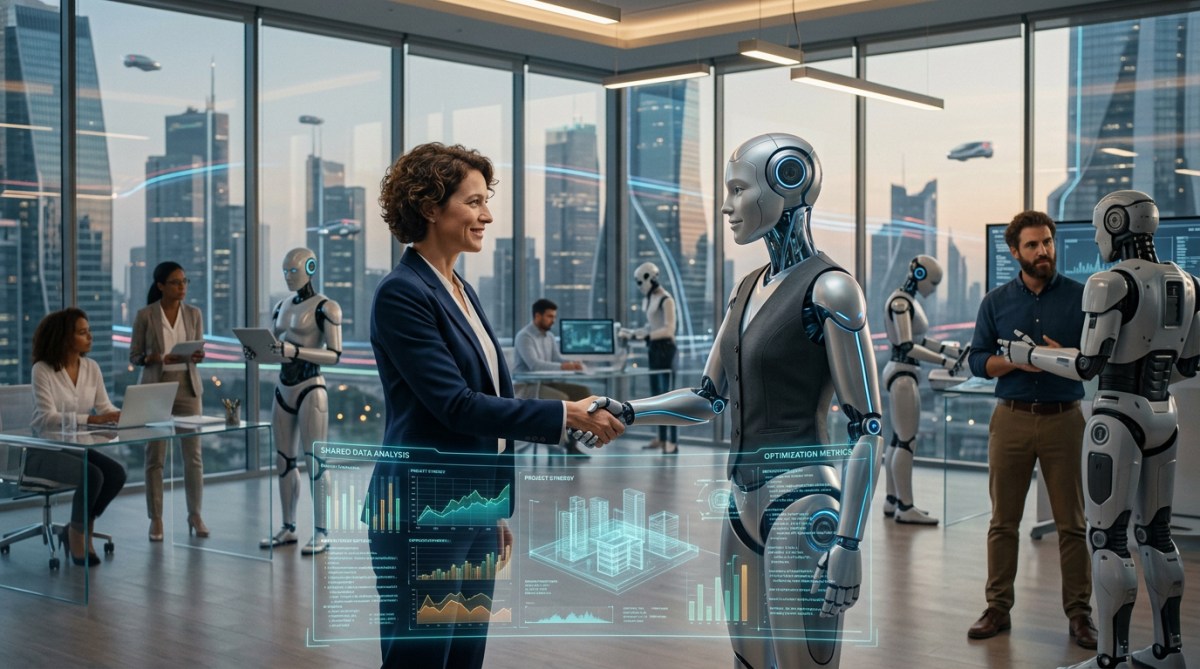
We are continuously monitoring our internal trend radar, where we define overarching developments and trends that directly impact and shape our organization. One of these trends is human–machine coexistence, which raises fundamental questions about empathy, responsibility, and collaboration in the age of AI:
- What if we need to rethink empathy?
- What if machines are better at simulating empathy?
- What if machines could help us understand both other humans and machines better?
- And: What if we outsource empathy to machines?
Artificial intelligence is rapidly moving beyond pure automation. Its potential lies not only in performing tasks faster or more efficiently, but in enhancing activities once considered uniquely human, such as moral judgment, care, or empathic communication.
From Automation to Emotional Intelligence: Changing Customer Expectations
This trend is already reflected in evolving customer expectations. When interacting with machines, users no longer expect only speed—they expect fairness, respect, and meaningful engagement.
AI is no longer judged solely by its accuracy or technical performance, but by how it makes people feel. As expectations rise, so does the pressure on organizations to deliver not just seamless experiences, but emotionally resonant ones—at scale.
AI and Empathy: Why Machines Are Perceived as More Empathic
Empathy is now at the center of human–machine collaboration. AI systems can simulate empathic responses with remarkable convincingness. In many contexts, they are rated as more empathic than humans—precisely because they are consistent, attentive, and free from fatigue or emotional volatility.
Various studies found that AI-generated messages can make recipients feel more heard than human-generated ones and are often better at detecting emotions. However, once recipients realized that a message came from AI rather than a human, the perceived empathic impact declined.
The Real Advantage: Orchestrating Human and AI Empathy
While machines may express empathy linguistically, human presence remains psychologically important.
The competitive advantage does not lie in choosing between AI empathy and human empathy, but in orchestrating both: designing systems in which AI enhances empathic quality, while humans provide authenticity, relational depth, and ethical grounding.
This orchestration opens up powerful opportunities. Leaders can leverage AI-generated insights to communicate with greater clarity, empathy, and consistency. Emotion-aware systems can enrich interactions, increase engagement, and provide support across long, high-volume processes without exhaustion.
Risks of AI-Driven Empathy: Manipulation and Echo Chambers
These developments also carry significant risks. Simulated empathy can mask misaligned intentions, creating systems that appear caring while manipulating users or optimizing for non-human goals.
Another danger lies in the creation of echo chambers, where sophisticated empathy mechanisms reinforce existing beliefs instead of challenging them—potentially amplifying distorted perceptions or, in vulnerable users, contributing to harmful psychological dynamics.
This risk transforms empathy from a mechanism of understanding into a mechanism of validation.
What Comes Next: AI, Robotics, and the Future of Human-Like Expression
The next milestone is already emerging. A research team led by Professor Hod Lipson at Columbia University has developed a new generation of robotics capable of highly precise, real-time facial synchronization with speech—a major step toward human-like expressiveness.
As Lipson states: “I guarantee you in a few years they are going to look like humans.”
This raises a critical question:
What happens when machines not only simulate empathetic language, but also surpass humans in facial emotional expression?
Empathy as a Strategic Capability in the Age of AI
Empathy is no longer a purely human trait. It is becoming a strategic capability for organizations, one that must be deliberately designed and governed.
The future belongs to organizations that understand empathy as a capability built at the intersection of humans and machines, combining technological scalability with human authenticity.
Telefónica Value Proposition: Driving Responsible AI with Strategic Impact
In this context, Telefónica embraces the challenge of becoming the leading gateway for citizens to access digital technologies, driving a transformation built on five key pillars: strengthening its European leadership by contributing to technological sovereignty; building a more innovative and competitive organization through simplification, efficiency, and highly skilled talent; delivering superior customer services supported by best-in-class networks and trust; advancing with ambitious, disciplined, and results-driven management; and reinforcing its role as a key institutional reference for Spain in Europe. Ultimately, the goal is to transform artificial intelligence into a responsible, human-centered capability that creates sustainable value for businesses, customers, and society.