
What is creative artificial intelligence and how is it changing design and content creation?
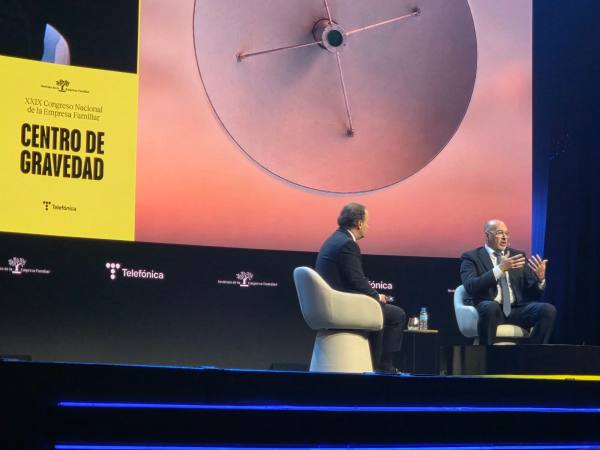
The new centre of gravity no longer lies in the tool itself, but in the judgement of the person using it. AI is the new oil: every company has access to it, but that doesn’t mean they all know what to do with it.
What is really changing is the workflow — delivery times are being drastically reduced — and the way we engage with knowledge. Goodbye to isolated knowledge, to reliance on a single tool, to siloed roles. Roles are intertwining and jobs are evolving. A very illustrative example is Anthropic: its greatest productivity lever has been in software engineering, because development teams are able to produce significantly more in the same amount of time.
The paradoxical effect is that this has led them to increase hiring in product, not reduce it. AI hasn’t cut teams there; it has scaled ambition.
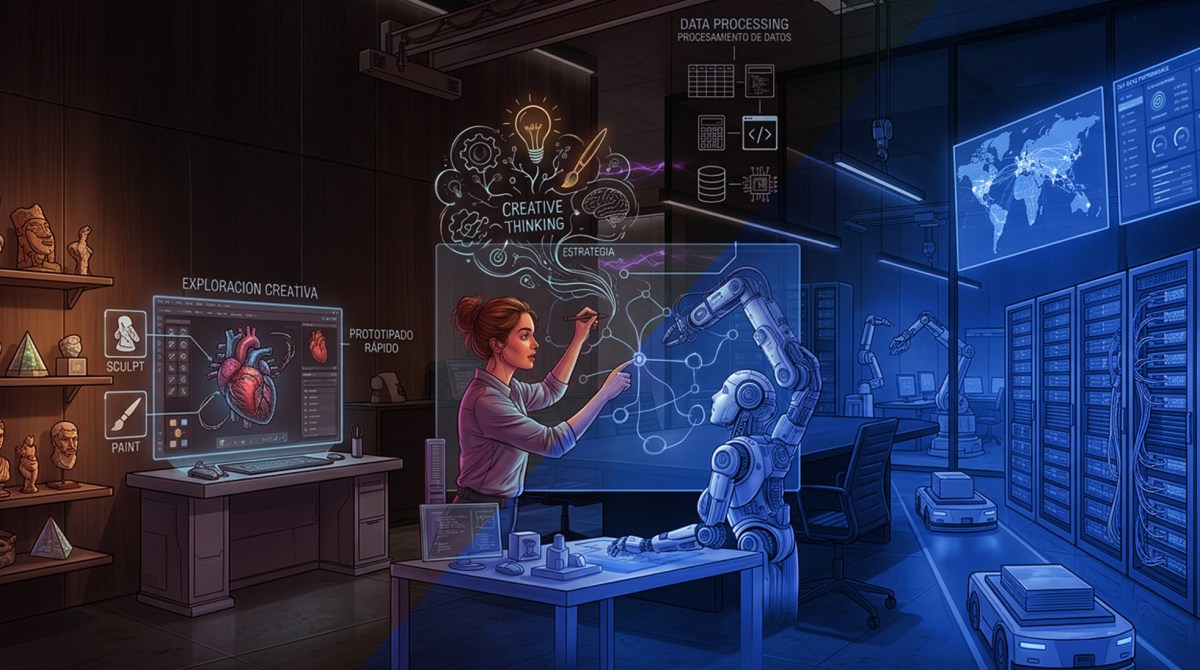
It is also a shift in scale of thinking. In design, specifically, it should free us up to engage in more creative and strategic thinking. Critical thinking must be the fuel in a world where replicating a value proposition is worth nothing. If AI generates 30% or 80% of the execution, what sets one professional apart from another is no longer speed: it is judgement, the question they ask before executing.
Advantages of artificial intelligence in design compared to traditional processes
There is a before and after, particularly in terms of speed. But AI is not yet a panacea, and pretending it is one of the most common mistakes in organisations.
The area where it helps most today is vast: from research with automatic transcriptions and insights analysis to the generation of complete workflows. With good integration, you can turn that knowledge into user stories, diagrams, design proposals and even functional code, all in one go.
However, there are clear limitations, the ‘five Achilles’ heels’:
- Hallucinations. Models generate plausible text, not verified truth.
- Context window. Loss of coherence in long workflows.
- End-to-end reliability. Accuracy drops when scaling complex processes.
- Security. Vulnerabilities such as prompt injection.
- Human bottleneck. Supervision becomes the critical point.
How artificial intelligence is changing professional profiles in design
There has been much talk about AI taking our jobs. What has really changed are the roles and the speed at which they evolve.
The roles that are growing are those that combine:
- Strategic thinking and technical execution
- Systems thinking
- Ability to evaluate AI outputs
- Skill in communicating data-driven decisions
At the same time, roles centred on repetitive tasks, dependent on a single tool or lacking real differentiation are disappearing or being scaled back.
Furthermore, a new role is emerging: designers of systems that integrate AI, capable of defining workflows, monitoring and agent behaviour.
How artificial intelligence can drive Telefónica’s leadership in digital innovation
We have always been a cutting-edge company in technology, but being at the forefront does not mean moving at any speed in any direction.
We are not yet operating under an AI-first model across all products, and that is not a weakness; it is a quality-driven decision. AI is not yet up to the task in certain contexts where the user experience leaves no room for error.
The most important thing is that judgement never fails: human oversight is not a brake on innovation; it is its guarantee of quality.
In an environment where almost everything can be automated, the value no longer lies in producing more, but in knowing what is worth producing.
Which artificial intelligence tools are setting the trend in design in 2026?
There is no one-size-fits-all solution; every team is finding its own tech stack.
Claude has established itself as a benchmark in workflows ranging from conversation to code generation, with integrations with Figma. Tools such as Cursor or GitHub Copilot are redefining technical and creative work.
The Figma MCP ecosystem is changing the relationship between design and development: it is no longer a handover, but a two-way flow.
In prototyping, solutions such as v0, Lovable or Bolt allow you to go from idea to product in minutes. And integrations with creative tools expand the scope of these workflows.
The key is no longer the tool itself, but how it fits into the process.
Telefónica and its vision
Against this backdrop of accelerated transformation, the evolution of artificial intelligence in design reflects a broader shift: the need for businesses and citizens to access digital technologies in a simple, useful and strategic way. This approach ties in with Telefónica’s ambition to become the best gateway to innovation, driving more advanced services, strengthening competitiveness in Europe and contributing to a more robust technological ecosystem. In an environment where technology is advancing faster than ever, true leadership is not just about adopting new tools, but about integrating them with discernment, responsibility and a clear vision of real impact on people and society.