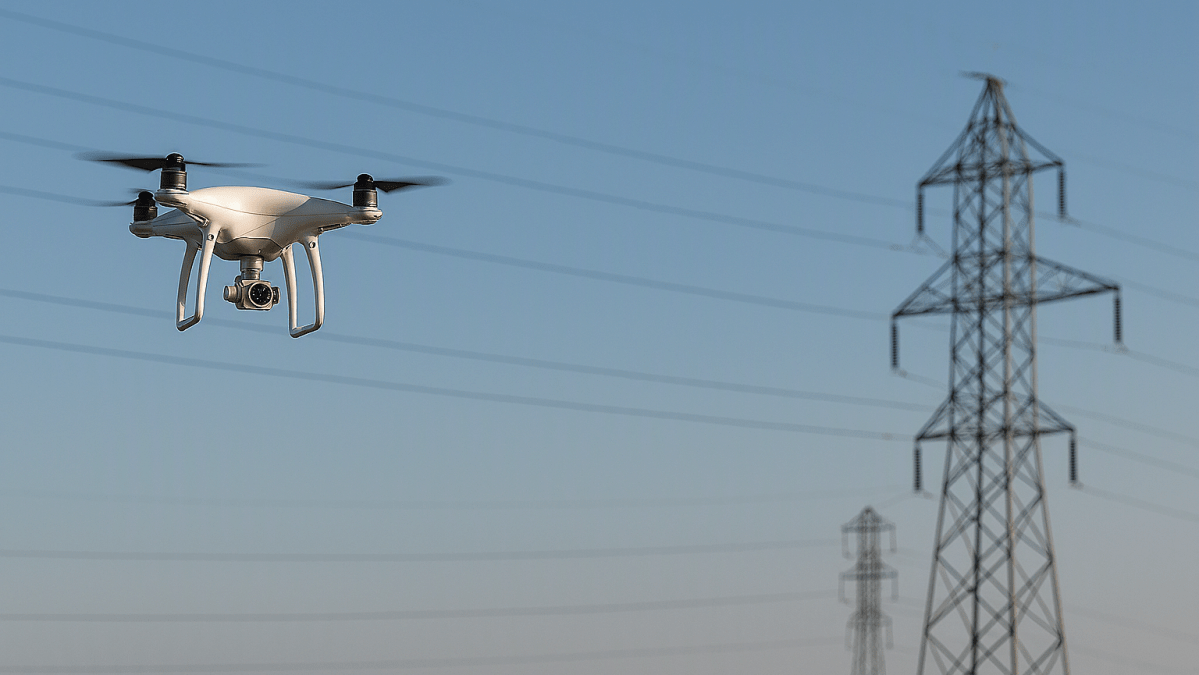

The model we have developed at Telefónica completely transforms the traditional way of operating. Previously, inspecting critical infrastructure — such as a power line, a pipeline or a forested area — involved deploying staff, time and money. Now, with our drone service, a pilot can operate a drone remotely over long distances thanks to the network’s advanced connectivity, whilst always complying with applicable operational and regulatory requirements, in real time, with high-definition video and AI analysing the images captured by the camera as it flies.
The drone is not the star of the show; it is the entire ecosystem that makes it possible: 5G, edge computing, computer vision and artificial intelligence, all integrated.
The value of combining drones and AI: greater safety, lower risk and faster operations
The main advantage is simple: achieving more with less risk and in less time.
In predictive maintenance, AI detects anomalies in thermal or visual images before they develop into an actual fault. In security, a drone can autonomously patrol a perimeter and send an alert only when it detects something relevant.
Network and infrastructure monitoring can be carried out in a matter of hours from a control centre. The pilot is still human, but AI automatically filters, prioritises and highlights the most relevant events and incidents to facilitate decision-making.
Cost reduction and improved efficiency: the real impact of smart drones
The impact on efficiency is very tangible. We eliminate the pilot’s travel time, which in many cases accounts for 70% or 80% of the total cost of a mission.
With Drone-in-a-Box technology, the drone is already at the mission site, in standby mode, ready to take off in a matter of minutes.
The 5G network enables a remote connection between the control centre and the location where the drone flight is to take place, making a widespread and robust mobile network a fundamental part of this new service. In this regard, Telefónica is the leader in 5G coverage in Spain, with a roll-out reaching over 95 per cent of the population.
And thanks to edge computing, data analysis does not have to travel to a central server; it takes place at the edge of the network, in real time and with minimal latency. This turns the drone into a tool for immediate response, rather than an instrument for delayed diagnosis.
From images to decisions: the key role of artificial intelligence in drone operations
AI is what turns data into decisions. Without it, the drone is merely a flying camera.
With computer vision and AI running on-board — or, more precisely, at the network edge so as not to overload the device — the system can detect early thermal anomalies potentially indicative of a fire risk, identify a structural defect in a pylon, or recognise an intrusion within a security perimeter, all practically in real time thanks to data processing at the network edge.
We don’t send images for someone to review; we send conclusions and alerts. That is what fundamentally changes the operational model.
Regulation, privacy and cybersecurity: the challenges of deploying AI-powered drones
The regulatory challenge is very real.
Operating BVLOS (Beyond Visual Line of Sight) drones requires specific authorisations from AESA, which are still complex to obtain and vary depending on the environment.
At Telefónica, we have chosen to include regulatory management as part of the service so that the customer has a solution tailored to their needs, without having to devote time and resources to aspects that may prove complicated for them to manage.
In terms of cybersecurity, the 5G network with licensed spectrum and encryption gives us a structural advantage over solutions based on Wi-Fi or uncontrolled radio frequencies.
And when it comes to privacy, the key lies in human oversight: total autonomy is not the goal. The aim is for AI to augment the operator’s capabilities, not to replace them without supervision.
The future of autonomous drones: 24/7 monitoring and increasingly smart cities
The immediate future lies in fleets of drones operated from centralised control centres, managing simultaneous missions across different parts of the country, with AI analysing information and generating alerts and recommendations in real time, whilst human operators oversee and validate the necessary actions.
For businesses, this means critical infrastructure monitored 24/7, with a significant reduction in operating costs and greater responsiveness.
For cities, it means drones integrated into emergency, traffic and security systems, acting as another node within a smart urban network.
What is truly interesting is not the drone itself, but the fact that Telefónica, as a network operator, is uniquely positioned to act as the connective tissue of this entire ecosystem.
Telefónica: access to the next generation of digital technologies
The evolution of connected drones, artificial intelligence, edge computing and 5G networks reflects a broader vision of technological transformation. In this context, Telefónica aims to play a role that goes beyond connectivity, enabling businesses, public authorities and operators of critical infrastructure to access the most advanced digital capabilities in a simple, secure and scalable manner.
Solutions such as Drone as a Service exemplify this approach, by integrating connectivity, artificial intelligence, cybersecurity and remote operation into a single service capable of accelerating the digital transformation of strategic sectors.
Telefónica has taken on the undeniable challenge of becoming the best gateway for citizens to access digital technologies, an ambition that is also being realised in the fields of intelligent automation and advanced infrastructure management. Furthermore, the company is working to‘have the best network for accessing the most innovative technology’, putting connectivity at the service of new operating models that help businesses and public administrations to become more efficient, secure and competitive.