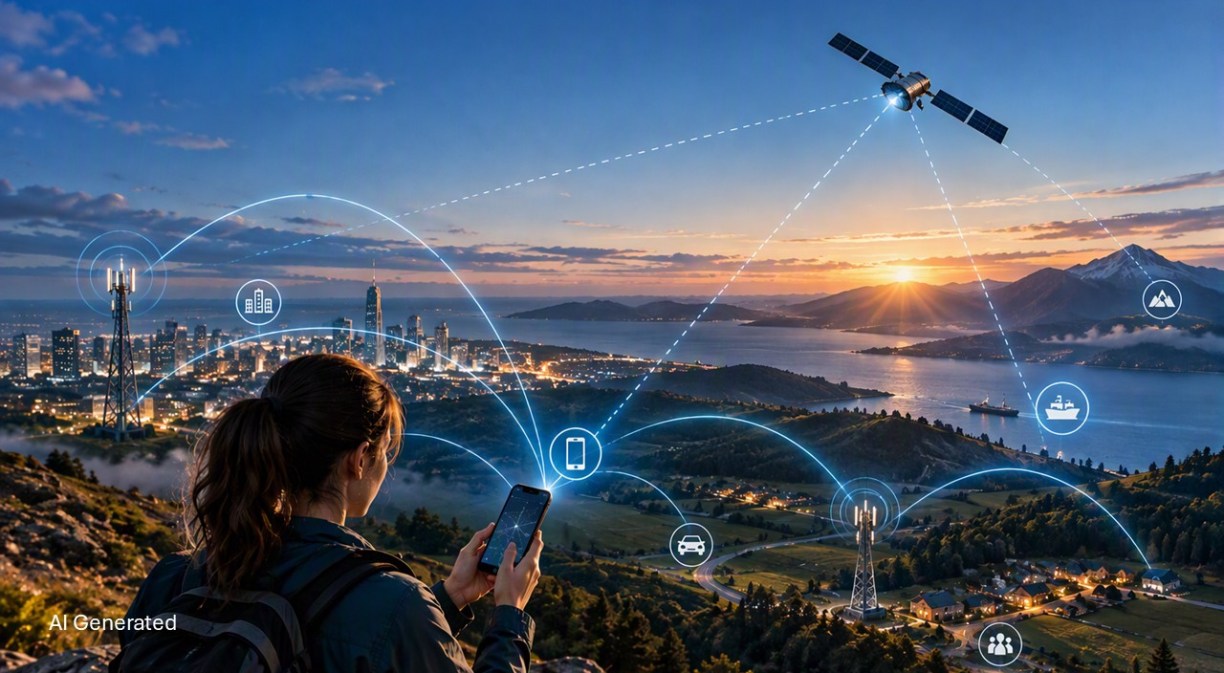

Satellite connectivity is opening a new chapter in the evolution of communications. It comes with high expectations, but also with persistent myths, particularly around its potential to replace terrestrial networks. Satellite connectivity offers complementary services and creates new opportunities for collaboration. Across markets worldwide, the future is increasingly pointing towards a model combining satellite and predominantly terrestrial connectivity.
Satellite Direct-to-Device can play a valuable role in extending outdoor connectivity to underserved areas and supporting critical and emergency communications. However, it cannot replicate the capacity, indoor coverage, uplink performance or geographic spectrum reuse of terrestrial mobile and fixed networks. Coverage should not be confused with capacity, nor occasional connectivity with the full mobile experience users expect every day.
As satellite communications move closer to mainstream mobile services, realising their full potential will depend on seamless integration with terrestrial networks, leveraging the infrastructure, expertise and trusted relationships of telecommunications operators.
The future of connectivity will therefore be mixed: terrestrial networks providing the primary connectivity layer, the capacity, quality and ubiquitous connectivity on which citizens, businesses and public administrations rely and satellites extending reach and critical communications where conventional connectivity is difficult, or critical (including while temporarily unavailable).
An open and sovereign strategic approach for Europe
Telefónica welcomes the European Commission’s MSS proposal to foster European satellite connectivity, including future D2D services, with European sovereignty at its core. We support a framework that looks to strengthen EU competitiveness, strategic autonomy and industrial capabilities.
Europe aims to remain open to international technology, investment and partnerships. At the same time, openness should not mean overlooking strategic dependencies or allowing critical connectivity functions to become concentrated in a very limited number of vertically integrated, non-European platforms.
The objective should be to develop an ecosystem in which European operators, satellite companies, technology providers and institutions can combine their respective strengths.
This requires flexible models that permit joint ventures, consortia and contractual partnerships between mobile and satellite operators. An applicant for MSS spectrum should be eligible to participate in the award procedure without being required to own satellite infrastructure, provided that it has a binding agreement securing the necessary satellite capacity and retains sufficient control over the service delivery and compliance with the relevant obligations.
This would better reflect the technical and commercial reality of satellite-terrestrial networks and could support faster deployment, investment and innovation.
Europe also needs a framework that ensures regulatory parity. Comparable connectivity services should be subject to comparable requirements, irrespective of whether they are delivered through terrestrial or satellite infrastructure. Transparent selection procedures, strong interference safeguards, predictable conditions and proportionate spectrum fees will be important to preserve fair competition and maintain incentives to invest in both terrestrial and satellite connectivity.
From satellite coverage to a comprehensive connectivity service
Looking ahead, for users, the underlying technology behind connectivity should be almost invisible. They could be able to move between terrestrial and satellite connectivity with the same device, number, authentication mechanisms, security protections, customer support and billing relationship.
This is where telecommunications operators bring distinctive value.
Mobile operators already integrate access networks, spectrum, devices, authentication, cybersecurity, customer care and service platforms into a single experience. They manage complex national infrastructures and have the operational capabilities necessary to integrate satellite connectivity into existing mobile networks. They can therefore transform satellite capacity into a complementary service that works as part of the broader communications ecosystem, rather than as an isolated connectivity layer.
European Operators also provide the sovereign ground infrastructure and functions needed to coordinate, monitor and manage the service. The joint initiative announced by Telefónica, Deutsche Telekom, Orange, and Vodafone reflects precisely this approach. The four operators have signed a Letter of Intent to explore a potential joint bid for the future allocation of Mobile Satellite Services spectrum in Europe.
What telecom operators contribute
The debate about satellite connectivity sometimes focuses almost exclusively on satellites and constellations. Yet the space segment is only one component of an end-to-end service. Terrestrial networks will continue to provide the primary connectivity layer, keeping users connected with greater capacity and richer capabilities in most places and situations, including during emergencies and critical events. The real value lies in bringing both together.
And there, telecommunications operators contribute capabilities that are essential for turning satellite connectivity into a secure, reliable and widely available service:
– Seamless network integration. Operators can integrate terrestrial and satellite connectivity, supporting service across different access technologies.
– Trusted customer relationships. They already serve citizens, businesses and public administrations and can incorporate D2D into established commercial, customer-care and support models.
– Spectrum and interference management. They have extensive experience in the efficient use of spectrum, coexistence between services, network monitoring and the management of harmful interference.
– Regulatory compliance. Operators are subject to obligations relating to security, resilience, lawful access, emergency communications and consumer protection.
– Infrastructure and operational scale. Their core networks, terrestrial sites, service platforms and operational teams can help accelerate deployment and avoid the creation of disconnected or duplicative service environments.
– Resilience and continuity. By combining terrestrial and satellite layers, operators can provide additional connectivity options for crisis situations, critical communications and locations beyond conventional coverage.
These capabilities are not peripheral to D2D. They are part of the service itself. The value of a connectivity ecosystem depends not only on what happens in orbit, but also on who manages the network, protects the data, authenticates the user, ensures regulatory compliance and remains accountable for service delivery. This approach remains open to different partnership models across the ecosystem.
Sovereignty is about control over critical functions
European technological sovereignty cannot be assessed solely by looking at who owns a satellite constellation. It also depends on the level of competition in the space segment and, critically, on who controls the service layer, the customer relationship, authentication, network management, data governance, security functions and continuity of service.
European telecom operators already perform many of these functions within strict regulatory and security frameworks. Their participation can therefore help anchor key sovereign capabilities in Europe, even where satellite capacity is provided through partnerships.
In the longer term, Europe should support competitive European capabilities across the entire value chain, including satellites, ground infrastructure, devices, chipsets, software, network technologies and standards. It should also play an active role in shaping future non-terrestrial network and 6G standards through bodies such as 3GPP ensuring that European requirements for security, interoperability, resilience and competition are reflected in global frameworks.
Finally, developing and anchoring these capabilities in Europe will require significant and sustained investment. Private investment will be essential, but experience in the United States demonstrates the important role that public funding, strategic procurement and long-term institutional demand can play in developing and scaling sovereign technological capabilities. Europe’s ambitions should therefore be matched by adequate resources, including through the next Multiannual Financial Framework, supporting strategic capabilities across the full connectivity value chain, from technology development and launch, to deployment, operation and service provision.
Building the European connectivity ecosystem of the future
The question is not whether terrestrial or satellite networks will prevail. Both will be needed, because they solve different problems and offer complementary capabilities.
Satellite connectivity can extend the reach and resilience of communications, though with limited capacity. Terrestrial networks provide the capacity, indoor coverage, local presence and service integration required for everyday connectivity. Telecommunications operators connect these two worlds.
The initiative launched by Telefónica, Deutsche Telekom, Orange and Vodafone provides an opportunity to translate this complementarity and Europe’s sovereignty ambitions into a practical European model: open to all mobile operators, supportive of competition and consumer choice, combining European governance with proven expertise, and providing a pathway for the growth of Europe’s satellite ecosystem.
To unlock the full potential of D2D, policymakers and the satellite industry should therefore build with telecom operators. Their networks, expertise, responsibilities and customer relationships make them indispensable partners in delivering sovereign, secure, resilient and seamless connectivity for Europe.