

The evolution of the concept of sovereignty
The continuous quest to expand the territories of empires led to a feudal system characterised by the decentralisation of political power, with the monarch as the main source of power. However, in practice, there were occasions when power was fragmented, with feudal lords exercising great influence and having multiple vassalage relationships. The result was widespread social segmentation and a great deal of conflict, even leading to civil war.
In this tumultuous context, Bodin proposed the recognition of state sovereignty as an effective solution that would bring order and peace. He conceived of sovereignty as a single, absolute power, without limits on its powers, possessed by a single, unitary political entity. This definition of sovereignty was in keeping with the historical framework in which absolutism emerged.
Bodin opened the door to reflection on sovereignty for later political philosophers, showing how the concept of sovereignty evolved according to each historical moment.
With absolutism at its height, Thomas Hobbes agreed with Bodin on the need to establish absolute sovereignty. In his opinion, this was the only solution to maintain peace and order in a world where human beings are ‘inherently selfish and prone to violence’.
Decades later, with the absolutist system in decline due to popular unrest, John Locke added a new dimension to the concept of sovereignty. He believed that the sovereignty of the state emanated from the consent of the people, with civil society having the power to choose a new political entity if their natural rights were not respected.
At the height of the Enlightenment, Jean-Jacques Rousseau argued that sovereignty not only emanated from society, but resided in the people, being an expression of the “general will”.
With the establishment and strengthening of democratic principles and social freedoms in the 20th century, Bertrand de Jouvenel conceived of sovereignty as an essential attribute of political authority. However, he warned that political power tends to seek expansion, so sovereignty should be limited by ‘rules’ (regulation) and legitimised by the population.
The concept of sovereignty in the global digital age
We are now facing another moment of decisive change in the course of history: the global digital age. As in previous changes of era, political, social and economic dynamics are being impacted, leading to a reflection on the priorities, organisation and interaction of states to prosper in this new stage. In this sense, sovereignty is a key concept.
Digital sovereignty could be understood as an extension of the sovereignty of states, whereby they have the capacity to ensure that activities and actors in the digital environment that impact the country’s economy or society comply with a set of rules, principles and standards.
The challenges in exercising digital sovereignty
But how can sovereignty be applied to a space without defined borders, with great interdependencies and with new actors whose power of influence is comparable to that of states?
Firstly, territorial definition is one of the basic principles of sovereignty. It establishes the space in which a state can exercise its authority, as well as the limits of one state’s actions vis-à-vis another. In contrast, the intangibility of the digital world and the absence of defined borders pose a challenge to states in exercising their sovereignty.
Secondly, the diversification of the value chain reduces the autonomy of states in decision-making and compliance with standards.
On the one hand, interdependencies make states more vulnerable to requests or changes in the digital industrial policy of other states. A current example is the pressure from the United States on the European Union to ban ‘high-risk suppliers’ (i.e., Chinese suppliers Huawei and ZTE) on the grounds of security, with a clear backdrop of technological rivalry between the two poles.
On the other hand, although states have some scope for interference in value chain activities, ensuring compliance with ethical standards is highly complex. For example, the extraction of raw materials needed to produce technology is mainly carried out in third countries, with the European Union having very limited influence on national environmental and labour policies.
Thirdly and finally, large technology companies, with their considerable economic power and influence on social dynamics, have become actors with a capacity for influence comparable to, or even greater than, that of a state. A recent example is the introduction of the concept of ‘fair share’ or, as technology companies refer to it, ‘network fee’ in the trade agreement between the United States and the European Union. Despite being an issue unrelated to trade between the two regions and a topic typically discussed by large technology companies, it was successfully incorporated into the agreement.
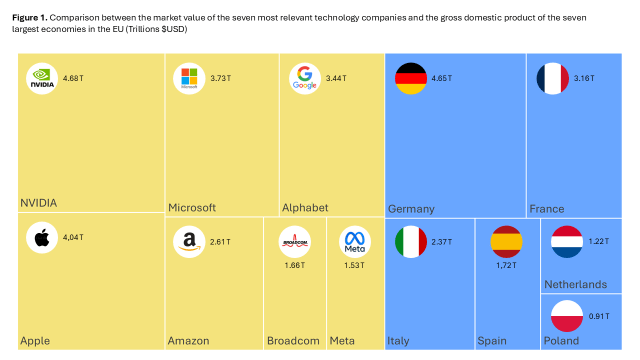
Figure created in-house using data from the World Bank and Companies Market Cap
In conclusion, the concept of sovereignty is not static; it evolves alongside major social and political transformations throughout history. Today, we are facing a new turning point: the digital age, which is forcing us to rethink its application in an abstract and complex environment.
To what extent is it truly possible to exercise digital sovereignty? Does the European Union have the capacity to exercise full digital sovereignty? Is it pursuing digital sovereignty or digital autonomy?
A subsequent publication will seek to provide answers to these questions.