

Public debates on technology and digitalisation have become a key forum for analysing challenges and opportunities and for shaping public policies that foster competitiveness, technological transformation, growth, and resilience.
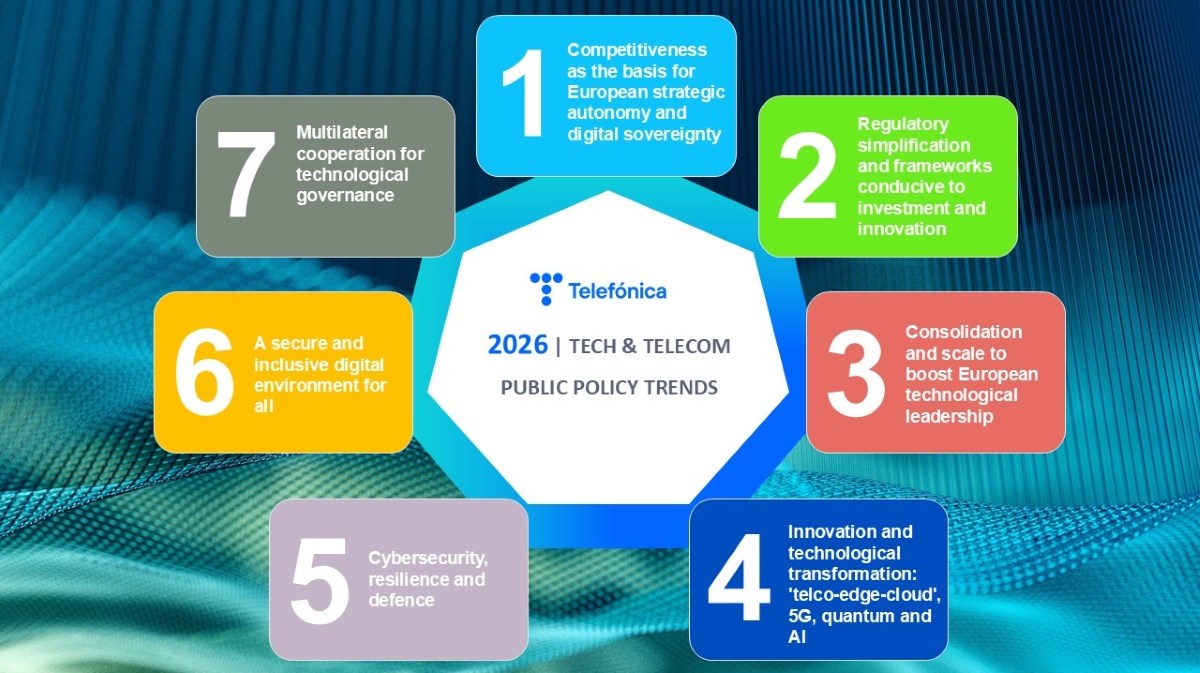
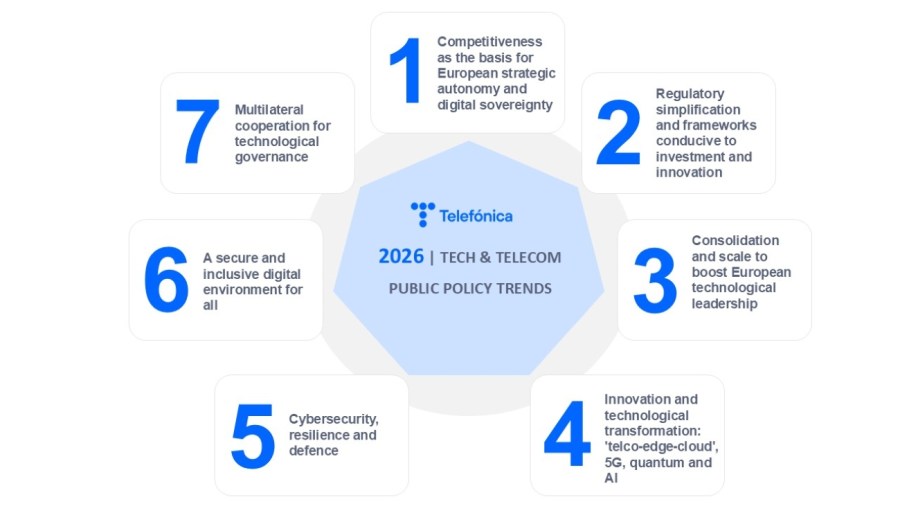
Curious about the main public policy priorities in technology and telecommunications for 2026? Continuing with the series of trends that we began in 2023 and followed in 2024 and 2025, we invite you to discover the seven most important issues that will shape the public agenda in 2026.
1. Competitiveness as the basis for European strategic autonomy and digital sovereignty
In 2026, the European Union (EU) will implement its ambitious work programme for 2026. This is aimed at completing the single market, simplifying regulation and creating the conditions for European companies to gain scale and competitiveness, promoting innovation and strengthening the EU’s strategic autonomy. The Commission and Member States recognise that progress requires investment, regulatory reforms and greater coordination.
This course of action continues the work begun in 2025 by the EU with the new industrial policy, set out in the Compass for Competitiveness and the European Commission’s 2025 programme, which also incorporated the AI Continent Action Plan. Together with the debates promoted by the Digital Decade 2030 and the Eurobarometer on citizens’ expectations regarding digitalisation, Europe has shown its determination to act on the persistent innovation gap, the fragmentation of the single market and external technological dependence. In this context, the telecommunications sector is consolidating its key role in advancing the integration of the single market, closing these gaps, accelerating the digital and green transition, and strengthening European leadership in strategic technologies.
2. Regulatory simplification and frameworks conducive to investment and innovation
In 2026 the EU will consolidate the reform initiated in 2025 through the Omnibus Digital package and the Digital Networks Act (DNA), advancing regulatory simplification, which is key to the future of the sector. Telefónica, in particular, advocates for an ambitious reform of the DNA that stimulates investment in next-generation networks and the deployment of advanced services. This requires clear rules that reduce uncertainty, simplify obligations, strengthen incentives to invest in spectrum and high-capacity networks, ensure a level playing field in the digital value chain and encourage technological innovation. In this regard, the repeal of the now obsolete ePrivacy Regulation is necessary.
In 2025, a key challenge became clear: Europe needs to be simpler and more agile in order to accelerate its competitiveness, starting with a modern and simplified regulatory framework that streamlines investment and innovation in the region. This simplification was considered urgent in 2025 according to organisations such as the OECD, which, at the Symposium for Regulatory Simplification and in its report, OECD Regulatory Policy Outlook, advocates effective regulation based on evidence and public-private dialogue.
3. Consolidation and scale to boost European technological leadership
In 2026, progress will be made towards a new approach to merger control in the EU, following the conclusions of the public consultation launched by the European Commission in 2025 on the Guidelines for the assessment of horizontal and non-horizontal mergers. The responses to the consultation show widespread demand from economic agents to incorporate a more dynamic view of markets in the application of competition policy. This view is in line with Telefónica’s position on the revision of the Guidelines and its position on the dynamic efficiency of markets.
From this perspective, the review offers an opportunity to recognise and apply a broader concept of consumer welfare that goes beyond price effects. Dimensions such as innovation, quality, choice, resilience and sustainability have a deeper and more lasting impact on consumer welfare than price alone. The aim would therefore be to move from an approach based on price competition to one focused on value competition.
This approach could result in more innovative, efficient and competitive services. In this context, it is argued that market assessment should be rethought and the natural reorganisation of the market through consolidation should be facilitated. This would allow operators to reach the required levels of take-up in network deployment areas, reinforce their investment capacity, and improve and expand the services provided, as evidenced in other markets, in line with the EU’s strategic objectives of competitiveness and well-being.
4. Innovation and technological transformation: ‘telco-edge-cloud’, 5G, quantum and AI
In 2026, connectivity will continue to evolve towards telco-edge-cloud networks, with greater integration of satellite services and a growing role for the uplink in 5G as a strategic asset, especially for uses linked to artificial intelligence. In this context, network slicing could be key to enabling specialised services. The main challenge will be to move towards a more horizontal regulatory framework that drives innovation and growth, fosters more balanced relationships between the various players and provides certainty in areas such as net neutrality, or greater transparency in relation to essential patents.
The telecommunications sector continues to be a driver of innovation, also in collaboration with third parties, as demonstrated by the NEXTONIC laboratory, which celebrated its tenth anniversary in 2025. Europe’s ambition to regain technological leadership necessarily involves connectivity, which is essential for the digital and green transition, with the 6 GHz high band set to play a significant role in the development of 6G services. All of this is taking place in a context in which the state of digital communications in Europe in 2025 has revealed significant challenges that remain to be addressed.
Looking ahead to 2026, the European Union will promote new industrial policies in artificial intelligence and quantum technologies, with the approval of the Quantum Act, the launch of gigafactories, and the adoption of standards for the application of the AI Act, following an intense debate in 2025 focused on the industrial development of AI, marked by the Paris summit.
5. Cybersecurity, resilience and defence
In an era of increasing digital complexity and geopolitical tensions, digital security has moved to the forefront of the political agenda. The role of operators in this area as strategic partners, as well as recommendations for improving resilience, are set out in Telefónica’s cybersecurity position paper. The year 2026 will be marked by a greater regulatory and geopolitical focus on the supply chain, the impact of artificial intelligence and a complex regulatory environment, despite efforts at simplification. It is also the year that the EU has set for the start of the transition to quantum-safe cryptography.
The year 2026 will also be the year to start implementation of the defence plans proposed in 2025. Operators such as Telefónica play a key role as a leading technology partner in the field of defence, especially in areas related to dual-use technologies, information management and the design and operation of advanced communications such as private 5G networks with critical communication bubbles, as well as in the development of drone capabilities.
6. A secure and inclusive digital environment for all
In 2026, public policies will prioritise the protection of users in the digital environment, especially vulnerable groups such as minors. To this end, policies focused on digital education in the curriculum, the deployment of protection tools such as age verification, and greater collaboration between institutions, the private sector, families and educational centres are expected to be promoted. Digital identity will be a key element, especially with the entry into force in 2026 of the obligation to offer a digital identity portfolio in each European member state.
And the fight against fraud will see the signing of multilateral agreements at the UN conference in Vienna in March to strengthen cooperation on this issue, as an essential complement to regulatory frameworks. Policies for inclusive digitalisation aimed at closing gaps in access, use and skills will also continue to be promoted in order to generate new economic opportunities for all.
2025 highlighted the urgent need to act in response to the growing complexity of the convergence between the digital and physical environments, as reflected in studies such as Generación Alfabeta, and to ensure safe digital environments for minors, a firm commitment of Telefónica. Likewise, 2025 emphasised the value of multilateral dialogue spaces, such as the Telefónica Policy Lab, to advance shared solutions.
7. Multilateral cooperation for technological governance
In 2026, the EU will strengthen its international presence in the digital sphere, translating its vision of strategic autonomy into concrete actions for global cooperation. Following the progress made in 2025, such as the digital trade agreement with South Korea, the promotion of digital diplomacy and digital partnership agreements, the agenda will focus on consolidating frameworks for interoperability, open digital trade and stable global rules that protect European values and strengthen competitiveness. This approach will promote strategic alliances with key blocs such as Mercosur and greater European leadership in multilateral Internet governance forums.
In 2025, forums such as Strasbourg Digital Week and the IGF in Oslo highlighted the complexity of internet governance and the need for more coordinated European leadership. Together with the EU’s International Digital Strategy and the B20 South Africa discussions, these experiences underscore the need to promote a more cohesive digital foreign policy in 2026, integrating trade, regulation and multilateral cooperation.