
- In his 1985 work Innovation and Entrepreneurship, Drucker explored this concept in depth, reviewing some of the theoretical foundations that had been previously postulated.
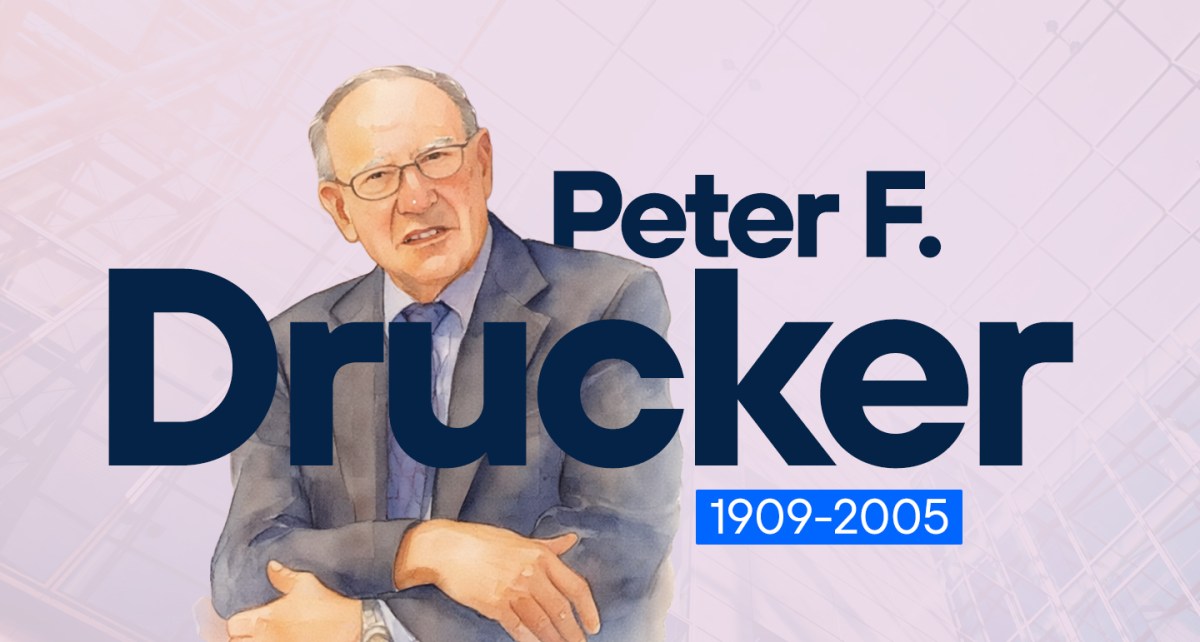
To mark World Entrepreneurship Day, celebrated every year on 16 April, we are going to take a closer look at a prominent figure in 20th-century entrepreneurship. We are talking about Peter Drucker (1909-2005), considered the father of modern management.
Peter Drucker’s origins, youth and education
Peter Ferdinand Drucker was born in Vienna on 19 November 1909 into an upper-middle-class intellectual family that, although converted to Christianity, came from a Jewish background.
His father, Adolph Drucker, was a senior official in the Ministry of Finance and his mother, Caroline Bondi, was a doctor.
Education of Peter F. Drucker
He attended secondary school in his native Austria and Germany at a time marked by the instability of the First World War.
During his time in Hamburg, he combined his studies with an apprenticeship at a cotton trading company.
He later graduated in Public Law and International Sciences from the University of Frankfurt, where he also wrote as a freelance journalist. The ideas of Keynes and Ortega y Gasset stimulated his interest in the analysis of social organisations and institutions, and he was also influenced by prominent economists of the Austrian School such as Schumpeter, Von Mises and Hayek.
The rise of Nazism to power in Germany in 1933 prompted him, given his Jewish ancestry, to move to London, which he also left four years later to settle in the United States.
Peter Drucker and entrepreneurship
His arrival on the American continent in the late 1930s led him to work as a consultant and publish more than thirty books, the first of which was The End of Economic Man, in 1939.
His professional career continued with writing, to which he added a position in 1971 as professor of social sciences and management at Claremont Graduate University in California.
It was in one of his works that Drucker theorised about entrepreneurship.
1985: Innovation and Entrepreneurship
In his 1985 publication Innovation and Entrepreneurship, Drucker presents innovation and entrepreneurship as a systematic discipline with a defined purpose, explaining and analysing the challenges and opportunities of the new American entrepreneurial economy.
In this work, Drucker theorises about the importance of entrepreneurs seizing opportunities, not simply solving problems.
Drucker refers to Jean-Baptiste Say’s definition of entrepreneurship, recalling that ‘there has been total confusion about the definitions of “entrepreneur” and “entrepreneurship”’.
He alludes to the specific case of his host country, the United States, where ‘the entrepreneur is often defined as someone who starts their own business, new and small,’ although ‘not all new small businesses are entrepreneurial or represent the entrepreneurial spirit.’
He illustrates this theory as follows: “The couple who open another delicatessen or Mexican restaurant in a residential neighbourhood in the United States are undoubtedly taking a risk. But are they entrepreneurs? All they are doing is what has been done many times before. They are betting on the growing popularity of eating out in their area, but they are not creating a new satisfaction or a new consumer demand. From this perspective, they are certainly not entrepreneurs, even if their business is a new venture.‘
He also refers to the size of companies, explaining that ’a company does not have to be small and new to be entrepreneurial.”
As an example, he says that ‘entrepreneurship is practised by large and often long-established companies. General Electric Company (G.E.), one of the world’s largest companies and over a hundred years old, has a long history of creating new entrepreneurial companies from scratch and turning them into large-scale industries’.
He also points out that ‘entrepreneurship is by no means limited to economic institutions,’ citing as an example of entrepreneurship ‘the creation and development of the modern university, and especially the modern American university.’
He develops this idea by explaining that “the modern university as we know it began as an invention of the German diplomat and civil servant Wilhelm von Humboldt, who in 1809 conceived and founded the University of Berlin with two clear objectives: to wrest intellectual and scientific leadership from the French and give it to the Germans; and to capture the energies released by the French Revolution and turn them against the French themselves, especially against Napoleon.‘
He concludes this thesis by recalling that ’sixty years later, around 1870, when the German university had reached its peak, Humboldt’s idea of the university as an agent of change was taken up on the other side of the Atlantic, in the United States.”
Frequently asked questions
He was born in Vienna on 19 November 1909.
On 11 November 2005 in Claremont, California (United States), at the age of 95.
He is considered the father of modern management and the most influential thinker in 20th-century business management, who also theorised about entrepreneurship.