

For the second consecutive year, Telefónica is publishing its Digital Public Policy Playbook. This document brings together in one place Telefónica’s vision and proposals to contribute to the design of public policies that will enable progress towards a more competitive, innovative and sustainable Europe.
However, this new edition is being presented in a very different context to that of a year ago, marked by the volatility and global uncertainty that accompany unstoppable technological development. This environment highlights the need for public policies capable of responding effectively to these challenges and ensuring that technology benefits all members of society.

The environment: a strategic factor in the design of public policies
Last year we published the first edition of the Digital Public Policy Playbook against a backdrop of shifting global dynamics, with Europe seeking to preserve its role as a major power. The start of the European Union’s new institutional cycle presented an excellent opportunity to set new policy objectives that would help strengthen the region’s competitiveness, strategic autonomy and social welfare.
2025 marked a moment of optimism for a Europe with a clear direction and renewed ambition to regain its relevance on the international stage. Drawing on the recommendations of the Letta and Draghi reports, the European Commission set out its new strategic roadmap for the EU for the period 2025–2029: the Competitiveness Compass. Its first pillar, “Closing the innovation gap”, includes as key actions the proposal for a Digital Networks Act (DNA) to drive the roll-out of the networks of the future and the revision of the Horizontal Merger Control Guidelines to enable companies to scale up and become more competitive in global markets.
A year on, 2026 emerges as a year for decisive action, against a backdrop where businesses are calling for greater ambition and agility in the European institutions’ response. Initiatives such as the DNA, the review of the Guidelines on Horizontal Mergers, the Cybersecurity Regulation 2, or the Artificial Intelligence Regulation, amongst others, have already been approved or are currently underway. These reforms have the potential to redefine the sector’s competitive and investment framework and to strengthen Europe’s capacity to develop, protect and scale its own technologies.
From our perspective, any public policy initiative should be designed from an industrial and comprehensive perspective of consumer welfare and promote an environment that guarantees equal opportunities to invest, innovate and grow. This would foster a broader, more diverse and sophisticated range of services for the benefit of society and European citizens.
Hence our renewed analysis of the key debates shaping today’s digital landscape.
A look at the Playbook 2026
This new edition comprises 14 topics identified as the main public policy debates and trends of the year in the digital sphere. Some of these were already present in the previous edition and have been updated; others are new and respond to emerging realities. They have been categorised around three pillars that articulate our vision and proposals in response to key challenges: competitiveness, technological innovation, and sustainability and inclusion.
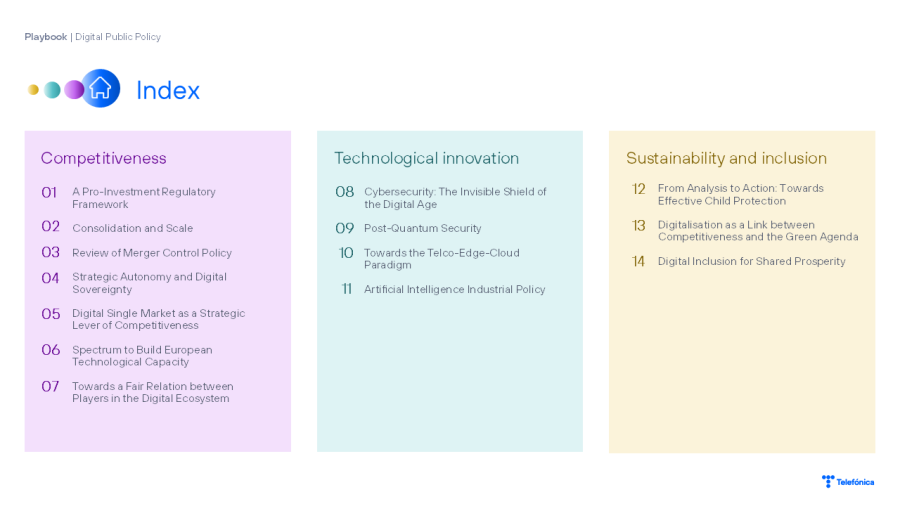
Competitiveness pillar
European competitiveness requires the creation of a dynamic business ecosystem capable of leading and innovating in global markets. The telecommunications sector is a strategic sector, as through the roll-out of high-capacity digital infrastructure and innovation in advanced technological solutions, it is essential to drive economic growth and social well-being.
The new edition of the Playbook offers concrete proposals to provide a strategic boost to European competitiveness and technological sovereignty. To this end, it addresses the need to create an environment that enables the sector’s scalability, ensures a level playing field with other digital players, and contributes to the achievement of European digital objectives.
Technological innovation axis
We find ourselves in a new paradigm of technological convergence, with the rapid adoption of telco-edge-cloud connectivity, artificial intelligence, cybersecurity and quantum technologies. Regulatory frameworks face the challenge of keeping pace with the dizzying speed of the technological revolution, to ensure an environment that allows society to fully reap its benefits.
It is essential to foster an environment that encourages private-sector investment in innovation and resilience. This must be underpinned by regulatory frameworks that ensure a level playing field within the digital ecosystem, as well as the development of standards and protocols to ensure that regulation does not stifle innovation in areas of transformative technologies such as AI.
Sustainability and Inclusion
The protection of minors, the competitive decarbonisation of Europe and the promotion of digital inclusion for all groups constitute the main pillars of action to advance the well-being of society in an increasingly digital environment.
To this end, it is crucial to strengthen the commitment of all stakeholders in the technology sector in order to create a safe environment, make efficient use of resources and encourage the participation of society as a whole in the digital world.
We hope you find Playbook 2026 a useful guide to understanding the key public policy debates that will shape Europe’s digital future, and we invite you to explore our proposals for moving towards a more competitive, innovative and sustainable Europe.