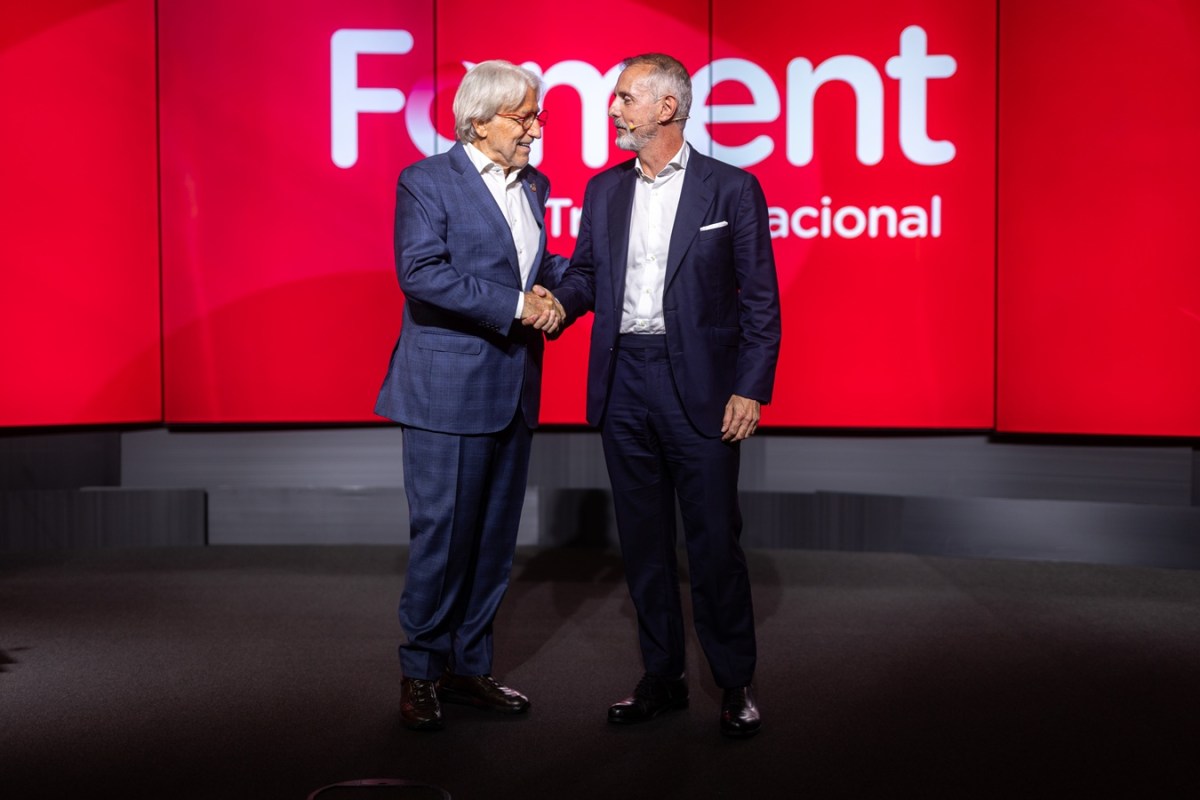
Telefónica’s Chairman and CEO, Marc Murtra, spoke out on Friday in defence of Catalonia’s importance in the group’s new phase of transformation. The chief executive reviewed the company’s current situation and prospects during a meeting organised by Foment del Treball, which was attended by members of the organisation’s Advisory and Consultative Councils, as well as a broad representation of Catalonia’s leading business community.
The president of Foment del Treball, Josep Sánchez Llibre, stated: “We agree with the president of Telefónica that Europe needs greater scale and a regulatory framework that facilitates investment and innovation, rather than hindering growth.”
Murtra explained that the company is undergoing a comprehensive transformation process to boost its competitiveness, underpinned by decisions such as withdrawing from certain countries, workforce adjustments in Spain, within corporate services and in Germany, a new capital allocation policy, the renewal of the management team and a refreshed strategy. The Chairman described this process as a genuine “palingenesis”: a concept that advocates changing what does not work and strengthening what one wishes to achieve. He also encouraged the Catalan business leaders present to join the “lobby for getting things done”: “to help with the transformation and make things happen”. “We business leaders are the agents of transformation,” he added.
This new phase forms part of the Transform & Grow plan, the implementation of which has enabled Telefónica to improve its outlook for 2026. The Chairman highlighted the improvement in the group’s forecasts: in July, the company revised its growth forecast for adjusted operating cash flow after leases (adjusted OpCFaL) – a key indicator in the telecoms sector – upwards from “more than 2 per cent” to “more than 3 per cent”, a 50 per cent improvement.
Investment in Catalonia
Telefónica’s Chairman and CEO explained how Telefónica’s role as the primary means of access to digital technologies for citizens is being realised in Catalonia, whilst also highlighting the company’s contribution to the region’s economic and technological development.
Murtra has outlined Telefónica’s operations in the region: an investment of 121 million euros by 2025, a workforce of around 1,043 employees and a customer base of 6.48 million accesses (1.2 million fixed broadband, 1.4 million fixed telephone lines, 607,000 television accesses and 3.2 million mobile accesses).
He also highlighted Telefónica’s contribution to Catalonia’s technological and cultural ecosystem. For example, its involvement in the AI Gigafactory in Tarragona, or the fact that, of the 17 edge computing nodes the group has deployed in Spain, two are in Catalonia (Barcelona and Terrassa), as well as its involvement with Escuela 42 in Barcelona, and its collaboration with iconic institutions and venues such as the Sagrada Família, the Gran Teatre del Liceu and the Palau de la Música.
Telefónica’s Chairman and CEO also highlighted the success of Movistar Plus, which has now reached 3.9 million customers, and its contribution to the Catalan audiovisual sector. As he pointed out, during 2025, the company filmed four productions in Catalonia (Yo siempre a veces, Por cien millones, Cinco minutos más and Matar a un oso) and has already begun filming Veredicto. “Telefónica is the largest producer of series and films in the whole of Spain, and we are the only major telecommunications company in Europe that generates its own content,” he stated. Furthermore, Murtra highlighted that the three Spanish films shortlisted for the Oscars are produced by Movistar Plus. Regarding the content produced by the platform, stated that the aim is to be “more daring, take more risks and produce much more”.
Leading the European agenda on technological sovereignty
Murtra’s speech also addressed the European context and the opportunity that this new phase of transformation represents for Telefónica. The Chairman advocated a European agenda based on technological sovereignty, competitiveness, security and digital rights, in line with the stance he has been putting forward in recent months.
In his view, Europe is facing a climate of uncertainty and opportunity that Telefónica must capitalise on to take the lead and establish its position on the European agenda for technological sovereignty, competitiveness, security and digital rights. Murtra reaffirmed the commitment to make Telefónica one of Europe’s leading telecoms companies by 2030. “I’ve been in the technology sector for 30 years and I’ve never seen an impact as rapid as that of artificial intelligence,” said Murtra.
In this regard, Murtra explained that in April 2026 there was a “Copernican shift” at the European Commission, which reviews the regulatory framework once every ten years, and they have brought this forward. “It’s a very smart move.” “The market is no longer defined at European level, but at global level, and this will enable European champions to have the scale needed to invest in technology,” he added. “I’m very optimistic; the change is already underway,” he concluded.
Recursos Relacionados
- PR Marc Murtra encourages Catalan business leaders to be agents of change and to ‘make things happen’PDF | 203 KB
- From left to right: Josep Sánchez Llibre, president of Foment del Treball, and Marc Murtra, chief executive of TelefónicaJPG | 225 KB
- Marc Murtra during his presentation at the event organised by Foment del TreballJPG | 2 MB