
Who runs innovation governance, and how the system works
Innovation governance is one of the most under-designed levers in large organisations. Many companies invest heavily in innovation programmes, challenges, venture studios or labs—yet outcomes can feel inconsistent. Too often the issue is not lack of ideas; it is the absence of a clear system for decisions, funding and accountability.
This first article (part 1 of 2) covers the first half of the framework:
- WHO: the roles and decision forums that make governance work
- HOW: the operating logic that turns innovation into a repeatable system
Why “WHO” comes first
Corporate innovation is a portfolio of bets. Without clear roles and decision rights, you tend to see:
- ideas that go nowhere
- inconsistent funding decisions
- projects that linger without progress
- teams that lose confidence in the process
Clarity on “who does what” creates speed, fairness and trust.
The three groups involved in innovation governance
In practice, corporate innovation governance usually involves three groups:
- The Innovation Board (the investment committee)
- Employees (the idea and project engine)
- The Innovation Management Team (IMT) (the operating engine)
The Innovation Board: your innovation “investment committee”
If innovation is a portfolio of bets, you need an investment mechanism that decides:
- what to fund
- what to stop
- what to scale
- what evidence is “enough” at each stage
That mechanism is the Innovation Board. Names differ across companies, but the job is the same: portfolio investment decisions and the ability to unblock scaling.
Who should sit on the board? It depends on your operating model and portfolio, but typical participants include:
- a senior leader accountable for innovation (or the business-unit leader in innovation decentralised models)
- business unit sponsors (essential for adoption and scale in innovation centralised models)
- innovation managers
- finance and HR (early—so the system is fundable and scalable)
- supporting functions as needed (IT, legal, security, procurement, sales, marketing)
- internal or external experts (depending on domain and projects maturity)
The most overlooked requirement is board education. Boards fail when expectations are fuzzy. Before you start, align on:
- decision rights (what the board decides vs delegates)
- speed (how quickly decisions are expected)
- what teams can reasonably provide at each stage (evidence and deliverables)
A shared language and clear expectations are essential.
Employees: no participation, no pipeline
If you want idea flow, participation must be designed—not assumed. Key questions include:
- who can participate (company-wide vs targeted)
- how risky participation feels (career, performance, visibility)
- what recognition and rewards exist
- how much time people can allocate in innovation (a percentage of their time, or full-time roles)
Two factors matter most: clarity and support. Educate employees communicating how the process works, what is expected at each stage, and provide training and mentoring. If participation feels risky and the reward doesn’t match the risk, people opt out—and the pipeline dries up.
The Innovation Management Team (IMT): the operating engine
The IMT makes governance real day-to-day. Typical responsibilities include:
- operating and continuously improving the system
- project follow-up
- reporting and portfolio insights
- ensuring both the board and employees are trained and educated
Innovation governance is a capability that must be built deliberately—and the IMT is where that capability lives.
HOW: from strategy to a repeatable innovation system
Even with the right people, innovation stalls if the operating logic is unclear. Without a structured HOW, you don’t have an innovation system—you have isolated initiatives.
The HOW in one sentence
Start with an Innovation Strategy, translate it into an Innovation Thesis, design an end-to-end innovation funnel, and use innovation accounting to support decisions.
Start with strategy: direction before activity
Two concepts are often mixed up:
- Innovation Strategy: where you choose to focus and invest
- Strategy of Innovation: how you innovate (the vehicles and programmes you deploy)
Innovation Strategy is the best starting point because it sets the direction for governance: what you prioritise, how you invest and how you decide. It prevents innovation theatre (activity with little impact) and gives employees clarity about what the company is—and isn’t—looking for.
Once the Innovation Strategy is clear, the Strategy of Innovation defines the vehicles you will use (for example: intrapreneurship, innovation labs, incubation, venture building/studios, corporate venture capital, venture clienting).
Before launching any innovation vehicle, start with three questions:
- Why do we want to do it?
- What do we want to achieve?
- Which approach is the best fit for our context?
An innovation vehicle is a means to an end—not the end itself.
Translate strategy into an Innovation Thesis (your investment logic)
An Innovation Thesis is an explicit statement of what you will—and will not—invest in. It reduces randomness, minimises political funding and avoids scattered portfolios.
A practical structure includes:
- Statement: the overarching ambition
- Thesis: what you will support (problem spaces, business models, technologies)
- Antithesis: what you will not invest in
For corporate innovation, it helps to add to this structure the corporate assets you can leverage as sources of unfair advantage: infrastructure, channels, customer access, partnerships, technology, data, know-how and capabilities.
Design the innovation funnel end-to-end
The innovation funnel guides portfolio decisions and provides a shared language for teams and decision-makers. It should define:
- the stages initiatives go through
- the outcomes expected at each stage
- what must be true to progress to the next stage
A simple structure could be:
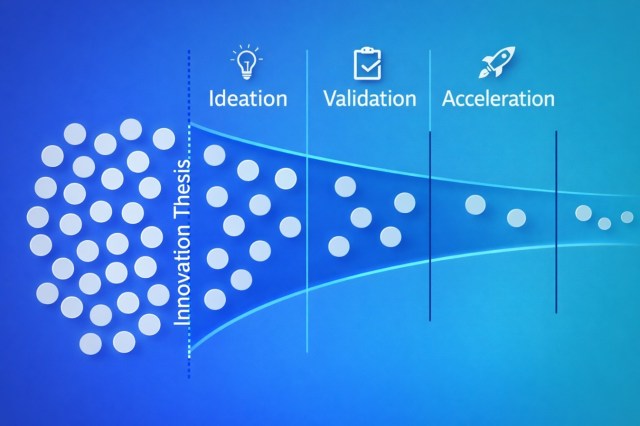
The Innovation Thesis is a filter: it decides which ideas enter the funnel.
Many funnels stop too early, producing a familiar outcome: a winning idea is incubated for a few months and then stalls because the “path to transfer” was never designed.
If your company has a commercialisation path, your funnel needs to connect end-to-end to:
- product roadmap / industrialisation
- go-to-market
- business unit adoption
Stage gates matter because they make “good” explicit. Each stage should define:
- the key questions to answer
- the hypotheses to prioritise
- expected evidence (lighter early; more stringent later)
- the decision options (fund / pivot / stop)
Innovation accounting: measure progress and decide
Innovation uses company resources, so progress and outcomes must be measurable. But using core-business KPIs too early can kill innovation prematurely.
Innovation accounting typically operates at three levels:
- Project progress (evidence-based learning): hypotheses validated and evidence quality
- Portfolio decisions: balance of types of innovation (incremental/adjacent/transformational), projects maturity distribution, strategic alignment with the company’s priorities and opportunity cost
- Impact: tangible impact (e.g., revenue, efficiencies, customer satisfaction) and intangible impact (skills developed, culture shifts, knowledge generated)
In addition, measure the system itself—because you can’t improve what you don’t measure (learning velocity, time-to-decision, conversion rates, transfer rate….).
Portfolio management is about ensuring good ideas/projects progress and avoiding:
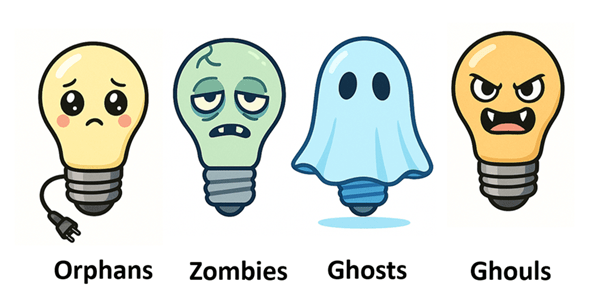
- Orphan: customers want the product, but the company won’t sell it
- Zombie: a project getting nowhere that refuses to die.
- Ghost: a project everybody has heard about, but nobody has seen it.
- Ghoul: we could say this is the cheater, for example a project that promises a breakthrough technology, a unique AI, but it is just prompting.
The combination of an Innovation Strategy and good portfolio management should prevent them all.