

In 2025, Telefónica and Airbus were honoured by Aerospace Tech Reviewwith the Collaboration of the Year award, an international award that recognises two or more companies whose collaboration has led to significant progress in the sector. The jury highlighted how both companies have combined their capabilities to transform the aerospace sector through the use of advanced 5G technologies, demonstrating the real impact of next-generation connectivity in complex and highly demanding industrial environments.
This international recognition underscores Telefónica’s role not only as a connectivity provider, but also as a strategic technology partner, capable of co-designing critical solutions alongside major industrial and defence players and taking them from the laboratory to operational deployment.
5G communication bubbles for defence and mission-critical applications
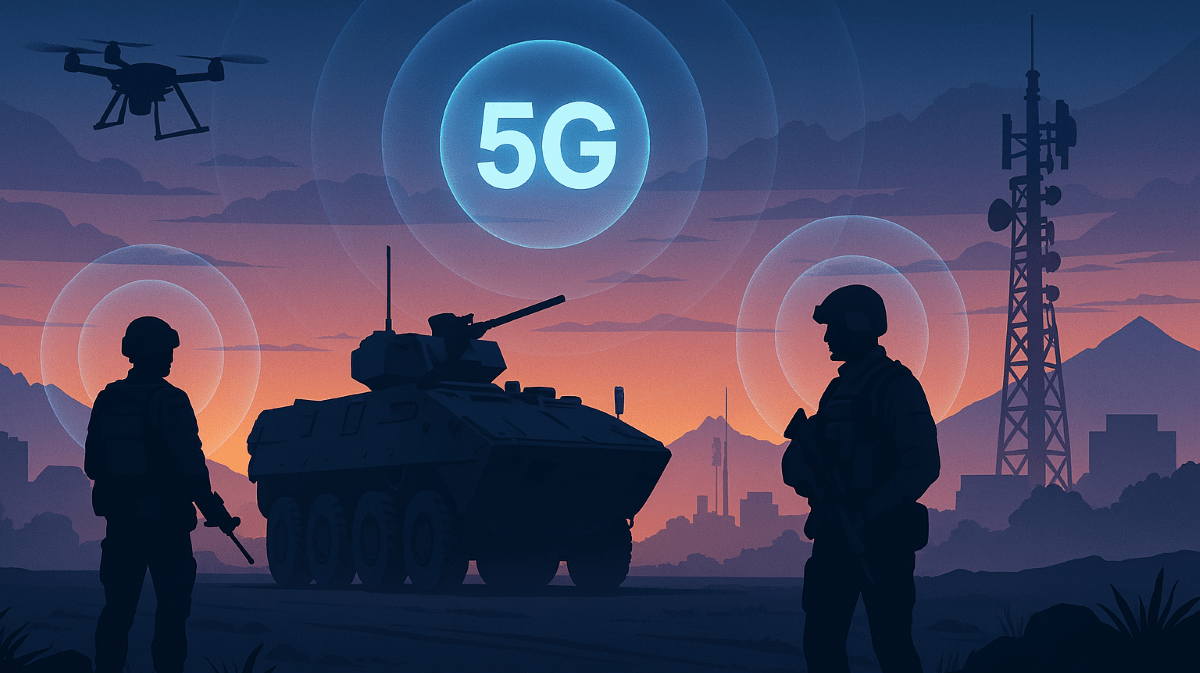
One of the concepts promoted by Telefónica is that of 5G communications bubbles: secure, resilient and autonomous connectivity environments that can be deployed wherever they are needed, even in degraded scenarios or without prior infrastructure.
These 5G bubbles enable advanced use cases in defence and mission-critical applications, such as:
- Real-time coordination between air, land and sea units
- High-quality live video transmission
- Secure voice and data communications
- Integration of drones, robots, sensors and surveillance systems
- Support for operations including emergencies, rescue and reconstruction
This is a paradigm shift: the network is no longer fixed and centralised, but has become a tactical, flexible, scalable and deployable capability, aligned with operational needs on the ground.
An unprecedented technological milestone: the first aerial 5G system
Among the most significant advances led by Telefónica is the deployment in November 2025 of the first aerial 5G bubble integrated on board a military aircraft (video), an unprecedented technological achievement achieved in collaboration with the Spanish Air and Space Force (EAyE) as part of the BACSI project. This project continues the proposals developed in 2024 for the implementation of communications and command and control systems, consolidating and expanding the capabilities tested at that time.
Thus, at the end of 2025, operational tests were carried out at the Albacete Air Force Base, concluding in the first airborne 5G system, integrated into an EAyE C-295 platform. The system was deployed and integrated with the rest of the aircraft’s communications by Telefónica España’s Defence and Security Engineering team.
During the trials, three independent 5G systems were successfully interconnected: the C-295 aircraft system, a terrestrial 5G system that provided service to an NH-90 helicopter, both deployed by Telefónica, and a third 5G system owned by the EAyE installed at the Maestranza itself.
The tests validated both air-to-ground and air-to-air links. In the first case, secure VoNR (Voice over New Radio) calls and video calls were made between users of the different systems using an application (Secret.T) developed by Telefónica. In the second case, real-time video transmission between the C-295 and C-101 aircraft was achieved.
All use cases were successfully completed, demonstrating that 5G technology acts as a key enabler of future operational capabilities and the efficient functioning of critical solutions.
This milestone makes Telefónica the first company to deploy private 5G communications on board a military aircraft, opening the door to new operational concepts in defence, security and emergency management.
This role is complemented by satellite connectivity capabilities such as those offered by the SpainSat 5G satellite in collaboration with Telefónica for the Armed Forces, extending coverage and redundancy in extreme environments.
When advanced connectivity becomes strategic infrastructure
Connectivity technologies are no longer merely a digital enabler, but have become a key strategic asset in defence, security and emergency management.
In this context, Telefónica has established itself as an essential player in the deployment of advanced communications, combining innovation, operational capacity and a deep understanding of mission-critical environments. Its private network capabilities, applied in industrial environments, extend to highly demanding critical scenarios.
The international recognition received in 2025, its contribution to the 5G air bubble application and its participation in the deployment of a private 5G network for NATO naval forces in the North Sea reflect a sustained track record of public-private collaboration and commitment to European security and technological autonomy.
Innovation, collaboration and technological sovereignty
As various European analyses emphasise, the continent’s defence and security begin with networks. Telefónica’s success in this area is based on three fundamental pillars:
- Applied innovation, with teams specialising in defence and security, with the capability to bring advanced technologies into the field. Working both internally and in collaboration with third parties, as demonstrated by the strategic agreement reached by Telefónica with NATO to make six of its R&D laboratories available under the DIANA initiative, starting in 2026, reinforcing its role as a key player in defence innovation and the development of advanced dual-use technologies.
- Public-private collaboration, working closely with the Armed Forces, state security forces, administrations and industrial partners. Both in national and international environments.
- Commitment to European technological sovereignty, focusing on interoperable, secure solutions that are aligned with Europe’s strategic interests.
The awards and examples shown reflect this consistent, long-term approach.
Beyond defence: advanced communications in emergencies and civil protection
The relevance of Telefónica’s capabilities goes beyond the field of defence. The technologies it develops and deploys have proven their value in highly complex civil scenarios, such as natural disasters and humanitarian crises, as well as in dual uses for industry, where advanced connectivity is key to security, competitiveness and operational continuity.
Added to all this are the services of the State Emergency Digital Radio Communications System in Spain, a key critical communications infrastructure based on Tetrapol technology currently migrating to broadband solutions, which guarantees encrypted voice and data, high reliability and national coverage for the State Security Forces and emergency services, ranking among the most advanced systems in Europe.
A key player in the critical missions of the future
Europe’s defence and security begin with networks. Telecommunications operators, and Telefónica in particular, are strategic players, responsible for deploying and operating secure, resilient and interoperable networks that are essential to society. Operators not only connect people, but also enable critical missions, protect key infrastructure and help save lives.
The challenge now is to scale up these capabilities, embed their relevance into public policy and ensure that connectivity and reliable, sustainable operators remain a strategic asset for Europe.