- Since 2019, World Braille Day has been celebrated every 4 January to commemorate the date on which Louis Braille, the creator of this reading and writing system for the blind, was born two centuries ago.
- Did you know that in 1909, a Spanish nun created a device known as the Regleta Sor so that blind children could write in Braille?
Since when has World Braille Day been celebrated?
At the end of 2018, the UN General Assembly—one of the main organisations of the United Nations—proclaimed 4 January as World Braille Day, with the first celebration taking place in 2019.
Resolution A/RES/73/161 specifies that the commemoration of this day stems from the idea of ‘raising awareness of the importance of Braille as a means of communication for the full realisation of the human rights of blind and visually impaired persons’.
The document also recalls that ‘the United Nations advocates multilingualism as a means of promoting, protecting and preserving the diversity of languages and cultures throughout the world, as well as increasing the efficiency and transparency of the Organisation and improving its functioning’.
Furthermore, it stresses that Braille ‘is a means of communication for blind people’ and ‘can be relevant in the contexts of education, freedom of expression and opinion, and access to information and written communication, as well as in the context of the social inclusion of blind people’.
Why is it commemorated on 4 January?
Although we will delve deeper into his life later on, Louis Braille was born on 4 January 1809, which is why the fourth day of the year was chosen to raise awareness of this means of communication and to remember the creator of the system.
What is Braille?
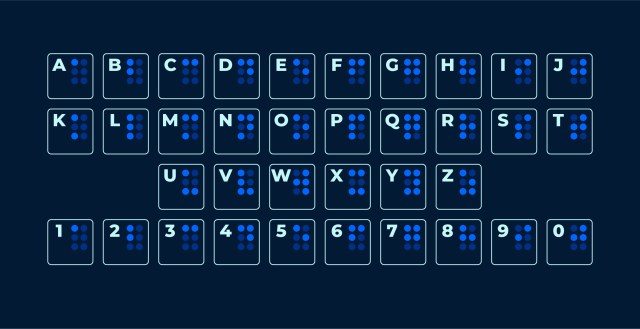
Braille, as defined by the United Nations on its international day website, is ‘a tactile representation of alphabetic and numeric symbols using six dots to represent each letter and number, and even musical, mathematical and scientific symbols’.
It is a system used by ‘blind or visually impaired people to read the same books and periodicals as those printed for visual reading and to ensure the communication of information important to them and others, representing competence, independence and equality’.
Why is it important?
The relevance of Braille lies precisely in this communication and in promoting the independence and equality of people with visual impairments or blindness, allowing this group to access culture, information and everyday procedures.
From the perspective of inclusion, this method has the advantage of being universally recognised and widely used in many public settings.
What is the origin of Braille?
Invented by Louis Braille in 1824, this system was a simplified adaptation of a military code of raised dots created by Charles Barbier de la Serre, whose original purpose was to enable soldiers to read messages in the dark.
Braille had been blind since the age of five after an accident at the age of three, and while he saw the potential of the ‘night writing and reading’ system, he also saw its limitations. Therefore, at the age of 15, Braille perfected Barbier’s code by reducing the system from 12 to 6 dots, making it much easier and faster for a blind person to read.
This system was officially adopted in his native France in 1854, and just over two decades later, in 1878, it became the international writing code for blind people.
Regleta Sor: a reading and writing device for the blind from 1909
One of the Spanish female inventors who is perhaps not very well known to the general public is María del Carmen Ortiz de Arce, a nun from the Order of the Daughters of Charity who, in 1909, created (and patented) a system to enable blind children to write in Braille.
This device, measuring 22 x 7 centimetres, was known as the Regleta Sor and has three lines with 25 larger-than-normal Braille cells, each of which has a rectangle.
This is complemented by a stylus for writing raised visual characters that are detectable not only by touch but also by sight.
As explained on the ONCE website—where one of these devices can be seen at the Typhological Museum in Madrid’s Tetuán district—‘the Regleta Sor could be used to write in Braille and Llorens systems and was one of several attempts to facilitate written communication between blind and sighted people.’
Telefónica and accessibility
In line with the recognition of digital accessibility as a key priority in the Convention on the Rights of Persons with Disabilities and the SDGs, the operator guarantees its customers access to information by adapting its communication and sales channels.
These adaptations include invoices, advertising and other information in Braille, large print or accessible electronic format.
The company also offers accessibility in call centres with communication through interpreters, accessibility in the mobile device catalogue, and training for developers, salespeople, and communication and marketing teams.