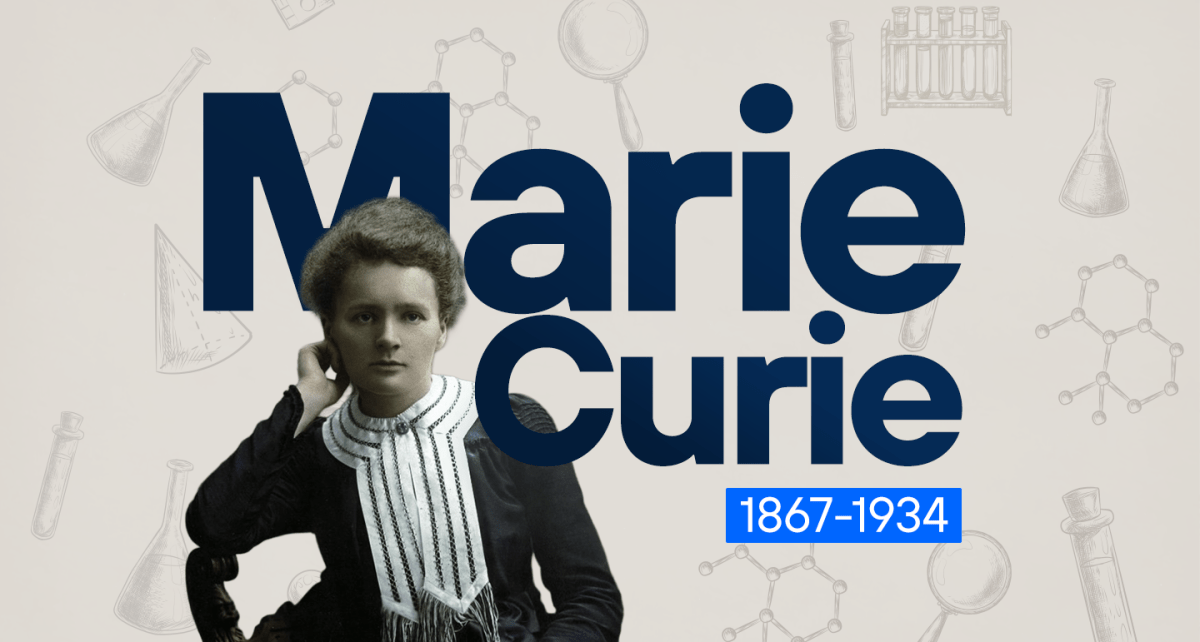

- Marie Curie was the first woman to receive a Nobel Prize, specifically in 1903 for Physics.
- In addition, in 1911 Curie made history as the first person to win the Nobel Prize in two categories: she added the 1911 prize in Chemistry to the one she had won in 1903.
Every 11th of February since 2016, International Day of Women and Girls in Science has been celebrated, which is why we are taking a closer look at the lives and work of some STEM role models who have gone down in history for their scientific achievements, such as Ada Lovelace and Hedy Lamarr.
In this article, we will learn more about Marie Curie (1867-1934).
Marie Curie: origins
Maria Salomea Skłodowska was born on 7 November 1867 in Warsaw into a family of five siblings, the youngest of whom was her father, a physics and mathematics teacher. Her parents were both educators, which is why her family environment promoted an interest in science and reading.
Her childhood was marked by the family’s financial hardship and the loss of her mother to tuberculosis and one of her sisters to typhus.
As women were not allowed to attend university in her native Poland, after several vicissitudes she moved to Paris in 1891, where she changed her name to Marie and enrolled at the Sorbonne University.
Marie Curie: from Poland to France. Scientific contributions
Her early years in France were marked by her academic achievements, graduating at the top of her class in physics (in 1893) and mathematics (in 1894).
In 1895, she married Pierre Curie, with whom she would work until his death in 1906.
Both with her husband and later on her own, Curie made history with numerous scientific milestones.
In relation to the theory of radioactivity, the Curies investigated the radiation emitted by uranium and, observing that other minerals also emitted radiation, deduced that there were unknown elements responsible for the phenomenon known as ‘radioactivity’, a term coined by Curie herself.
In 1898, the Curies discovered polonium (named after Marie’s homeland) and shortly afterwards radium (named for its high radioactivity), two chemical elements they found while working with pitchblende in their search for new radioactive substances.
Marie Curie: first woman to win the Nobel Prize (1903, Physics) and first person in history to win two Nobel Prizes (1911, Chemistry)
As a result of this research, in 1903 the Nobel Prize in Physics was awarded to Antoine Henri Becquerel and the Curies. The former was awarded for ‘the extraordinary services he has rendered by his discovery of spontaneous radioactivity’ and Pierre and Marie Curie for ‘the extraordinary services they have rendered by their joint research on the phenomena of radiation discovered by Professor Henri Becquerel’.
In line with this same research, Marie Curie alone received the Nobel Prize in Chemistry in 1911 ‘in recognition of her services to the advancement of chemistry through the discovery of the elements radium and polonium, the isolation of radium, and the study of the nature and compounds of this remarkable element.’
As a curiosity to these three Nobel Prizes awarded to the Curie family (two to Marie and one to Pierre), it should be added that one of their daughters, Irène Joliot-Curie, and her husband, Frédéric Joliot-Curie, won the Chemistry Prize in 1935 ‘in recognition of their synthesis of new radioactive elements’.
Decades after her death, in 1995 to be precise, Curie became the first woman to enter the Pantheon in Paris on her own merits, although the first woman was Sophie Berthelot in 1907, who was buried there to accompany her husband, Marcellin Berthelot.
Both the scientific advances of her research and the level of recognition she received have made Marie Curie an icon in the world of science.
Girls Love Tech
#GirlsLoveTech is an initiative by Telefónica that aims to share a passion for technology with younger generations through female role models from the company itself.
These female colleagues carry out activities with girls, young women and even university students with the aim of raising the profile of female talent and connecting women in the field.
Frequently asked questions
Marie Curie was born on 7 November 1867 in Warsaw.
Maria Salomea Skłodowska, later changing her name to Maria Salomea Skłodowska-Curie after her marriage to Pierre Curie.
She died on 4 July 1933 in the French town of Passy.
Curie died at the age of 66 from aplastic anaemia. It is suspected that this disease was caused by her high levels of exposure to radiation.
Curie was renowned for her studies in the field of radioactivity, discovering the elements radium and polonium.
Polonium is named in honour of Poland, the native country of Marie Curie, who discovered it together with her husband Pierre in 1898.
Marie Curie, who won the Physics Prize in 1903 alongside her husband Pierre Curie and Henri Becquerel for their studies on radiation. In 1911, she won the Chemistry Prize on her own for the discovery of radium and polonium.
It was also Marie Curie for Physics, which she won in 1903.
The first woman to enter the Pantheon in Paris on her own merits was Marie Curie in 1995, although the first woman overall was Sophie Berthelot in 1907, who was buried alongside her husband, Marcellin Berthelot.
The Curie family: in addition to Marie's two and Pierre's one, their daughter Irène Joliot-Curie and her husband, Frédéric Joliot-Curie, won the prize for Chemistry in 1935.
Marie Curie, following the research of Henri Becquerel.