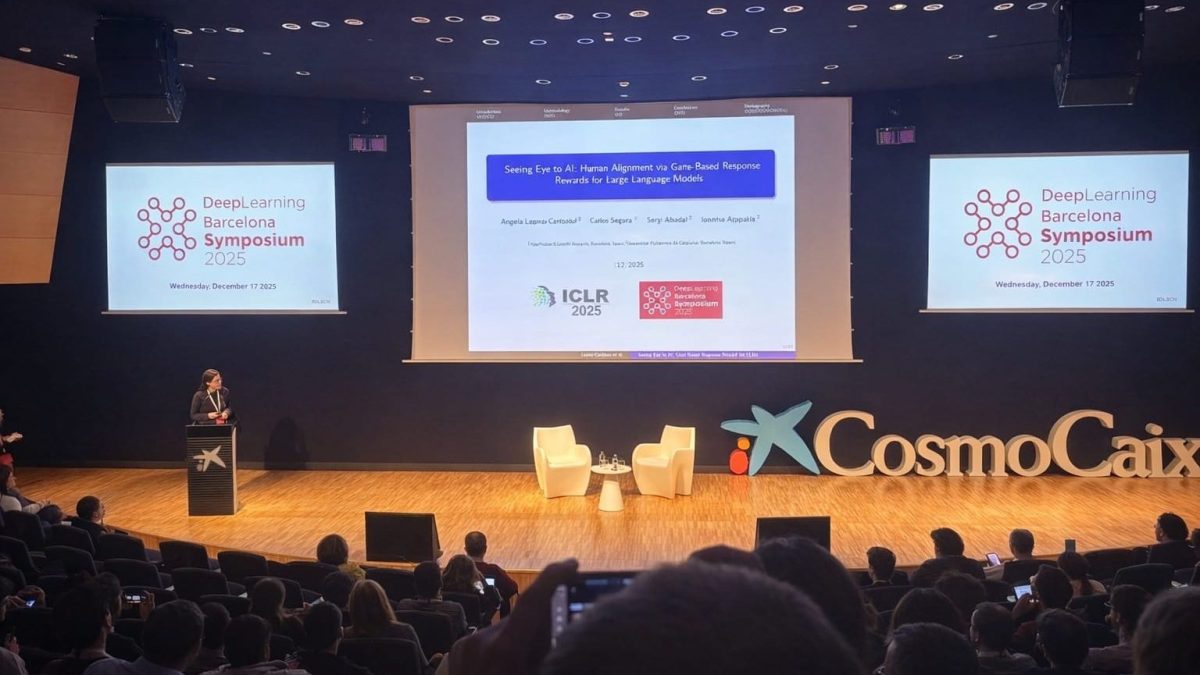

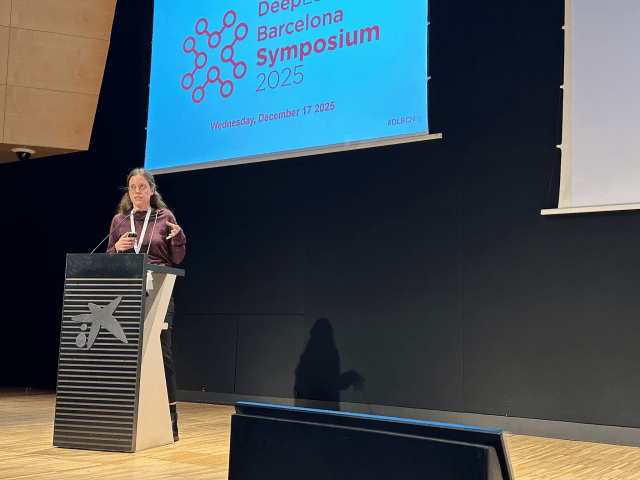
We were recently lucky enough to participate in the seventh edition of the Deep Learning Barcelona Symposium (DLBCN 2025), held at the CosmoCaixa Science Museum.
DLBCN has a very clear (and very necessary) objective: to raise the profile of deep learning research carried out by scientists with links to Barcelona; those who work here today or who have passed through the city at some point in their careers and, at the same time, to reinforce Barcelona’s role as an AI hub in the Mediterranean. In 2025, the symposium was also integrated into the ELLIS PRe-NeurIPS Fest for the first time, further connecting the local community with the European ecosystem of excellence in machine learning.
A programme designed to foster dialogue between deep learning researchers
One of the things we liked most about this edition is that the programme was designed to maximise interaction: 1 keynote, 6 invited talks, 9 spotlights and 99 posters. In fact, a new format was promoted in 2025: those accepted as spotlight+poster first presented 5 minutes in an oral session and then defended their work in poster format. And the response from the community was overwhelming: more than 345 attendees participated in the day, in an event that was also free thanks to sponsors, something that helps a lot to make access truly inclusive.
Deeplearning with impact: the value of dialogue between academia and industry
DLBCN is special because it brings together, without too much ceremony, people from multiple disciplines and also from multiple ‘houses’: universities, research centres and industrial laboratories. In the organisation and the programme we saw the participation of profiles and teams linked to Amazon, Apple, Sony AI, AstraZeneca, and a keynote from NVIDIA. The invited sessions also included Google DeepMind and Meta, along with other academic and scientific institutions.
This balance was also noticeable in the corridors: conversations that start with a methodological question, continue with an ethical concern (there was a panel on AI Governance and the EU AI Act) and end with how we translate all this into useful, evaluable and accountable systems.
Telefónica Innovación Digital’s contribution to DLBCN 2025
From the Telefónica Digital Innovation team we arrived with a particularly strong presence. We presented five papers, one of them also in spotlight format, focused around two axes that matter a lot to us: (1) how to align models with real human signals and (2) how to better understand the variability of people when interacting with intelligent systems.
The work we shared was linked to these papers:
- OASST-ETC Dataset: Alignment Signals from Eye-Tracking Analysis of LLM Responses (PACMHCI, ACM ETRA 2025)
- Brain-Language Model Alignment: Insights into the Platonic Hypothesis and Intermediate-Layer Advantage (JMLR / UniReps 2025)
- Seeing Eye to AI: Human Alignment via Gaze-Based Response Rewards for Large Language Models (ICLR 2025) – also presented as spotlight
- Beyond Clicks: Eye-Tracking Insights into User Responses to Different Recommendation Types (RecSys 2025)
- Beyond One-Size-Fits-All: A Study of Neural and Behavioural Variability Across Different Recommendation Categories (ICTIR 2025)
Beyond the titles, what was valuable was the feedback: tough questions, practical suggestions and, above all, confirmation that there is a growing community interested in person-centred metrics and signals, not just benchmarks.
With an eye on 2026
None of this happens without collective work. Thanks to the Telefónica Scientific Research team for pushing research that combines scientific ambition with methodological care, and for doing so with generosity in discussion.

We close 2025 with renewed energy and new partnerships on the horizon. If DLBCN makes one thing clear, it is that when the community comes together, in an auditorium and around a poster, progress naturally accelerates.
See you at DLBCN 2026.