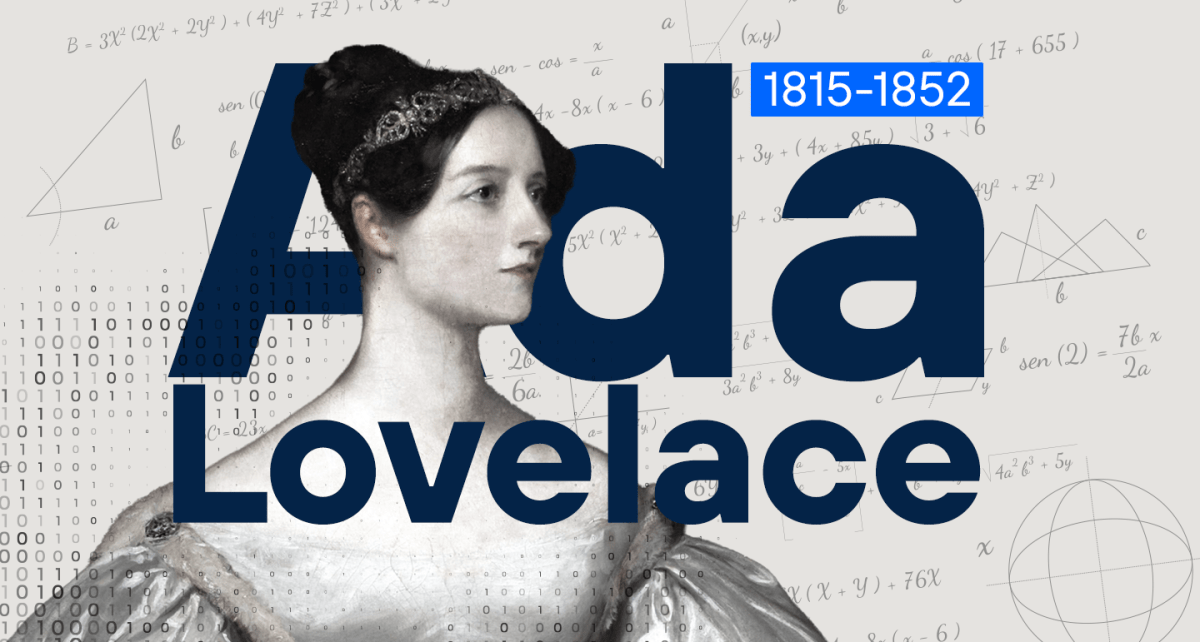

- Lovelace was a student of Mary Somerville, a renowned Scottish scientist and astronomer.
- She is also known for being the daughter of the famous Romantic poet Lord Byron.
Her relationship with programming came about when she studied the Analytical Engine of 1837, designed by Charles Babbage.
On the occasion of the International Day of Women and Girls in Science, we are going to take an in-depth look at some leading women in these fields, such as Ada Lovelace.
But first, let’s learn a little more about this day.
International Day of Women and Girls in Science
In resolution A/RES/70/212 of 22 December 2015, the UN General Assembly—one of the main bodies of the United Nations—approved the proclamation of this international day on 11 February, with the first edition taking place in 2016.
The document recognises that ‘women and girls play a vital role in the scientific and technological communities and that their participation should be strengthened’.
The resolution also commends the initiatives carried out by UNESCO, the United Nations Entity for Gender Equality and the Empowerment of Women (UN Women), the International Telecommunication Union (ITU) and other relevant organisations to support women scientists and promote access to education, training and research for women and girls.
Ada Lovelace: origins
The importance of Ada Lovelace (1815-1852) is such that she even has her own day: Ada Lovelace Day, a day that has been held on the second Tuesday of October since 2009 to raise awareness of the work of women in STEM (science, technology, engineering and mathematics).
Although she has gone down in history as Ada Lovelace, her birth name was Augusta Ada Byron, the only legitimate daughter of the famous poet Lord Byron and Anne Isabelle Milbanke, also known as Ada Byron or Ada Byron Lovelace.
Ada was born on 10 December 1815 into a wealthy family, which is why she was able to receive an education that was unusual for a woman of that time.
Through various governesses, mentors and teachers, she received a strict education that included subjects as varied as languages (French, German, Greek and Latin), music, history and, of course, mathematics and science.
This education focused on scientific subjects to ‘counterbalance’ the poetic or bohemian side of her father, with whom she had little contact since, when she was still a baby, her mother and she left Byron, whom Milbanke threatened to expose for his extramarital affairs.
Scientific vocation: relationship with Mary Somerville
In addition to this counterbalance to her father’s interests, Milbanke also promoted her daughter’s education due to her health problems, which forced her to be bedridden for months when she was seven and fourteen years old, respectively, in the latter case due to complications from a severe case of measles.
Her mother’s desire to give her the best scientific education led her to hire the prestigious Scottish mathematician and astronomer Mary Somerville.
This woman was known as the Queen of Science and was also the first person to be described as a ‘scientist’ (although the English term does not differentiate between men and women engaged in science) in the press in 1834.
But returning to Ada Lovelace, in addition to all the learning derived from the mentor-student relationship, Somerville also had an indirect influence on what would become her most recognised scientific achievement, that of being the first programmer in history.
It was at a high society party organised by Somerville that Lovelace met the mathematician Charles Babbage.
Relationship with Charles Babbage: from a calculator to something bigger
This encounter led to a lifelong friendship and collaboration, with Babbage being a renowned mathematician who had designed a mechanical calculator that could calculate tables of numerical functions using the method of differences. The Analytical Engine, from 1837.
In other words, the inventor of the first mechanical device capable of performing calculations, a scientific development that arose under the premise of eradicating human errors in calculations derived from causes as varied as fatigue, boredom or overexertion.
As explained by UNESCO on its website, Lovelace was fascinated by this analytical machine and envisioned a range of possibilities that went beyond calculation. Where the mathematician saw a powerful mechanical calculator, she saw a machine with greater capabilities and diverse possibilities, such as composing music, analysing systems, or modelling abstract ideas.
This intuition led her to anticipate the concept of the programmable computer by almost a century.
The Italian mathematician Luigi Menabrea analysed Babbage’s machine in 1842, and Lovelace translated it into English a year later. In her translation, she took the opportunity to introduce a series of notes that tripled the length of the original text and included what is considered to be the first published computer program: an algorithm designed to enable the Analytical Engine to calculate Bernoulli numbers.
Although it is true that her scientific contributions received little recognition at the time, they were rediscovered in the mid-20th century with the development of electronic computers.
For all these reasons, Ada Lovelace has become one of the great female role models in the STEM world.
Girls Love Tech
#GirlsLoveTech is Telefónica’s community of STEAM professionals whose goal is to connect their talent, knowledge and experience with girls and young women. More than 200 Telefónica professionals and experts in the fields of humanities, engineering, entrepreneurship, mathematics, science and technology make up this community, which is determined to increase young female students’ interest in scientific and technological studies.
In its five years of existence, it has carried out more than 300 activities in which more than 8,000 girls and young women between the ages of 12 and 22 have participated.
Frequently asked questions
On 10 December 1815, in London.
On 27 November 1852, also in London.
They were father and daughter. In fact, her birth name was Augusta Ada Byron.
She is considered to be the first programmer in history.
As mentioned above, she was the daughter of the poet Lord Byron, although they had little relationship.
Every second Tuesday in October, since 2009.
The Scottish scientist Mary Somerville was Lovelace's teacher and introduced her to Charles Babbage.