Telefónica’s extensive knowledge of 5G use and its experience in military applications in more than 15 field trials have led the operator to become the leading reference for this technology within NATO.
Telefónica’s track record in the creation and deployment of multi-domain 5G tactical bubbles—by land, sea, air, and cyberspace—has resulted in the launch of the first “Center for Development, Training, and Testing for Military Operations in Cyber Defense with 5G Technology” (5G Cyber Defense Center) in Europe, in collaboration with the Spanish Ministry of Defense, whose technological solutions will be included in one of NATO’s projects at the end of this month.
Javier López Gutiérrez, Director of Defense and Security at Telefónica Spain, states: “In 2026, we are consolidating all the efforts we have been making since 2022 to position ourselves as a benchmark in 5G in the field of Security and Defense, both in Spain and in the European Union and NATO. With this 5G development and testing center, geared towards an international organization of the size of the Atlantic Alliance, our armies and navy are becoming an authority in promoting not only hyperconnectivity, but also other cutting-edge enabling technologies such as AI, edge computing, and quantum computing for their benefit. All of this has allowed Telefónica to consolidate its position as a leader in the deployment of next-generation communications, combining innovation, operational capacity, and extensive experience in mission-critical environments.
Spain’s contribution to European technological sovereignty
The 5G Cyber Defense Center, developed by the operator together with the Armed Forces Joint Cyberspace Command (MCCE) located in the Community of Madrid, will be integrated into NATO Digital Foundry, an innovative Alliance initiative that tests cutting-edge solutions from the defense industry of member countries using NATO’s own data to test them and expand their use in the military environment.
This center protects communications between different assets of the Ministry of Defense, such as radars, drones, weapons systems, barracks, and even combatants themselves. It also develops use cases in operational areas, allowing for the assessment of the strengths and areas for improvement of 5G when applied to an environment as demanding as defense. Research and development work is also carried out here, as well as training for Armed Forces personnel. In addition, the Center incorporates the study of AI tools to detect and prevent cyberattacks in advanced environments such as 5G tactical bubbles with multiple nodes.
The 5G Cyber Defense Center has been chosen by NCIA—NATO’s Communication and Information Agency—to join its NATO Digital Foundry initiative, a pioneering program that establishes an open and secure innovation platform for NATO member countries and entities to develop, test, and scale emerging and disruptive technologies at all stages.
To this end, NATO Digital Foundry provides the basic data infrastructure, tools, expertise, and testing environments necessary to channel technological advances in the coming years and create new standards that will keep Alliance countries at the forefront of the various digital threats that arise.
Pioneers in 5G tactical bubbles
Telefónica has completed its deployment of 5G tactical bubbles in all environments where the armed forces operate—air, sea, land, space, and cyberspace—demonstrating the benefits of next-generation connectivity in complex and highly demanding environments.
In this regard, Spain’s first aerial 5G bubble was recently incorporated into a military aircraft at the Albacete Air Base, giving rise to the first airborne 5G system, a deployment for the Air and Space Force, which has been added to those previously carried out by sea, land, and space. This pioneering use case was developed with partners within the framework of the BACSI project (Connected, Sustainable, and Intelligent Air Base), an initiative of the Air and Space Force to evolve aerodromes through disruptive technologies and infrastructures that improve their efficiency while making them more sustainable and secure.
The 5G tactical bubble was deployed by integrating it with the aircraft’s other communications systems, which included three land-based 5G systems, and was loaded onto an Airbus transport aircraft. To test the technology’s effectiveness, VoNR (Voice Over New Radio) radio calls and video calls were made, ensuring secure communications between users and the interoperability of different systems, including real-time video transmission between two different aircraft participating in the exercise.
This milestone, which confirms that Telefónica has established itself as a key player in the deployment of advanced communications, follows on from the pilot project carried out by the operator at the end of 2025 on a real mission involving a ship from the Alliance’s Standing Naval Forces under NATO Maritime Command. For four months, the operator, in collaboration with a network of partners, deployed a 5G node on board an Alliance ship to connect it with the rest of the group, including unmanned units, to establish secure, ultra-fast, low-latency communications with the various naval units without the need for public networks or satellite connections throughout the fleet.
Other notable examples of Telefónica’s use of 5G include the incorporation of this technology in combat vehicles, the integration of 5G bubbles with public networks and government satellite communications, and participation in events involving several countries, such as the NATO DiBaX exercise, which enabled NATO to establish itself as a provider of 5G services between different countries, facilitating multi-domain operations.
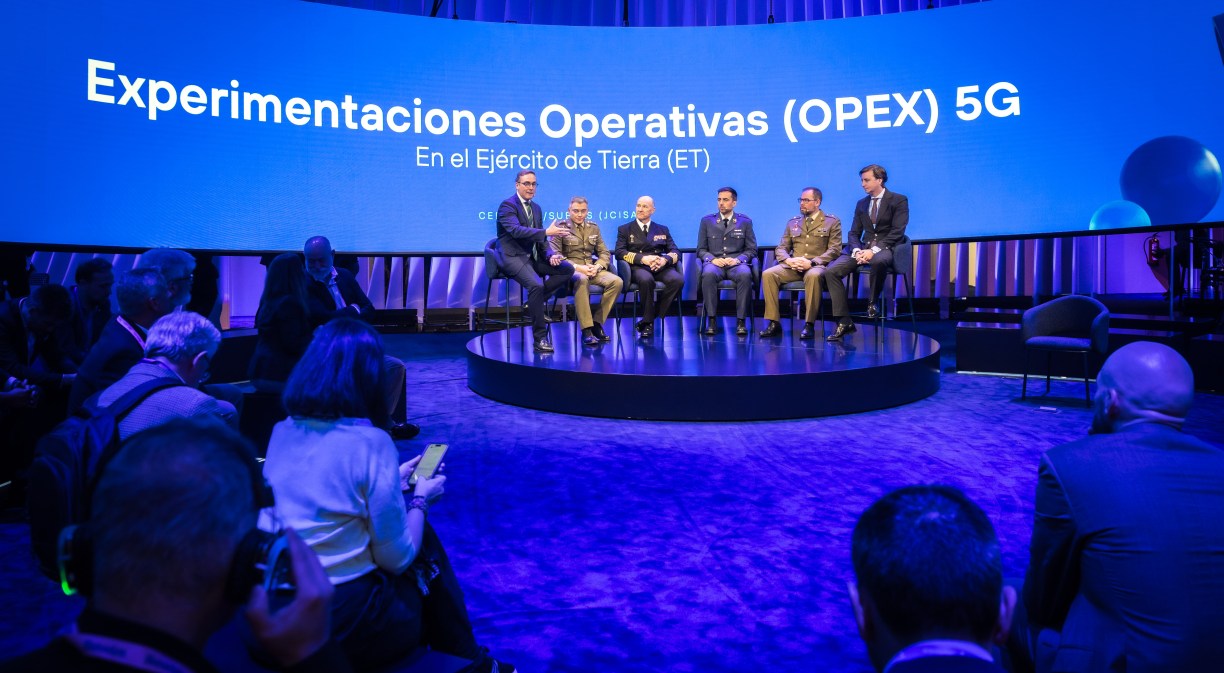
At the Mobile World Congress (MWC) being held this week in Barcelona, these advances were showcased during the session ‘5G Operational Experimentation: Defense and Innovation in the era of Dual-Use Technologies’, which took place at Telefónica’s Agora and was led by Jesús Abraham, Director of Defense Innovation at Telefónica Spain, and Carlos de la Cuesta, Director of Defense Programs at Telefónica Spain.
For more information:Mobile World Congress 2026: all the information – Telefónica