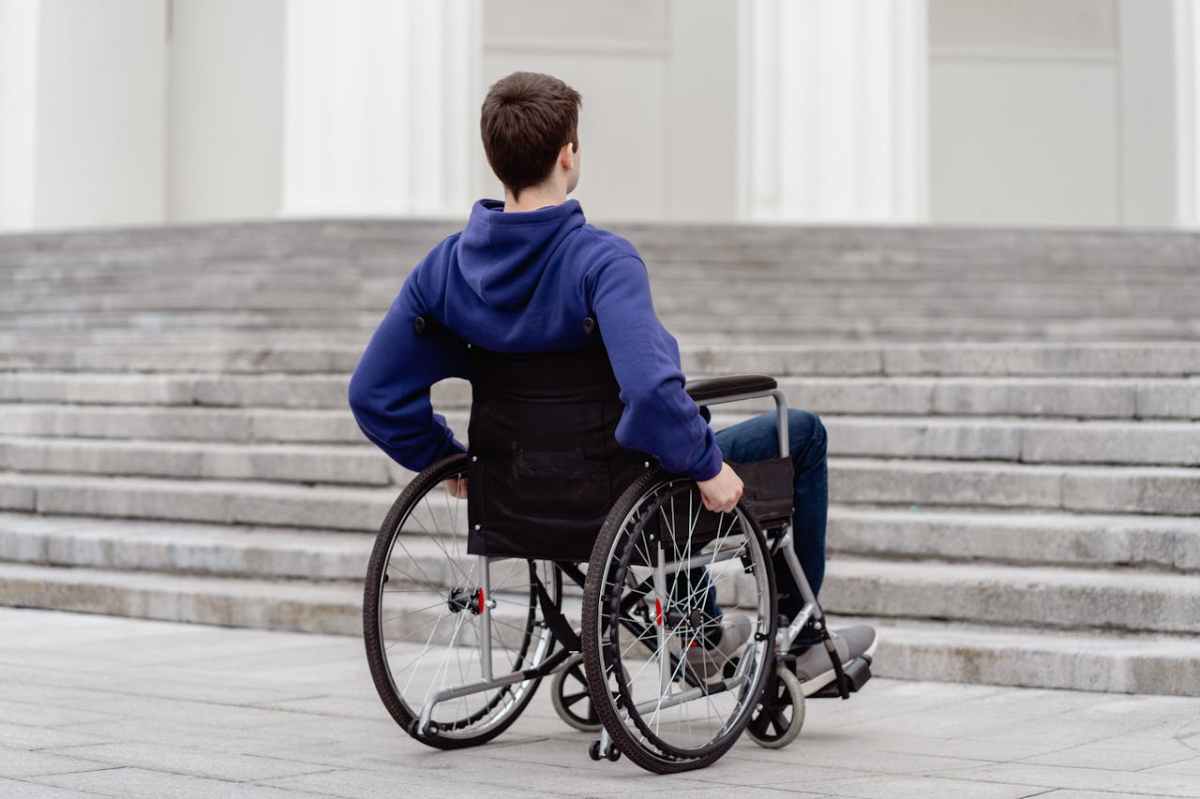

- Accessibility involves both removing barriers and promoting the inclusion and participation of all people in all social matters, encouraging the independence and autonomy of all individuals.
- Accessibility is not exclusive to physical environments: it also refers to the digital realm.
What is the definition of accessibility?
Although the definition of accessibility given by the RAE is quite succinct, ‘the quality of being accessible’, the three meanings of this adjective give us a clearer idea of what this term refers to:
- Having access.
- Easy to access or use.
- Easy to understand, intelligible.
Going into greater detail, the definition of accessibility given by the Pan-Hispanic Dictionary of Legal Spanish is ‘the condition that environments, products and services must meet in order to be understandable, usable and practicable by all citizens, including persons with disabilities’.
Accessibility as a fundamental principle
As explained by the United Nations office in Geneva, accessibility ‘is a fundamental principle that guarantees equal access and inclusion for all people’.
For this reason, this UN body advocates ‘removing barriers to facilities, services and information’, something it considers ‘essential for the full and effective participation of persons with disabilities in society’.
Eliminating these physical, cognitive or sensory barriers begins with identifying those obstacles, whatever their nature, that hinder or prevent access to goods, services, environments or information. Once these impediments have been identified, the next step is to remove them.
Accessibility as a fundamental principle also has to do with inclusion and participation, allowing persons with disabilities—whose day is commemorated on 3 December—or other limitations to have the ability to participate in any aspect of social life, just like any other person.
Accessibility also relates to the ideas of autonomy and independence, enabling everyone to live and function independently at all levels.
Where does accessibility apply?
The application of accessibility goes beyond physical environments, which may be the most obvious: the digital environment must also be accessible.
On the physical level, on the one hand, we find urban accessibility, which is linked to outdoor spaces for public use. On the other hand, architectural accessibility has to do with the possibilities of access and mobility inside buildings.
Public transport is another example of physical accessibility, which also includes private transport, with adaptations not only inside vehicles but also outside. An example of this is reserved parking spaces, which are free of obstacles that could hinder entry and exit.
Moving on to the digital realm, the information society and telecommunications cannot be left out and must guarantee the accessibility of websites, applications and digital systems.
Both the physical and digital realms converge on certain issues of fundamental importance, such as access to and dialogue with public administration, or participation in public life in general, in areas as diverse as access to employment and participation in electoral processes.
Responsible digitalisation for a fair society
Telefónica’s Digital Inclusion Report shows the operator’s commitment to a digital revolution that must be inclusive, secure and generate opportunities.
One of the five basic pillars of the report is related to accessibility, as well as affordability and coverage, with all three concepts referring to inclusive access.
As proof of this, the company has brought fibre optics (FTTH) to more than 85 million homes and achieved 92% 4G coverage.
Similarly, the operator offers social tariffs and promotes accessibility, confirming its commitment to making technology and digital services available to everyone.