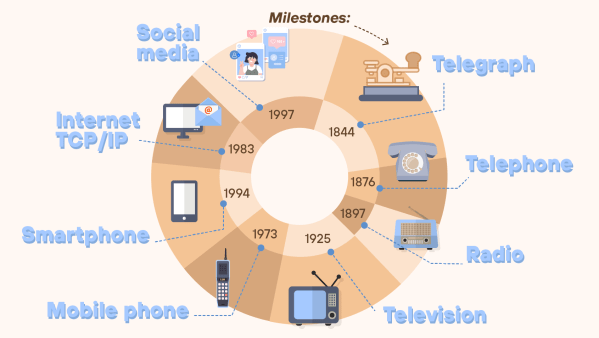


- Telecommunications refers to the ability to send and receive information over a distance using technology.
- The main components of telecommunications are the sender, the receiver, the channel or means of transmission, and the message.
- The telecommunications sector faces several challenges in various areas such as regulation, infrastructure development, and security.
Telecommunications is the set of systems and technologies that enable both the transmission and reception of information, whether images, data, or videos.
This remote exchange of information occurs through the use of different media such as cables, fibre optics, electromagnetic waves, or satellites.
The purpose of telecommunications is precisely this electronic exchange, and it forms the basis of essential everyday services such as the Internet, telephony and television.
In addition to explaining what telecommunications consists of, in this article we will also analyse some of the challenges it faces with the advancement of technology.
Components of telecommunications
The basic or main components of telecommunications are the sender, the receiver, the channel and the message.
The sender is the source of information, which can be a person or a device such as a computer or mobile phone, and whose function is both to prepare and send the message through the appropriate channel.
The receiver is the person or device that receives and processes the information sent by the sender.
The channel or means of transmission that carries the information from the sender to the receiver can be either the physical channel or the medium through which the data travels. This form of transmission can be wireless or wired.
Once we know who is sending, who is receiving and how this communication is carried out, we still need to know what is being sent. A message can be sent in analogue or digital form and can be text, voice or video.
To these components we could also add protocols, understood as the set of rules that regulate how communications are carried out, including issues such as encryption, speed, and compatibility between different devices.
Challenges in telecommunications
Telecommunications face multiple challenges as time has progressed and, with it, technological capabilities.
From a security perspective, challenges arise in the form of cyberattacks (with the resulting economic and reputational losses they can cause) and data privacy.
The advancement and emergence of new technologies means that telecommunications must adapt and integrate the Internet of Things (IoT), “new” realities such as virtual, augmented and mixed reality, and artificial intelligence, requiring, for example, more powerful and scalable networks.
Linked to this issue, we must also point out the expansion of infrastructure as one of the challenges facing telecommunications, requiring investment in fibre optic networks, 5G or satellites to improve and guarantee coverage, facilitating its arrival in remote areas, or to make the massive increase in traffic viable, as is the case, for example, in network management at large events.
Regulatory requirements can also be included in the category of challenges, sometimes requiring telecommunications companies to invest to adapt to regulatory standards that may exist at different administrative levels.
Telecommunications regulation
In an article on our blog about what regulation is, we use the example of telecommunications to distinguish between ex ante and ex post regulation, with the difference between the two types being whether or not a market is competitive.
If it is understood that it is not, the regulation requires certain companies already operating in that market to allow new entrants to meet certain requirements to make it easier for them to do so and for the market to be truly competitive. However, if it is understood that it is, these prior requirements no longer exist, and the