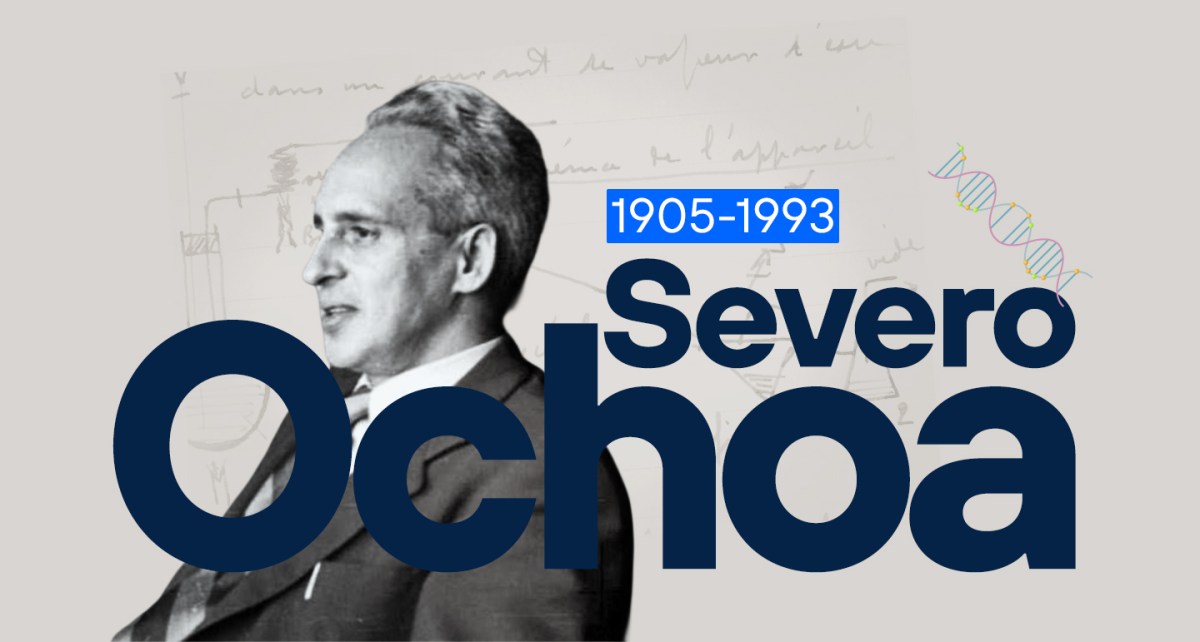

- Severo Ochoa received the Nobel Prize in Medicine in 1959, becoming the second—and so far the last—Spanish scientist to receive it in history.
As part of World Health Day, which has commemorated the birth of the World Health Organisation two years earlier since 1950, we are going to remember some important figures in this discipline.
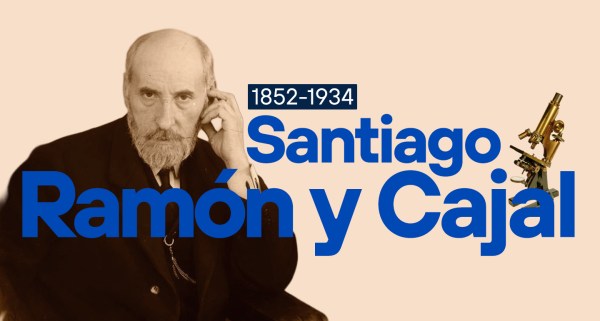
In a previous post, we took an in-depth look at the life and career of Santiago Ramón y Cajal. This time, we will do the same with the other Spanish scientist who has won the Nobel Prize in Medicine: Severo Ochoa (1905-1993).
Severo Ochoa’s origins and childhood
Severo Ochoa de Albornoz was born in the Asturian town of Luarca on 24 September 1905, the youngest of seven siblings. In 1912, the family moved to Malaga following the death of his father and on medical advice for his mother.
After studying in the Andalusian city, in 1922 he moved to Madrid to study at the Faculty of Medicine of the University of Madrid (the precursor to the current Complutense University).
Severo Ochoa’s training and education
The truth is that Ochoa had no intention of practising medicine, but at that time it was the best way to train as a biologist, as stated on the website of the Spanish Society of Biochemistry and Molecular Biology.
The Asturian scientist was enthusiastic about the work of Santiago Ramón y Cajal. His desire was to study neurohistology under his supervision, which never happened as Cajal retired shortly before he could take the course.
This did not mean that Ramón y Cajal was not a major influence on Ochoa’s scientific career.
As stated on the Complutense website, Ochoa graduated in medicine in 1928 and obtained his doctorate in 1933.
He completed his training abroad thanks to scholarships from the Board for the Extension of Studies, which took him to Germany –to the Kaiser Wilhelm Institut für Medizinische Forschung under the direction of fellow Nobel laureate Otto Meyerhof, specialising in muscle biochemistry – and to Scotland and England, studying brain metabolism at the University of Glasgow and in London respectively.
Severo Ochoa’s professional career
Severo Ochoa’s professional career was initially marked by his mentor Juan Negrín, who would become president of the government during the Second Republic, at the School of Physiology in Madrid, where the Canarian politician and doctor was a professor.
There, Ochoa trained in muscle metabolism before the Civil War, and it was Negrín himself who facilitated his exile in 1936.
Settling in the United States, where he would eventually obtain citizenship, he worked at the University of Washington and later at New York University (NYU), where he was head of the biochemistry department until his retirement in 1975.
Among his scientific advances, it is noteworthy that in 1955 he isolated polynucleotide phosphorylase, a key enzyme in RNA synthesis, laying the foundations for deciphering the genetic code.
Advances in DNA and RNA are precisely what led him to win the Nobel Prize in Medicine, as we shall see below.
In 1985, he returned to Spain to the Severo Ochoa Molecular Biology Centre in Madrid, where he died in 1993.
1959: Nobel Prize in Medicine
In 1959, the second—and, to date, last—Nobel Prize in Medicine was awarded to Spanish scientists.
Severo Ochoa received the award in this discipline together with the American Arthur Kornberg ‘for their discovery of the mechanisms of biological synthesis of ribonucleic acid and deoxyribonucleic acid’.
Severo Ochoa referred to the only Spaniard who had preceded him in receiving this illustrious distinction in his acceptance speech in Stockholm on 10 December of that year, a person for whom he felt professional admiration, as we mentioned earlier, and who was one of the reasons why he studied medicine.
‘Being originally from Spain, a country to which I owe much of my education and cultural training, I was deeply influenced by my great predecessor Santiago Ramón y Cajal. I entered medical school too late to receive his teachings directly, but through his writings and example, he contributed greatly to awakening my enthusiasm for biology and crystallising my vocation.’
In his speech, he also acknowledged that he could not find ‘the right words’ to express his appreciation for ‘the great honour.’ He summed it up as ‘the greatest honour a scientist can receive,’ while considering himself ‘very happy to share it with my former colleague, my friend of many years, Arthur Kornberg.’
Frequently asked questions
On 24 September 1905 in the Asturian town of Luarca, Spain.
On 1 November 1993 in Madrid, at the age of 88.
This Spanish biochemist and molecular biologist, who also became a naturalised American citizen, is renowned for his discoveries on the mechanisms of biological synthesis of ribonucleic acid (RNA) and deoxyribonucleic acid (DNA).
Two, both in Medicine or Physiology. The first was Santiago Ramón y Cajal in 1906. The second was Severo Ochoa in 1959.
The Spaniard Severo Ochoa, together with the American Arthur Kornberg, ‘for their discovery of the mechanisms of biological synthesis of ribonucleic acid and deoxyribonucleic acid’.
Ochoa admired Ramón y Cajal's work, although he never became his student because Cajal retired before Ochoa could enrol in his course. They are also the only two Spanish scientists to have received a Nobel Prize.