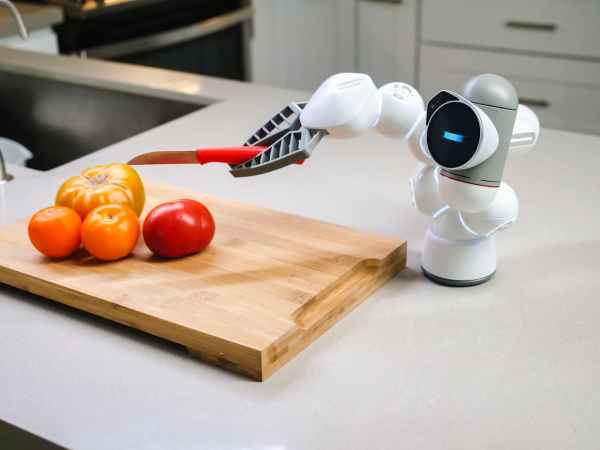


- What does the term robot have to do with a play written in Czech in 1920?
- Isaac Asimov was the first to talk about robotics when he set out his famous laws.
Origin of the term
Before analysing the history of robotics, it is interesting to note that the term itself dates back to the 20th century. Specifically, the term robotics was coined by Isaac Asimov in his laws.
Asimov took the term robot as the origin for this discipline, a word derived from the Czech ‘robota’, which could be translated as ‘forced labour’ or ‘servitude’.
The relationship between this word and its current meaning arose from the 1920 work R. U. R. (Rossum’s Universal Robots) – originally R.U.R. (Rossumovi univerzální roboti)—by Karel Čapek (1890-1938), who introduced this name to refer to artificial humans created by a company to lighten people’s workload.
The playwright credited the authorship of the term with this application to his brother Josef Čapek (1887-1945), a multifaceted artist who excelled like Karel in the field of literature, but also in drawing and painting. Paradoxically, famous for coining a term translated as ‘forced labour’ or “servitude”, he ended his days in the Nazi concentration camp at Bergen-Belsen.
Robotics in ancient history
As we have just seen, the term robotics dates from the 20th century. Previously, the term automaton was used, a term derived from the Greek: ‘That which moves by itself’.
It is precisely in Greece that the use of mechanical devices that imitated the movements of living beings is considered to have begun. Although some even place the use of automatons for different purposes, such as recreational, religious or practical, in Ancient Egypt.
There are also examples of automata in the ancient cultures of Ethiopia and China, such as a statue of King Memon in the former, which emitted sounds when illuminated by the sun, and a flying magpie made of wood and bamboo and a jumping wooden horse invented by King-su Tse in 500 BC.
Automation in the Industrial Revolution
The Industrial Revolution was accompanied by the automation of some processes, although these examples are quite different from how we conceive of robotics today.
However, James Watt’s steam engine, which replaced manual and animal labour, allowing machines to operate with greater capacity and efficiency, and the mechanical loom, which enabled the rapid production of fabrics and paved the way for large-scale production, were steps forward in the advancement of industrialisation and the automation of processes.
As we can see, the automatons of this historical moment were mechanical machines which, although very distant even conceptually from the sophisticated industrial machinery that operates today, represented a great advance at the time.
20th century: modern robotics
In both the recreational and industrial spheres, the 20th century saw the arrival of numerous milestones in robotics (beyond, as we mentioned earlier, the official adoption of this term to refer to this discipline).
An example of the former could be the multifaceted Spanish inventor Leonardo Torres Quevedo, creator, among other things, of the world’s oldest aerial tramway, which is still in operation today at Niagara Falls.
In the field of robotics, Torres Quevedo built El Ajedrecista (The Chess Player) in 1912, an automaton considered to be the first capable of playing chess in history, an experimental model presented in Paris in 1914. In 1920, he made another version with notable improvements in its presentation, although no changes were made from an automatic point of view.
Industrial robotics
In the industrial field, George Devol and Joseph F. Engelberger are considered the fathers of robotics applied to this discipline and some of the most prominent figures in robotics.
Founders of Unimation, considered the world’s first company to develop robotics, they also developed a 1,800-kilogram industrial device whose function was to lift and stack large pieces of hot metal. It was sold to General Motors, prompting other automotive companies, such as Ford and Chrysler, to also incorporate this technology in the 1960s.
Other notable names in industrial robotics include Victor Scheinman (inventor of the Stanford arm, a fully electric, six-axis articulated robot, a technology for the use of robots in assembly and welding) and Takeo Kanade (famous for having built the first robotic arm with motors installed directly in its joint in the 1980s).