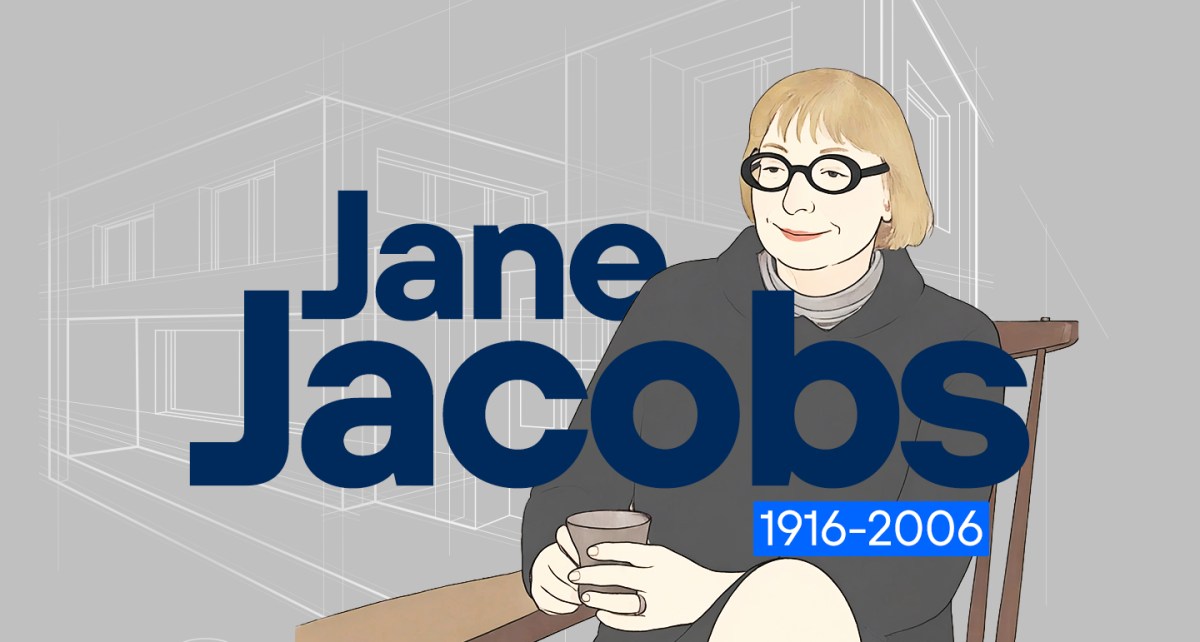

- Jacobs led a neighbourhood fight against the demolition of parts of New York neighbourhoods such as Soho, Little Italy and the Village for the construction of a ten-lane motorway.
When it comes to mobility, urban development and planning have a major impact. In this regard, urban planner Jane Jacobs (1916-2006) was a leading figure, with a particular influence and direct impact on New York.
Jane Jacobs’ origins
Born and raised in the city of Scranton, Pennsylvania, on 4 May 1916, Jacobs was influenced by her childhood in this town, with its strong mining and industrial roots. In fact, at the end of the 19th century, it was known as the Anthracite Capital of the World.
This experience of the first part of her life in an industrial city, coupled with her observation of the neighbourhoods of New York—where she later settled—developed her vision of the importance of community life and urban diversity.
After working for the local newspaper in her hometown, she moved to the Big Apple, where she juggled various jobs as a stenographer and freelance writer, which led her to get to know the city in depth.
Jacobs and Greenwich Village
Although she originally settled in Brooklyn, she later moved to Greenwich Village, a historic neighbourhood in southern Manhattan that might have changed significantly in structure and composition had it not been for the neighbourhood struggle led by Jacobs.
Urban planner Robert Moses, known in the 1950s and 1960s as New York’s ‘master builder,’ proposed the Lower Manhattan Expressway (LOMEX), a ten-lane highway whose construction would have involved the demolition of numerous residential and commercial buildings in neighbourhoods such as Greenwich Village, Soho and Little Italy.
In response, Jacobs advocated for pedestrian life, diversity and community density over large urban projects such as motorways, as well as the preservation of historic buildings in neighbourhoods.
The neighbourhood struggle led by Jacobs served, among other things, to save the iconic Washington Square Park in the heart of the neighbourhood, as well as numerous buildings in this famous enclave characterised by its bohemian and countercultural life, which is also the birthplace of LGBT pride.
The Death and Life of Great American Cities
It is precisely in her 1961 work The Death and Life of Great American Cities that the urban planner expresses her ideas against the urban renewal of the 1950s in the United States, which involved the elimination of public spaces to make way for vehicles.
Structured in four parts, it analyses the specific attributes that contribute to the vitality of a city, the reasons behind urban decline and practical recommendations for urban planners and architects to create more liveable spaces.
Although this work met with considerable resistance, over time it has influenced many contemporary perspectives on city design and community participation.
Another idea Jacobs put forward in her work is that of “eyes on the street” as a way of ensuring the constant presence of people and, indirectly, securing public space by giving it vitality.
This situation was achieved by bringing together shops, homes and offices in the same spaces, ensuring activity throughout the day and not just at particular times.
Jacobs and 15-minute cities
The concept of 15-minute cities, although it was born as such in 2016, has been influenced by the previous contributions of numerous figures in urban planning. Among them, Jacobs herself.
In fact, some of the ideas she advocates in The Death and Life of Great American Cities are considered the basis for the thesis of cities where work, leisure and housing can be combined in a quarter of an hour.
This concept has a major impact on mobility by prioritising the design of cities for their inhabitants rather than for vehicles, thus reducing congestion in urban environments and also resulting in a better quality of life by reducing pollution and travel times.
Frequently asked questions
She was born on 4 May 1916 in Scranton, Pennsylvania, in the United States.
She died at the age of 89, on 25 April 2006, in the Canadian city of Toronto.
Jane Jacobs became famous as an urban planner in the 1960s for proposing cities that were centred on people rather than cars. She also led a neighbourhood fight against the demolition of parts of New York City neighbourhoods to build a ten-lane motorway.