
Biometrics play an increasingly vital role in the digital world by enabling secure, convenient, and trustworthy verification and authentication. Seamlessly integrated into everyday devices and environments, biometric technologies are used across smartphones and laptops, airport security systems, wearable health monitors, smart home assistants, and payment terminals, becoming part of daily life in mobile, enterprise, financial, healthcare, and government platforms. As the global biometrics market continues to grow rapidly, innovative modalities and intelligent AI models are expanding the possibilities for authentication by increasing the robustness and inclusiveness of recognition systems, delivering frictionless user experiences while combating identity fraud and safeguarding privacy.
However, their use raises key challenges. To protect such sensitive data, decentralized AI techniques, such as federated learning and on-device training, are becoming essential, enabling models to learn without exposing raw biometric information. Moreover, beyond privacy, establishing trustworthiness through transparency, fairness, and auditability is also critical. Responsible biometric AI must mitigate bias across populations and comply with ethical standards to ensure equitable and trustworthy deployment.
What is biometrics and why is it key to digital identity?
Biometric modalities can be broadly categorized according to the type of traits they rely on. Biometrics authenticate individuals using unique physiological or behavioral characteristics.
Types of biometric features: physiological and behavioural
Physiological traits, such as fingerprints, iris, face, and periocular images, are typically stable and highly distinctive, while behavioral traits, including voice, gait, keystroke dynamics, and touchscreen interactions, capture patterns of human behavior that may evolve over time. Emerging or hybrid biometrics further combine physiological and behavioral cues or fuse multiple data sources to improve recognition performance.
Verification vs. biometric identification: how they work
The use of biometric systems generally falls into two principal tasks: verification (1:1), which confirms whether an individual is who they claim to be by comparing captured data to a single stored template (e.g., unlocking a smartphone with a fingerprint), and identification (1:N), which determines an individual’s identity among many candidates by matching biometric data against a database (e.g., searching a national passport photo repository).
How artificial intelligence enhances biometric systems
Modern biometric systems leverage AI, particularly deep learning, to extract and match biometric features with high accuracy while resisting fraud such as presentation attacks and deepfakes.
Key capabilities of AI-based biometrics
Key capabilities include multimodal fusion to improve robustness, continuous learning to adapt to aging users and evolving environments, real-time and contactless authentication for fast and non-intrusive use, liveness detection to counter spoofing attempts, and contextual or adaptive security mechanisms that dynamically adjust decision thresholds based on situational risk.
How Decentralized AI Enhances Privacy in Biometrics: Federated Learning and On-Device Training
The deployment of modern biometric AI systems is increasingly shaped by regulatory frameworks such as the GDPR and emerging AI legislation, which mandate strong data protection, transparency, fairness, and privacy-preserving practices. Decentralized AI approaches, particularly federated learning and on-device training, promise an enhanced privacy by keeping sensitive biometric data on user devices and limiting data exchange to encrypted or aggregated model parameters.
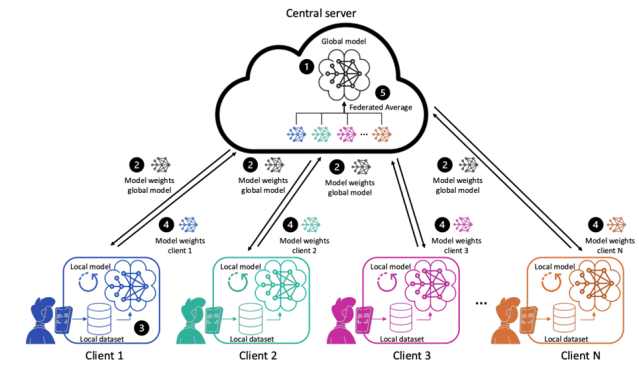
Particularly, federated learning enables multiple devices to collaboratively train a shared global model while preserving data locality, reducing the risk of data leakage and mitigating threats such as centralized data breaches, model inversion, and membership inference attacks when combined with secure aggregation and differential privacy techniques.
On-device training
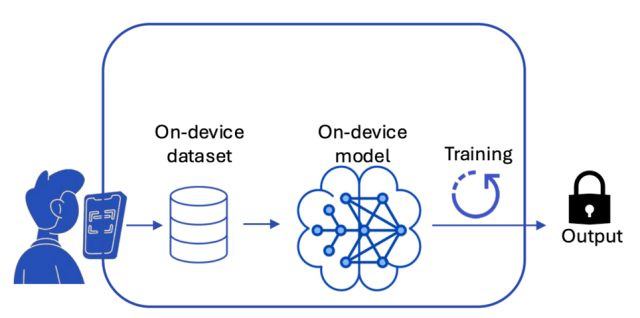
In parallel, on-device training performs feature extraction, model adaptation, and inference locally, reducing latency, enabling offline operation, and supporting continuous personalization to behavioral and environmental changes.
Privacy by design and GDPR compliance
Beyond privacy, these paradigms can also contribute to improved fairness by allowing models to adapt to underrepresented user characteristics without requiring sensitive data centralization, ultimately strengthening security, user trust, robustness, and scalability while aligning biometric systems with privacy-by-design principles and regulatory requirements.
Real-world applications of biometrics with decentralised AI
Decentralized AI is increasingly deployed across a variety of real-world domains, demonstrating the versatility and privacy-preserving potential of modern biometric systems. In consumer electronics, smartphones leverage on-device face and fingerprint recognition to provide secure, seamless authentication. In healthcare, behavioral biometrics enable privacy-preserving monitoring and patient identification. The finance sector relies on biometric authentication systems that comply with GDPR and PSD2 regulations, ensuring both security and legal conformity. In industrial IoT, offline-capable biometric and contextual authentication supports robust access control in low-connectivity environments. Finally, research and regulatory initiatives, such as EU-funded programs, are exploring compliant and responsible biometric AI, bridging innovation with ethical and legal frameworks.
Addressing Challenges: Fairness, Security, and Trust
Despite advances, biometric AI systems face challenges related to bias, robustness, and regulatory compliance.
- Bias and Fairness: Performance disparities across demographic groups remain a concern. Mitigation strategies include diverse datasets, fairness-aware training, independent audits, and transparent reporting. The EU AI Act reinforces these measures by restricting certain uses of biometric categorization and requiring impact assessments.
- Security and Anti-Spoofing: Systems are exposed to threats such as deepfakes and adversarial attacks. Defenses include liveness detection, adversarial training, multimodal authentication, and continuous monitoring.
- Privacy and Compliance: Ensuring compliance involves informed consent, explainability, and privacy-by-design strategies such as federated learning and on-device processing to limit exposure of sensitive data.
- European Trends: Europe leads in ethical governance, emphasizing audits, explainable AI, human oversight, and emerging technologies like blockchain and secure multiparty computation, shaping the next generation of trustworthy, privacy-preserving biometric systems.
The future of biometric digital identity
Next-generation biometrics are central to modern digital identity, enabling secure and user-friendly authentication across sectors. By combining biometrics with decentralized AI approaches such as federated learning and on-device training, these systems offer scalable, privacy-centric alternatives to traditional passwords. Addressing fairness, transparency, robustness, and regulatory compliance is essential to sustaining trust. As Europe sets global benchmarks, biometric technologies are evolving toward a future where security and privacy are foundational elements of a trustworthy digital society.