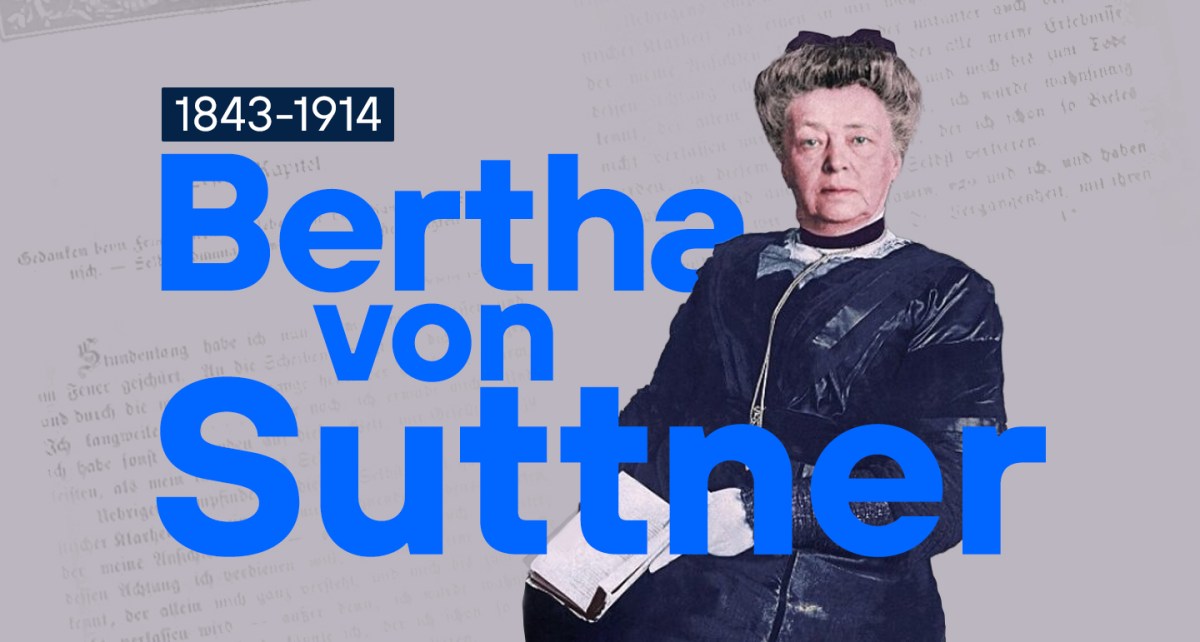

- The Czech activist and writer was the first woman to win the Nobel Peace Prize, in 1905.
Around International Women’s Day, which has been celebrated every March 8 since 1975, we are going to learn about some leading women who have advanced the cause of equality.
In a previous publication, we took an in-depth look at Valentina Tereshkova, the first woman in history to travel into outer space. In this article, we are going to learn more about Bertha von Suttner.
But who was she and why is she famous?
Bertha von Suttner’s childhood
Baroness Bertha Felicie Sophie von Suttner (born June 9, 1843, in Prague and died June 21, 1914, in Vienna), born Countess Kinsky — actually born Bertha Félicie Sophie Gräfin Kinsky von Wchinitz und Tettau — was the posthumous daughter of a field marshal and granddaughter, on her mother’s side, of a cavalry captain. These military influences were by no means coincidental in the course of her later life.
As a member of the aristocracy, her childhood and youth were characterized by studying music and languages, a keen interest in reading, and a social life marked by activity and the ability to travel frequently, which was unusual at the time except for her social class.
She was raised by her mother, although she was tutored by a member of the Austrian court and was an example of a person from an aristocratic society marked by militaristic traditions, which she did not reject in the first part of her life, but against which she later rebelled.
Marriage to Baron Arthur Gundaccar von Suttner
In her thirties, she accepted a position in Vienna as a teacher and companion to the four daughters of the Suttner family, where she met her future husband, the youngest son of the family.
Later, in 1876, she moved to Paris, where she became Alfred Nobel’s secretary, a relationship we will explore in more detail later. However, she soon returned to Vienna to marry Baron Arthur Gundaccar von Suttner, a fact that indirectly influenced her literary career.
This union was opposed by the Suttner family, which led the couple to settle for almost a decade in the Caucasus, where they earned a living by teaching music and languages, as well as through literature.
Bertha von Suttner’s literary career
In 1883, she published her first novel, Inventory of a Soul, in which she included the idea of a society that would achieve progress through peace.
After reconciling with his family and returning to Austria in the mid-1880s, the greatest recognition of her literary career came with the publication in 1889 of Lay Down Your Arms, a work in which the protagonist, Countess Martha Althaus, experiences the horror of four of the European wars of the second half of the 19th century.
This novel cemented her status as a pacifist figure by reflecting on the senselessness of glorifying war despite the loss of lives among the protagonist’s closest circle. With the publication of this work, Von Suttner became a recognized figure in pacifism.
From writer to pacifist leader
The effect of the work’s publication was so real and its condemnation of militarism so forceful and socially impactful that the author became an active leader of the pacifist movement. The momentum of these ideas grew with successive translations of the work into languages other than the original German.
Von Suttner devoted much of her time and writing to the cause of peace, attending international meetings and conferences, helping to set up pacifist groups, recruiting people, giving lectures, and corresponding with people around the world to promote projects.
Nobel Peace Prize 1905
It was this involvement with pacifism that led her to make history in the field of equality by becoming the first woman to receive the Nobel Peace Prize, specifically in 1905.
The reason she was awarded this distinction was “her audacity in opposing the horrors of war.”
Von Sutter also made history by being the second woman in history to receive a Nobel Prize, two years after Marie Curie won it for the first time in her life (she would repeat the feat in 1911).
Paradoxically (or fortunately, who knows), she died just one month before the start of World War I.
Relationship with Alfred Nobel and the Nobel Prizes
The Nobel Prize website itself explains that “there is no doubt that Von Suttner’s friendship with Alfred Nobel influenced the content of his will, and many attribute the creation of the peace prize to her.”
The Swedish businessman and inventor even went so far as to say to the writer and pacifist activist: “Inform me, convince me, and then I will do something great for the movement.”
Telefónica and gender equality
As part of Telefónica’s diversity and inclusion policies, the company reaffirms its commitment to gender equality, as “understanding the pay gap is not only about ensuring that our employees are paid the same for the same work, but also about ensuring that they have the same opportunities regardless of their gender.”
Similarly, the company collaborates with programs to increase the presence of women in technical careers, addressing the shortage of women in scientific and technological careers or in the field of entrepreneurship.
Frequently asked questions
La escritora y activista pacifista Bertha von Suttner, quien recibió el galardón en 1905.
Precisamente Bertha von Suttner en 1905, después de haberlo recibido previamente -en 1903, concretamente- Marie Curie.
Por su “audacia al oponerse a los horrores de la guerra”, tal y como se explica en la web de los galardones.