
- What role did Alan Turing play in World War II?
- Are the Turing Machine and the Turing Test the same thing?
Machine learning and AI would not have become what they are today without the theoretical and practical contributions of numerous figures in the scientific field.
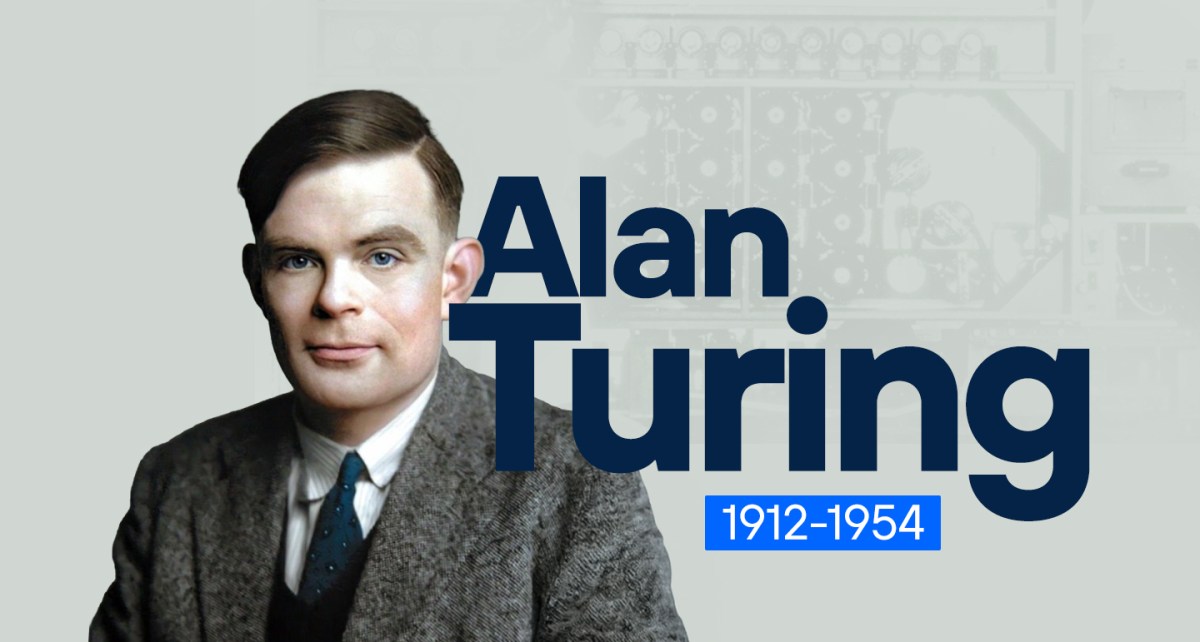
One of them is Alan Turing (1912-1954).
What are Alan Turing’s origins?
Born in the London borough of Paddington on June 23, 1912, Alan Turing’s childhood was marked by his father’s work as a Colonial Administration official in India, which meant that he and his brother spent periods away from their parents, either in the care of tutors or even in boarding schools.
Rumor has it that he taught himself to read in just three weeks, and from a very young age he showed an enormous interest in science, to the point of setting up a chemistry laboratory in his home at the age of eight.
He graduated with honors in mathematics from King’s College, Cambridge University, in 1934—the institution that houses the Turing Archive—and then moved to Princeton (in the United States) to pursue his doctorate in mathematical logic under the supervision of Alonzo Church in 1938.
What is the Turing Machine?
In 1936, Turing presented a theoretical model of computation known as the Turing Machine, which, despite its name, was not a physical device.
In it, the British scientist defined the fundamentals of computation, investigating the limits of what can be calculated.
With the aim of determining “computability,” understood as knowing whether a problem can be solved with an algorithm, the Turing Machine had an infinite memory tape, a read/write head, and a control unit.
Although, as we have said, the Turing Machine did not physically exist, it is considered the basis of theoretical computer science.
What was Turing’s contribution to World War II?
At the British facility at Bletchley Park, Alan Turing led the team that deciphered the Enigma machine used by the Nazis in World War II.
To do this, they used the electromechanical “Bombe” machine to speed up the breaking of the codes used by German intelligence, which allowed the Allies to anticipate certain German movements.
Some estimates suggest that this may have hastened the end of the war by two years, saving thousands of human lives.
What was the “Bombe”?
To counter the Enigma encryption device mentioned above, which had 159 million combinations—making it considered virtually infallible and unbreakable—Turing and his team sought to automate the search for daily configurations of the Enigma rotors.
Using logical techniques, they looked for contradictions in the combinations, discarding the false ones and finding the correct one. The machine had 36 replicas of the Enigma machine, thousands of cables, and a million solder joints, and was improved with the contribution of another English mathematician, Gordon Welchman.
In this way, the Allies were able to “read” thousands of Nazi messages every month, enabling them to accurately determine the position of German submarines.
What is Alan Turing’s connection to AI and machine learning?
Turing wondered whether machines could think in his article “Computing Machinery and Intelligence,” published in 1950 in the journal Mind.
In this essay, the British mathematician proposed testing a machine’s ability to display intelligent behavior indistinguishable from that of a human being.
This test, known as the Turing Test, involves a human evaluator conversing with another human and a machine through text in an imitation game. If the evaluator cannot distinguish between them, the machine passes the test.
The objective was to see if the machine could think or imitate human intelligence in a practical way through the evaluation mentioned above, a mere textual conversation focused on natural language processing and the ability to give responses similar to those of humans.
Despite the limitations of the test, it is still considered a benchmark in the field of AI.
Death and posthumous recognition
The end of Turing’s life, at the early age of 41, was marked by the rejection of his sexual orientation at the time.
By “self-incriminating” himself as homosexual in a court case, he ended up being sentenced to chemical castration if he wanted to avoid prison, a hormonal treatment that led to both physical and psychological effects.
The depression caused by this treatment, combined with the withdrawal of his authorization to work at the Government Communications Headquarters (GCHQ), led Turing to commit suicide after eating an apple laced with cyanide (although some claim it was an accidental experiment with fatal consequences).
Six decades after his death, Queen Elizabeth II of England granted him a posthumous royal pardon. Subsequently, the 2017 Turing Law also granted pardons to those who had been convicted of homosexual practices in the United Kingdom, a pardon that could be applied by removing the criminal record if the person was still alive or, as in the case of Alan Turing, posthumously.
Frequently asked questions
He was born in London on June 23, 1912.
In the English town of Cheshire, on June 7, 1954.
Turing is considered one of the fathers of modern computing, as well as one of the fathers of AI.
It was an electromechanical encryption device used by the Nazis for their communications in World War II.
The leading figure in solving the Enigma code was Alan Turing, who led a team that developed an electromechanical machine crucial to deciphering Nazi communications. This shortened the duration of the war and, as a result, saved millions of lives.
Alan Turing committed suicide after being sentenced to chemical castration for having confessed to being homosexual. Decades later, he was posthumously rehabilitated with a pardon, restoring his reputation both in the scientific field and for his impact on World War II.
Because he was such a well-known figure, the law that pardoned (posthumously or while still alive) people who had been convicted of homosexuality in the United Kingdom is known as the Turing Act.
An AI test proposed in 1950 by Alan Turing to measure a machine's ability to behave like a human being.
It is a theoretical model proposed in 1936 designed to simulate the logic of any computer algorithm.