
- In 1906, Cajal and Camilo Golgi received the Nobel Prize in Medicine for making it possible to observe and document the anatomy of the nervous system in detail.
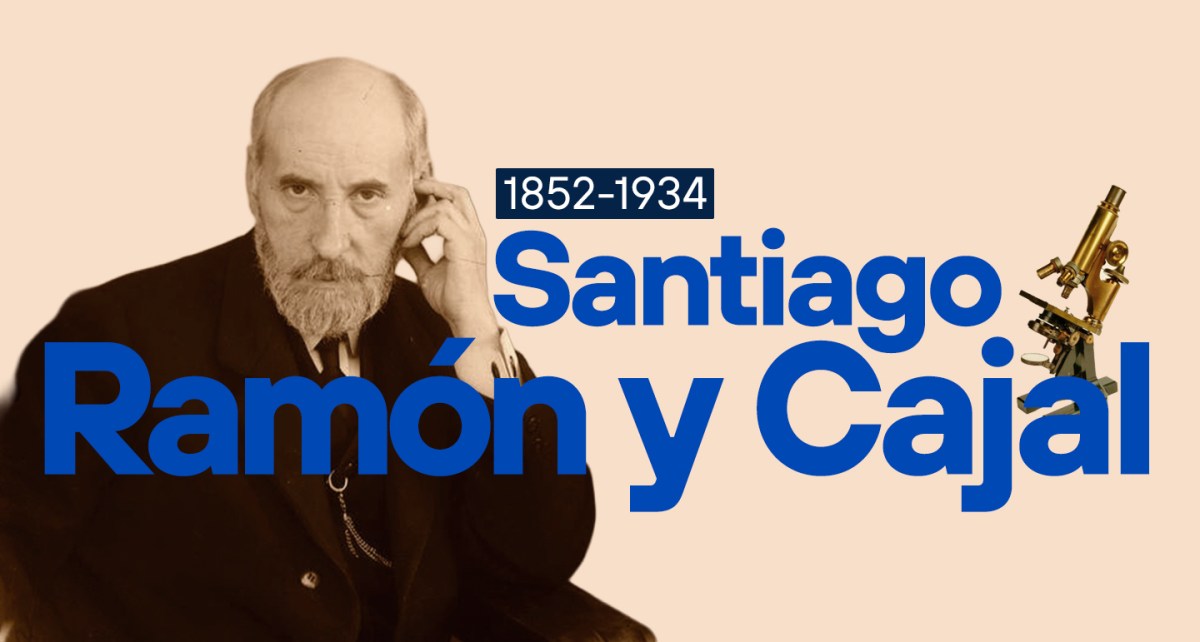
As part of World Health Day, which has been celebrated every 7th of April since 1950, we are going to remember one of the great figures in the sector in Spain, Santiago Ramón y Cajal (1852-1934).
Ramón y Cajal’s origins and childhood
Santiago Ramón y Cajal was born on 1 May 1852 in the Navarran town of Petilla de Aragón. However, he was descended from Aragonese, as both his parents came from the Huesca municipality of Larrés, where they moved when Cajal was two years old.
As he recounts in his book Memorias de mi vida (Memoirs of My Life), he spent his childhood moving between numerous towns in the provinces of Huesca and Zaragoza due to his father’s work as a surgeon. After studying in Jaca and Huesca, he ended up in the Aragonese capital to begin his studies in medicine, graduating in 1873 at the age of 21.
Professional career
In 1877, he completed his doctorate at the Central University of Madrid (one of the predecessors of the Complutense University) with a thesis entitled ‘Pathogenesis of Inflammation’, subsequently combining his medical work with teaching positions at universities in Valencia and Barcelona.
Between 1884 and 1888, he published his ‘Manual of Histology’ in instalments, before returning to Madrid in 1892 to take up the chair of Histology and Normal Histochemistry and Pathological Anatomy at the Central University of Madrid, which he would hold until his retirement in 1922.
Cajal School
In 1900, the modern Laboratory of Biological Research was created, as well as the Spanish Neurological School, an influential scientific group led by Ramón y Cajal in the early 20th century.
This group, also known as the Cajal School, developed the neuron theory, establishing that the nervous system is made up of individual cells.
The importance of this work is such that these manuscripts, histological drawings, photographic plates and bibliographic material were inscribed in 2017 by UNESCO in the ‘Memory of the World’ register as World Heritage. Part of the archive is available at the Museum of Natural Sciences in Madrid.
Ramón y Cajal, father of modern neuroscience
Santiago Ramón y Cajal is often referred to as the ‘father of modern neuroscience’ due to his studies on microscopic anatomy, his observations on degeneration and regeneration, and his theories on the function, development, and plasticity of virtually the entire nervous system, as stated by the Spanish National Research Council on its website.
The first cartographer of the brain
All these advances in mapping the brain using a technique developed by Camillo Golgi, as we will see later when discussing the Nobel Prize winner.
Cajal perfected the Italian scientist’s technique and used it to map the central nervous system, producing a catalogue of detailed and meticulous drawings covering numerous spaces and areas of the brain.
The Spanish scientist’s hypothesis was that the neurons in the brain were in contact but did not touch each other. It was not scientifically proven until the 1950s, but this theory stipulates that each nerve cell in the brain is different and that neurons communicate through synapses.
1906: Nobel Prize in Medicine
In 1906, Santiago Ramón y Cajal became the first Spaniard to win the Nobel Prize in Medicine. He was also the second Spaniard to receive any of these awards after José Echegaray made history in 1904 with the Nobel Prize in Literature.
But back to Ramón y Cajal, he received the Nobel Prize in Physiology or Medicine together with the Italian Camillo Golgi ‘in recognition of their work on the structure of the nervous system’.
The interaction between the brain and the nervous system began to be studied after Golgi’s discovery in the 1870s that nerve cells could be stained with silver nitrate, which opened up new opportunities for their study.
Cajal began using this method in 1887 and achieved groundbreaking results, such as demonstrating that each nerve cell is an independent entity and that nerve synapses transfer nerve impulses from one cell to another.
Golgi began studying the grey matter of the brain using techniques to stain cells that marked almost all parts of this dense tissue simultaneously, without revealing information about its finer details, which led him to seek a more sophisticated staining system.
In his research, he discovered a way to impregnate nerve tissue with a silver solution, which stained only a small number of nerve cells black, allowing the neurons to be seen in their entirety. Golgi was thus able to observe with remarkable clarity the complex contours and details of numerous branches.
Golgi’s silver staining method was not appreciated until Ramón y Cajal improved its resolution and used this technique to investigate the brains of young animals. With a microscope, pencil and paper, Cajal created thousands of drawings depicting the details of nerve tissue, which to him resembled a forest of spreading trees.
In short, the work of Golgi and Cajal made it possible to observe and document the anatomy of the nervous system in detail.
Frequently asked questions
He was born on 1 May 1852 in the Navarran municipality of Petilla de Aragón, into a family of Aragonese origin.
He died in Madrid on 17 October 1934, at the age of 82.
He is considered the father of modern neuroscience and unravelled the mysteries of the structure of the nervous system, placing Spain at the forefront of international science.
Santiago Ramón y Cajal in 1906.