
Tell us a little about yourself. What does your job at Telefónica involve?
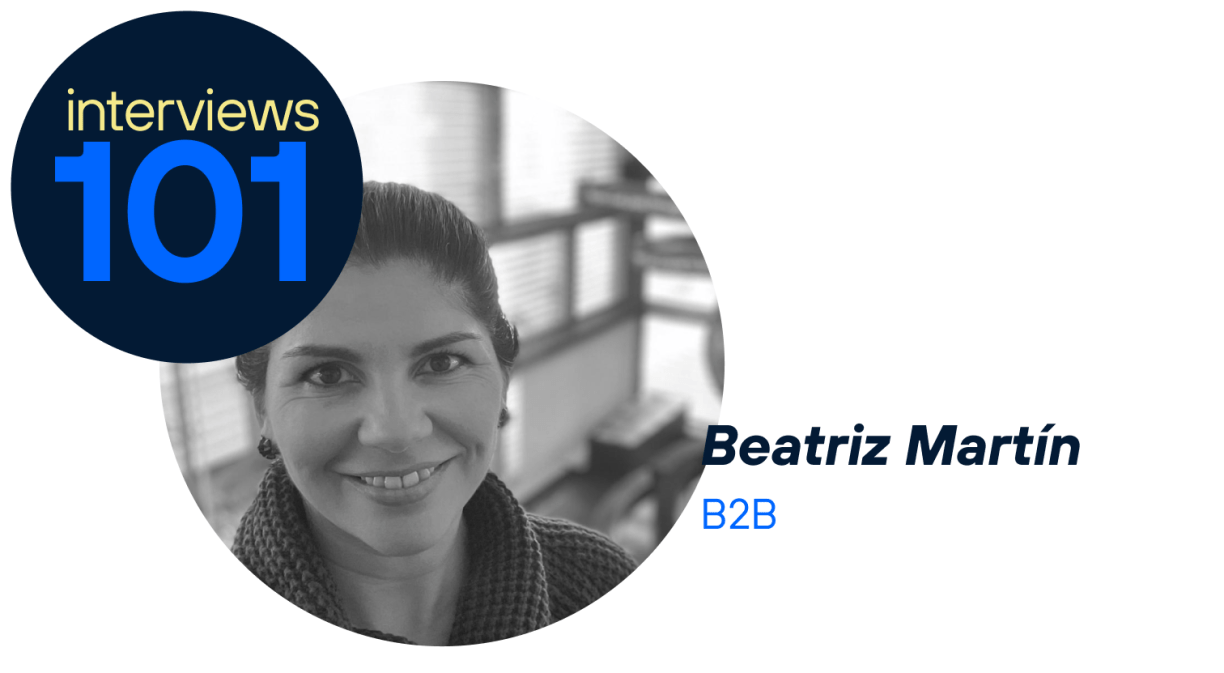
I work in Telefónica’s Global B2B area, in the Commercial Acceleration team, where we help develop sales channels for the B2B segment for the entire company from various perspectives.
My day-to-day work is a mix of creativity and analysis. I am responsible for communicating specialised training content to the sales teams through platforms such as B2B Sales Academy — where, by the way, I even appear as a guest actress in one of the courses! — and B2B Sales Podcast, which is another of our favourite spaces for sharing knowledge.
I also analyse data to support decision-making that accelerates the business (although sometimes the data is resistant and you have to be very patient), and I collaborate on projects that seek to improve the sales teams in this segment, facilitating their day-to-day work and creating business opportunities.
What I am most passionate about is inspiring with what I communicate, measuring the impact of what we do and working hand in hand with local areas. We are a business acceleration project area for the business units, and that means being close to them, understanding their challenges and contributing as strategic partners in their development.
How would you define global B2B?
For me, Global B2B means working with a broad perspective, but with attention to detail. It means understanding that behind every customer, every proposal and every market there are different people, contexts and needs. All this with the sole objective of helping countries generate more revenue and achieve their annual targets.
And that means collaborating with diverse teams, adapting language, strategy and even pace. Developing a commercial turnover management project in Brazil is not the same as doing so in Spain. Just as practical sales training in Spain is not the same as in Germany.
That is why it is essential to listen more, ask better questions and have the flexibility to adjust course without losing focus. Here, creating value beyond borders means working as a team, connecting cultures and supporting local sales teams so that they can grow to their full potential. And that is where our advisory role comes into play.
What professional profiles are dedicated to these tasks?
They are very senior profiles, with extensive experience in the sector and a strategic and cross-cutting vision of the business. People who not only understand the product, service or channel, but also know how to manage, communicate and position it and make it relevant for each customer, each sector, each channel and each market.
They usually have experience in business development, marketing, data analytics or project management, and a great ability to connect areas, adapt to the environment and understand the internal customer — which in our case are the company’s B2B commercial areas. Because what really defines these profiles is their ability to listen, collaborate and anticipate.
In my case, I feel part of that group that works behind the scenes to ensure that ideas come across clearly, with impact and meaning. And that, believe me, requires both strategy and intuition… and sometimes a little bit of stagecraft too.
What are the most in-demand skills?
In a cross-functional and consultative area like ours, it takes much more than knowing how to use tools or understand processes. What is really valued here is the ability to see the big picture, connect the dots and translate needs into solutions… even when those needs have not yet been formulated.
On the one hand, you need to have strategic vision, but also communicative sensitivity. Because yes, you can have the best analytical model in the world (even if it sometimes crashes at the worst possible moment), but if you don’t know how to explain it, translate it and make it useful for the sales teams, it’s not much use.
We analyse everything from business intelligence to channel management, including marketing, offerings and the development of specific tools. In other words, cross-functional collaboration is essential: we work with people from different areas, countries and profiles, and that requires empathy, flexibility and a strong desire to learn. Because in this environment, everything changes quickly, and constant curiosity is not optional… it’s part of our DNA.
What are the differences with B2B on a smaller scale?
Working in Global B2B is like looking at the business from the International Space Station: every decision can have an impact on multiple markets, cultures and teams, and you have to be able to see the big picture. Unlike local B2B, where the dynamics are more straightforward, here you have to connect the common with the particular, without losing sight of what really matters. We provide local teams with ideas and solutions that they cannot come up with themselves, either because they are too caught up in their day-to-day work or because they do not have access to best practices from other countries in the group.
But be careful, thinking big does not mean forgetting the details. That is why collaboration between local and global teams is absolutely key. Local teams know the terrain, the customer, the context. We, from a global perspective, provide vision, alignment and resources. And when we work together, the proposals are more solid, more relevant and more adaptable.
The true value of global B2B lies in listening to those who are close to the customer, understanding their challenges and adding value from what we know how to do. Because in the end, the global is built from the local, and we are here to accompany, support and facilitate that journey.
How does the emergence of new technologies affect the world of B2B?
As in other business segments, new technologies are revolutionising B2B, not only in what we offer, but also in how we think about it, communicate it and deliver it. Everything is more immediate, more personalised and measurable. And that is a gift… and a challenge.
They allow us to better understand the customer, anticipate their needs and offer more tailored solutions. But they also require us to be more agile, more collaborative and more strategic. That is why I insist on the importance of collaboration between local and global teams. Each one contributes their perspective and experience, and together we make technology really work.
From the use of WhatsApp as a sales channel, to CRM developments tailored to each team, to AI in business prospecting, to practical sales training… all of this only makes sense if it is built with the people involved, from team managers, sales agents, engineers, back office, marketing, business development and others, right through to the end customer.
Which people working at Telefónica would you nominate for this interview who you consider to be excellent at their job?
When I think of people who are making a difference in the B2B world within Telefónica, two names immediately come to mind: Pedro Galván, for his leadership in the development of the Non-Exclusive Channel, a completely new initiative within the group’s B2B channel strategy. And Gabriel Giusti, for his deep experience in managing indirect B2B channels in Brazil, with whom I have discovered that passion transcends borders.