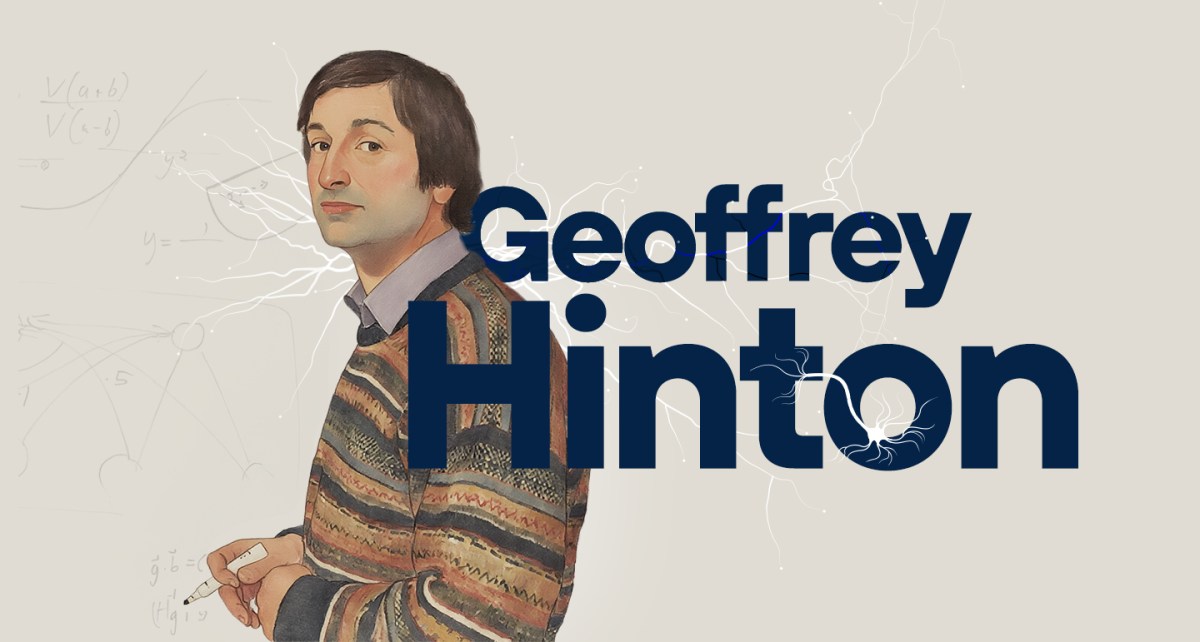

- In 2024, Hinton received the Nobel Prize in Physics “for fundamental discoveries and inventions that enable machine learning with artificial neural networks.”
In a recent publication, we analyzed the figure of one of the considered fathers of AI and machine learning, Alan Turing. In this article, we will delve into another relevant figure: Geoffrey Hinton.
Coincidentally, both are Londoners. Turing was responsible for numerous theoretical advances in a field that Hinton has continued to explore decades later. Anecdotally, they are also linked by the fact that the latter received the Alan Turing Award in 2018.
Geoffrey Hinton’s scientific origins and education
Hinton was born on December 6, 1947, in the London borough of Wimbledon into a family with links to science and mathematics.
In fact, he is the great-great-grandson of Mary Everest Boole and George Boole, who laid the foundations for the zeros and ones (in his 1847 book The Mathematical Analysis of Logic) used to encode digital information; a system known as Boolean algebra, making him one of the historical figures in the evolution of algorithms.
As a curiosity, we can add that he is also a distant relative of George Everest, the British surveyor and geographer after whom Mount Everest is named. In fact, his full name is Geoffrey Everest Hinton, in homage to his great-granduncle.
Geoffrey Hinton’s education
In terms of his education, between 1967 and 1970 he studied at King’s College, Cambridge, where he alternated between physiology, philosophy, and physics before graduating with a degree in experimental psychology in 1970.
In 1972, after a year spent learning carpentry, he returned to academic life at the University of Edinburgh, where he studied for a PhD in Artificial Intelligence, graduating in 1978 with a thesis on neural networks under the supervision of Christopher Longuet Higgins.
University career
Hinton then pursued postdoctoral studies at the University of Sussex, moving to the United States: first to the University of California, San Diego, and then to Carnegie Mellon in Pennsylvania, where he popularized the use of backpropagation in multilayer neural networks, a concept we will discuss later.
His concern for the evolution of AI, as seen in his speech upon receiving the Nobel Prize in 2024, is not limited to recent years.
In fact, in the late 1980s, he moved to Canada in disagreement with the Reagan administration’s policy on military funding of AI, joining the Department of Computer Science at the University of Toronto.
We will learn about his most notable professional contributions through two prestigious awards: the Alan Turing Award and the Nobel Prize.
2018 Alan Turing Award
The link with Alan Turing does not come solely from what we have mentioned above, but Hinton has even received the Alan Turing Award, considered the Nobel Prize of computing, an award that has been presented by the ACM (Association for Computing Machinery) since 1966.
Specifically, in 2018, Hinton received this award for his contributions in three particular fields:
- Boltzmann machines. In 1983, together with Terrence Sejnowski, Hinton invented Boltzmann machines, one of the first neural networks capable of learning internal representations in neurons that were not part of the input or output.
- Backpropagation. In Learning Internal Representations by Error Propagation, written in 1986 with David Rumelhart and Ronald Williams, Hinton demonstrated that the backpropagation algorithm allowed neural networks to discover their own internal representations of data, making it possible to use them to solve problems previously considered beyond their reach.
- Improvements in convolutional neural networks. In 2012, together with Alex Krizhevsky and Ilya Sutskever, Hinton improved convolutional neural networks using rectified linear neurons and dropout regularization, reducing the error rate in object recognition by almost half.
2024 Nobel Prize in Physics
In 2024, Geoffrey Hinton received the Nobel Prize in Physics “for fundamental discoveries and inventions that enable machine learning with artificial neural networks,” an award he shared with John J. Hopfield.
We recently discussed the Nobel Prize in Physics in another post on this blog, as 1903 marked the milestone of the first woman ever to receive one of these prestigious awards, and it was in this very discipline. We are talking about Marie Curie.
Concern about short- and long-term risks
In Hinton’s speech at the gala dinner for the award ceremony, he referred to the recognition of advances in a new form of AI “that uses artificial neural networks to learn how to solve difficult computational problems,” a new form of AI that “excels at modeling human intuition rather than human reasoning and will allow us to create highly intelligent, knowledgeable assistants that will increase productivity in almost every industry.”
However, Hinton warned in his speech of “short-term risks” that “require urgent and vigorous attention from governments and international organizations.”
Similarly, the British scientist spoke of “a longer-term existential threat that will arise when we create digital beings more intelligent than ourselves,” which is why he advocates “urgently researching how to prevent these new beings from wanting to take control.”