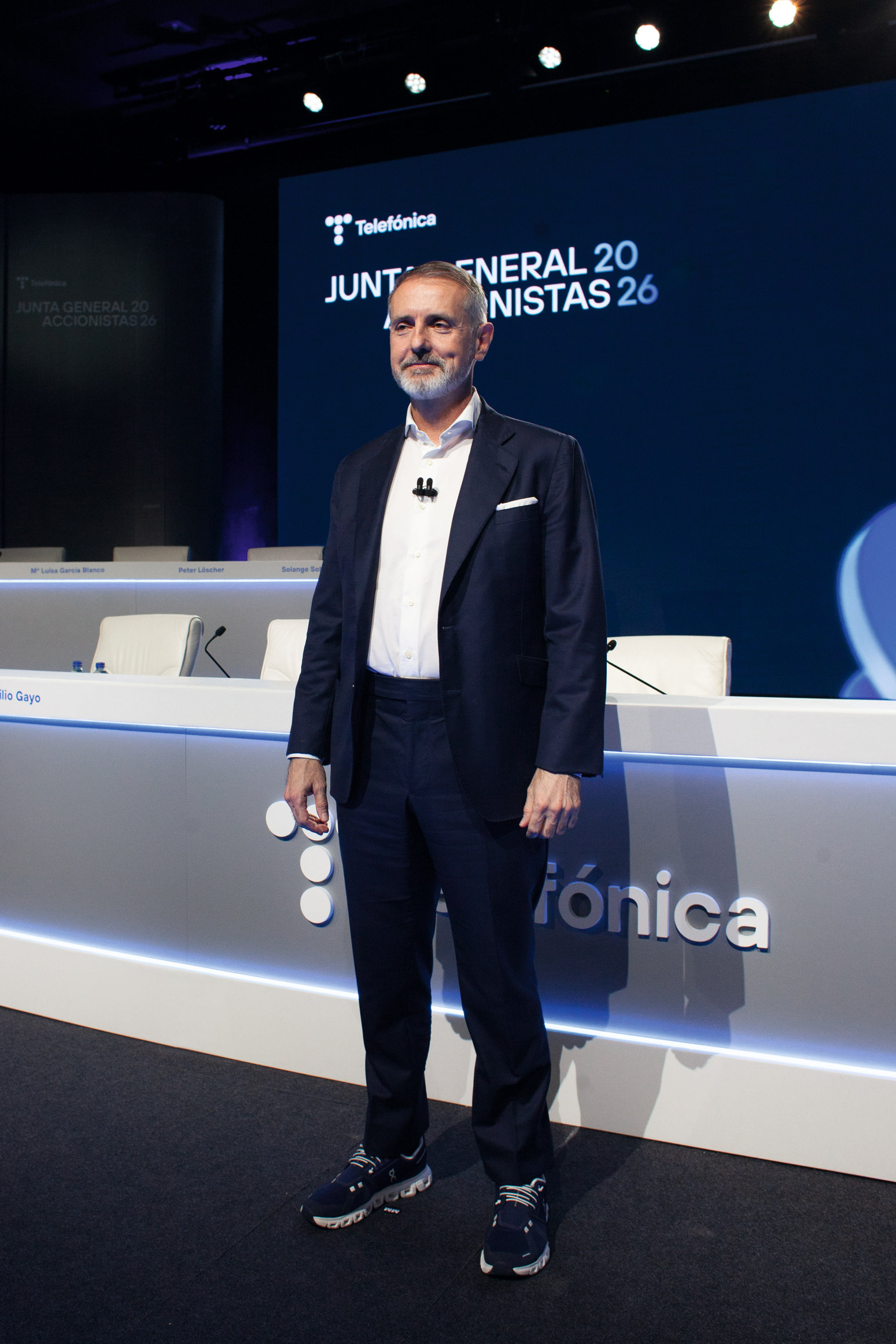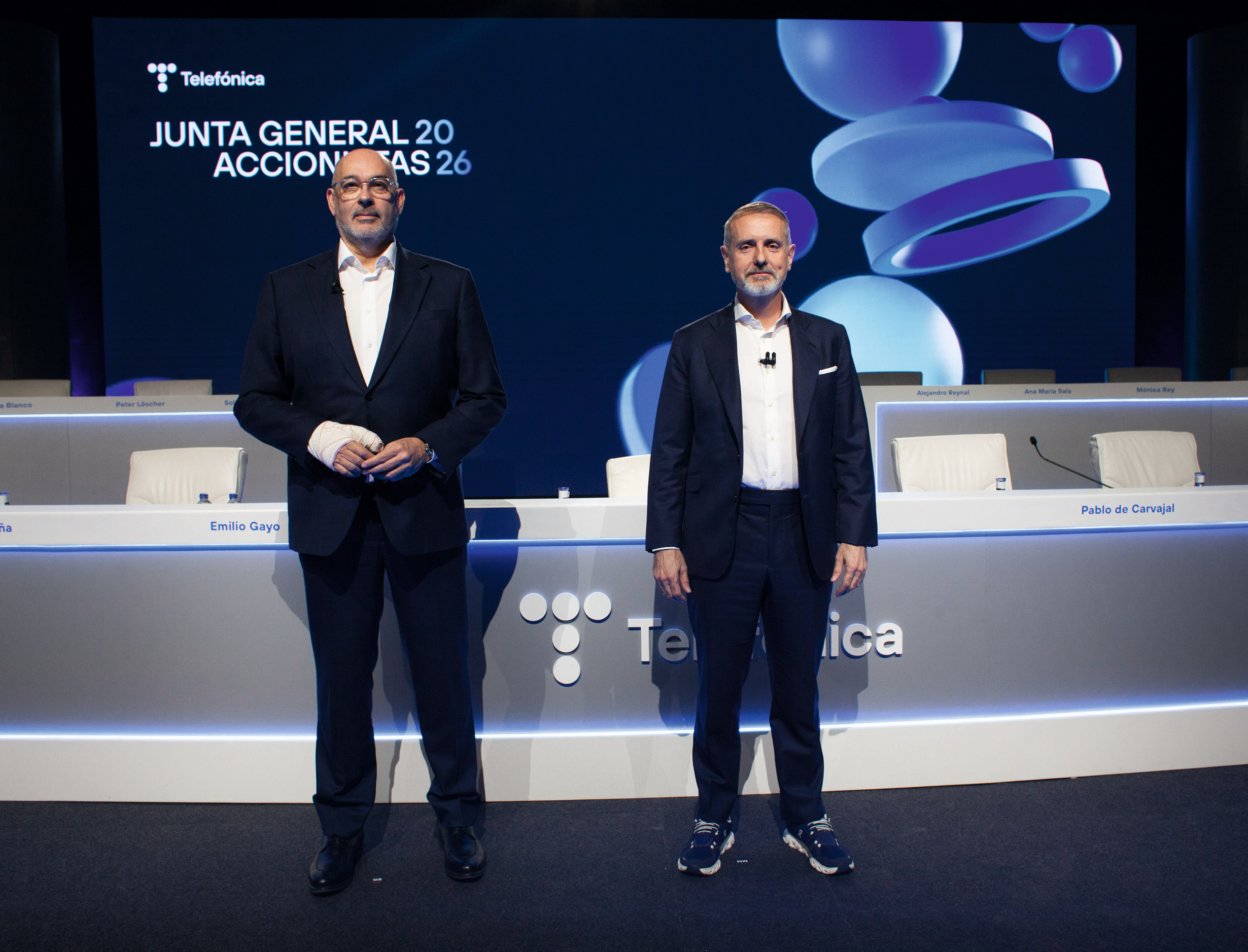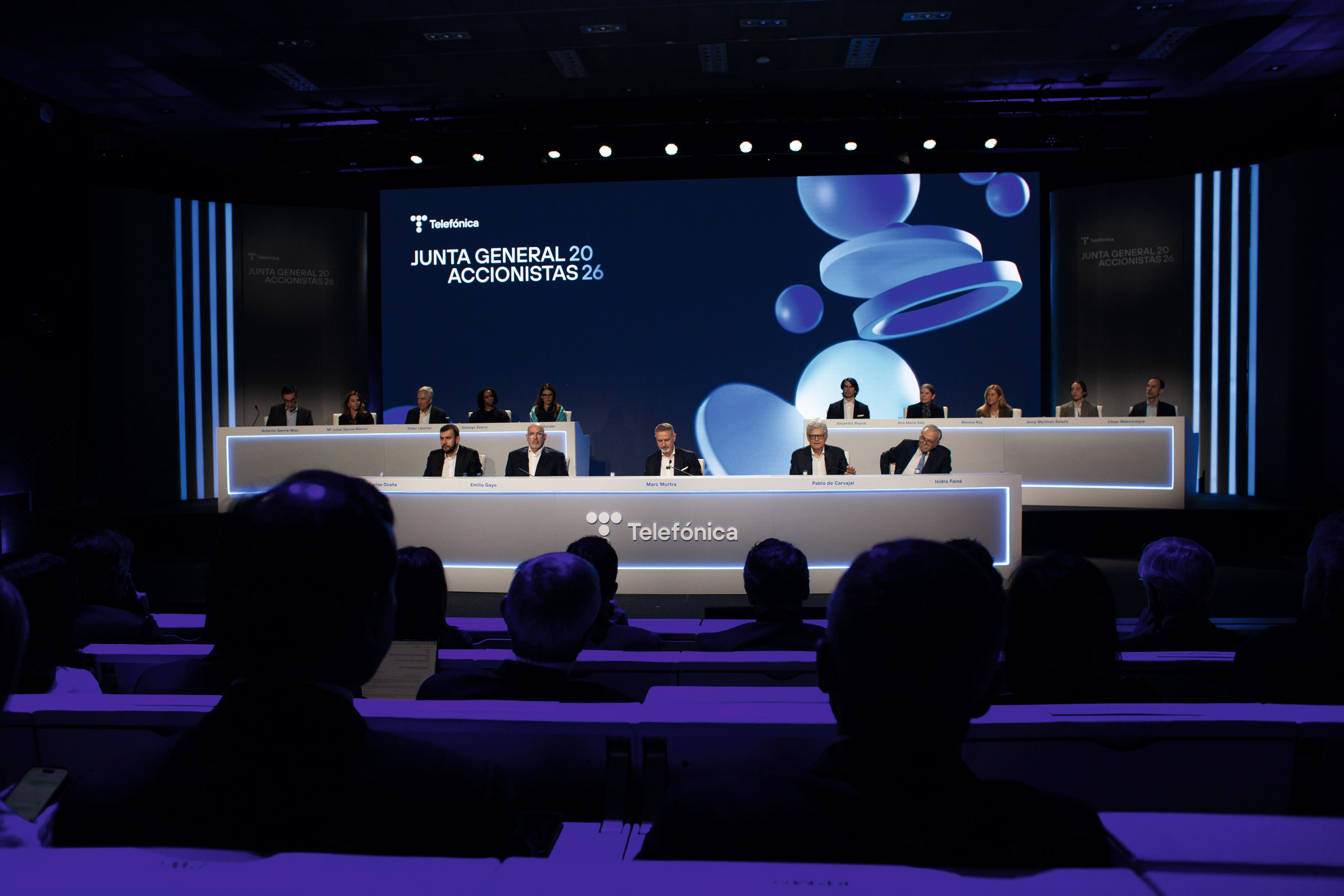
- Telefónica’s Annual General Meeting of Shareholders has approved by a wide margin the resolutions put to the vote, including the re-election of María Luisa García Blanco as an independent director, the ratification and appointment of Anna Martínez Balañá, César Mascaraque Alonso and Mónica Rey Amado as independent directors, and the appointment of Jane Thompson as an independent director..
- Shareholders also approved the second payment of the dividend for the 2025 financial year, €0.15 per share, to be paid in cash on June 18..
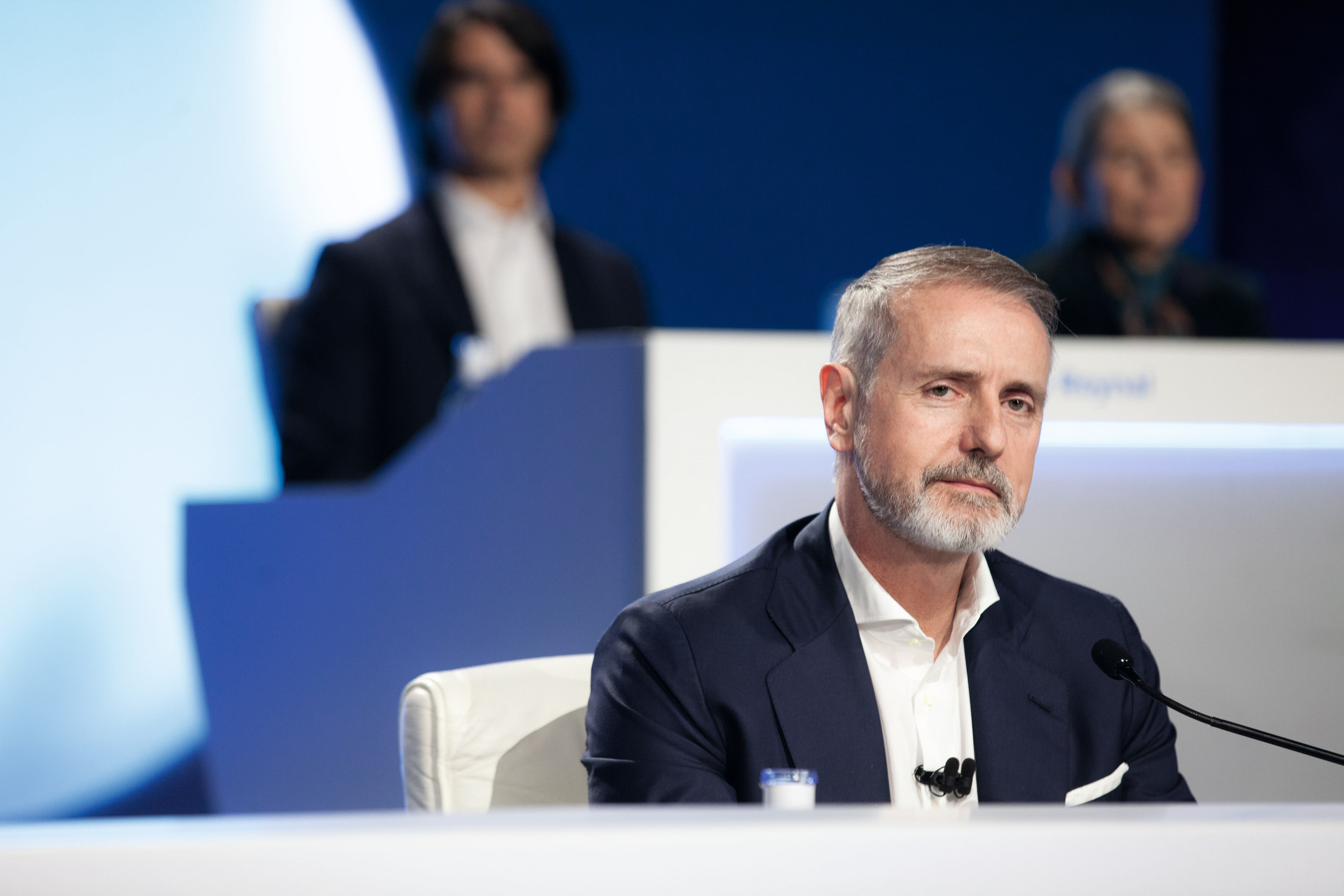
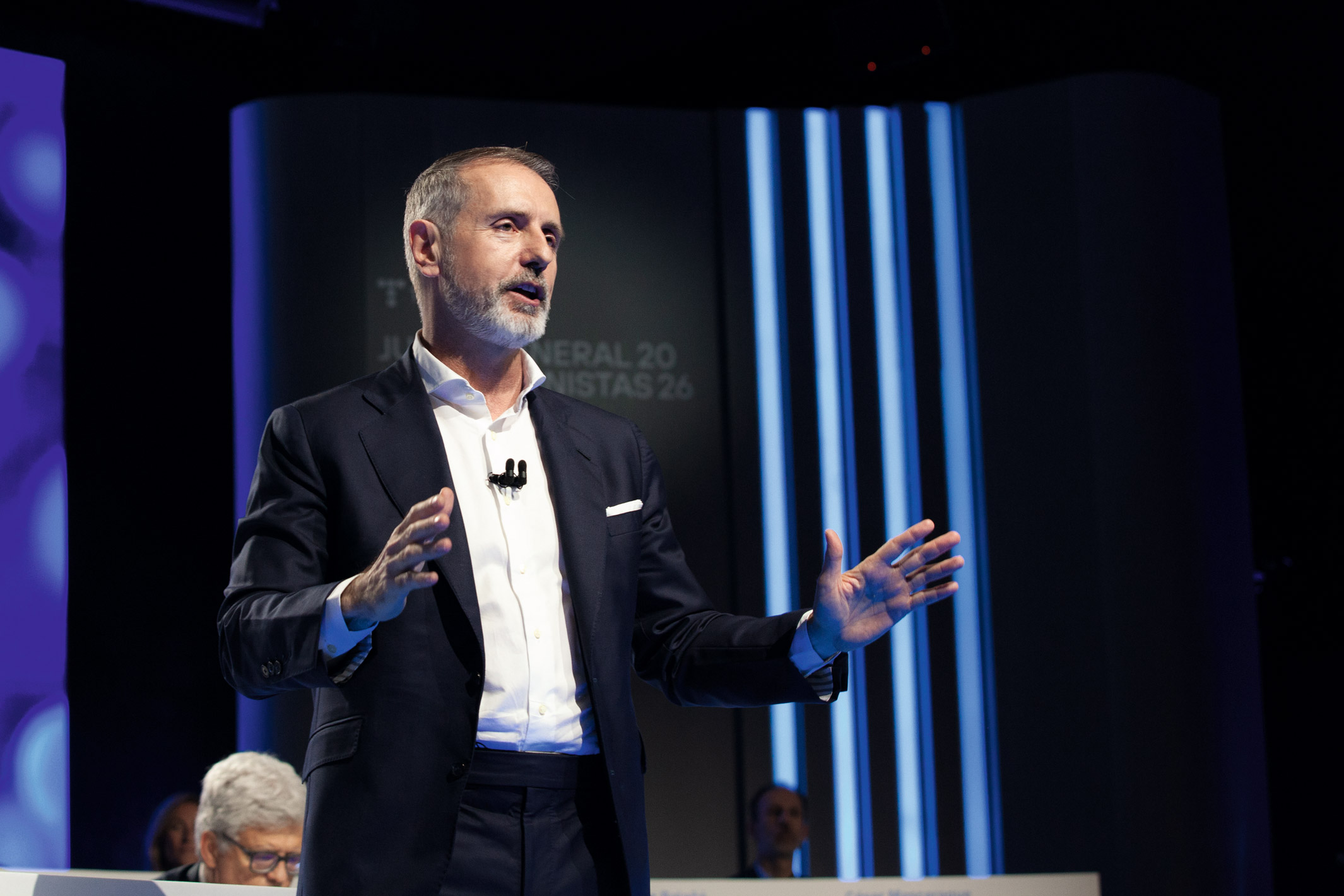
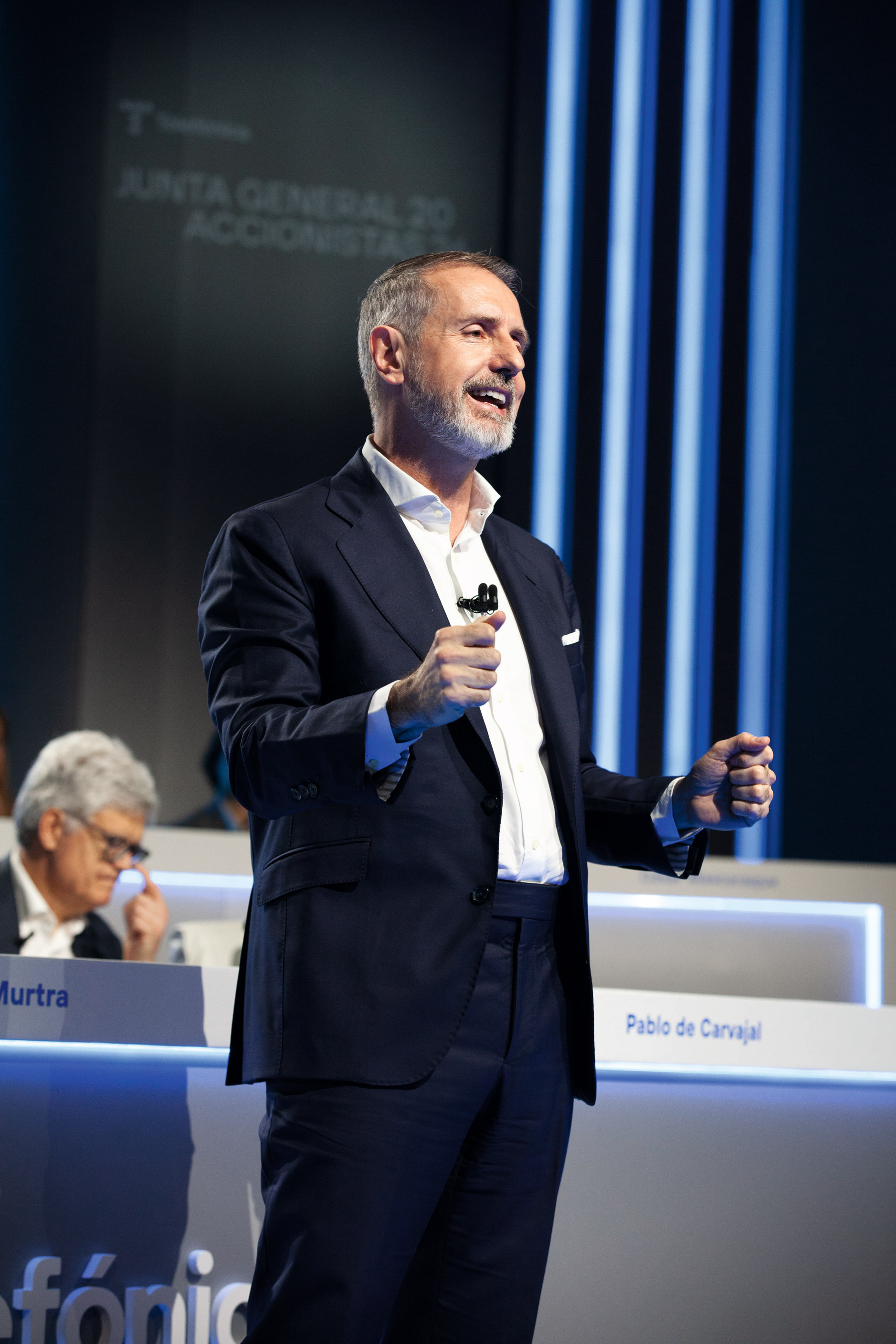
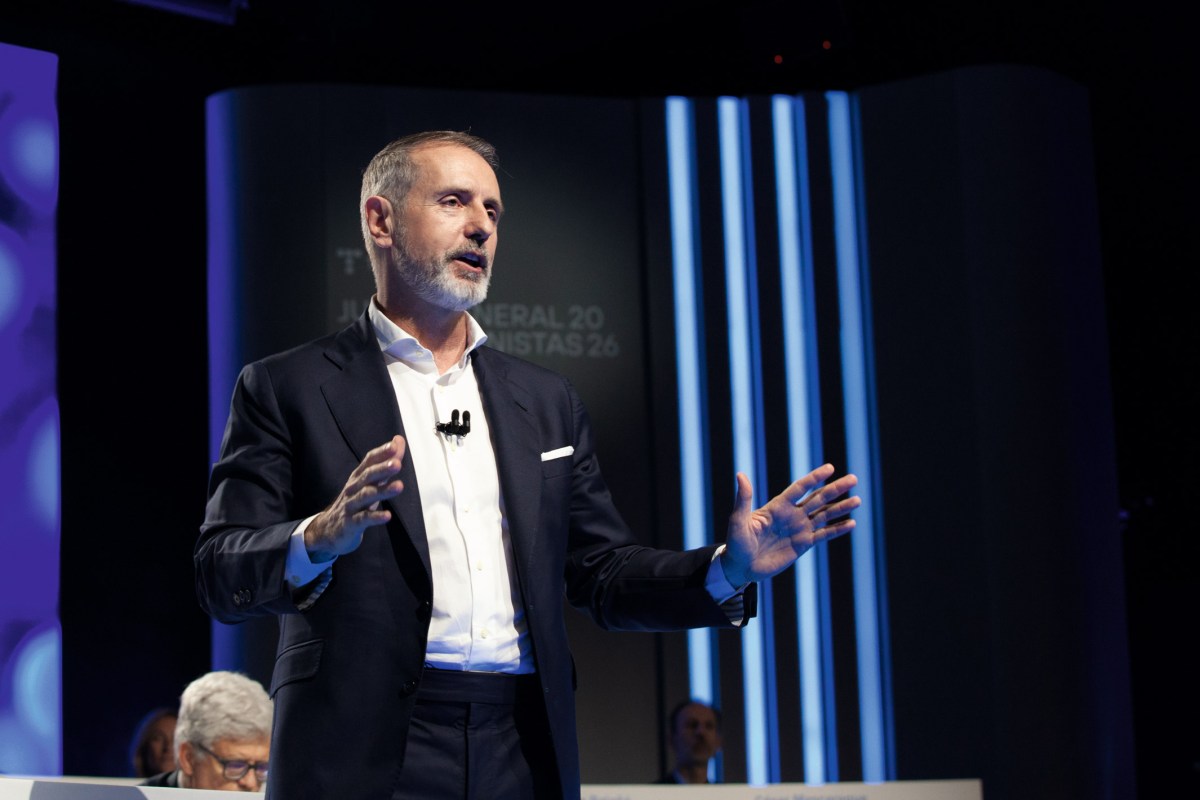
- “At Telefónica, we have taken on the clear challenge of becoming the best gateway for citizens, businesses, and institutions to access digital technologies. To be one of the best telcos in Europe by 2030 and one of the best telcos in the world by 2035. With this goal in mind, we want to transform the company comprehensively,” said the company’s Chairman, Marc Murtra, during his address to shareholders..
Madrid, 26 March 2026. Telefónica’s Annual General Meeting held today in Madrid approved all the proposals put to the vote by the company’s Board of Directors. Shareholders have approved the accounts and management report for 2025 and have approved the re-election of María Luisa García Blanco as an independent director, the ratification and appointment of Anna Martínez Balañá, César Mascaraque Alonso and Mónica Rey Amado as independent directors, and the appointment of Jane Thompson as an independent director.
In addition, shareholders have given the green light to the distribution of the second tranche of the 2025 dividend, consisting of a cash payment of €0.15 per share. The payment will be made on June 18.
Among the other items on the agenda approved today, it is worth noting the re-election of PricewaterhouseCoopers as auditor for the 2026 financial year and the appointment of the same firm to audit the accounts for 2027, 2028 and 2029; the approval of the remuneration policy for Telefónica directors, which will apply from the date of approval and for the following three financial years (2027, 2028 and 2029); and the favorable advisory vote on the Annual Report on Directors’ Remuneration for the 2025 financial year.
“We are already building a stronger company”
During the AGM, Telefónica’s Chairman, Marc Murtra, emphasized that the company is fully committed to implementing ‘Transform & Grow’, the strategic plan presented in early November. “We have a five-year plan, but we are already building a stronger, more efficient, more profitable, more disciplined company, better prepared to compete globally,” he stated.
“We are delivering, and we will continue to do so. With ambition, with rigour, with responsibility. For our shareholders, for our employees. And for Spain, Europe and Brazil,” stated the Chairman of Telefónica. And as a result of this determination, he added: “Spain, Europe and the world are undergoing a profound transformation. Telefónica wants to make a decisive contribution to that change. Telefónica has met its 2025 targets. The transformation is already underway.” Murtra has framed this ambition within a context characterized by the transformation and challenges, in which Telefónica must play a leading role. “We are living through a period of unprecedented geopolitical and technological transformation. At Telefónica, we want to be at the forefront of this transformation. We want to lead in such a way that every user is convinced that Telefónica will enable them to access the best digital products that technology has to offer,” he argued.
Transformation, execution and future
“Fifteen months ago, we embarked on a phase of profound transformation. Today we are not here to talk about intentions. We are here to talk about execution. We are here to talk about results. And we are here to talk about the future,” said the Chairman of Telefónica to the company’s shareholders.
Murtra acknowledged that the in-depth analysis carried out to launch the company’s transformation confirmed that “Telefónica is an extraordinary company”. “A leader in two of our four core markets, with advanced and robust infrastructure, a pioneer in convergence strategy and, above all, with a human capital of immense value,” he specified. He added, however, that this analysis also helped identify what the company needed to fix: “Organizational complexity, slow execution, limited financial flexibility, structural cost pressures and an aversion to making difficult decisions”. “Transformation demands clarity. And clarity means making decisions. We decided to simplify. We decided to focus. We decided to strengthen the balance sheet. And to take calculated risks. Because transformation does not arise from comfort. It arises from determination and execution” he stated during his speech. He added: “Transformation requires taking risks and knowing how to identify when to take them with rigour.”
Five key pillars
This transformation underpins the company’s current and future objectives. “At Telefónica, we have taken on the unquestionable challenge of being the best gateway for citizens, businesses and institutions to digital technologies. To become one of the best telcos in Europe by 2030 and globally by 2035.
With this aim in mind, we want to transform the company comprehensively,” he argued.
This objective and this transformation are based on five pillars. The first relates to consolidation and European leadership. “Europe needs strong operators, with investment capacity, sufficient scale and strategic vision,” he explained, adding: “In the increasingly unstable geopolitical landscape in which we live, we firmly advocate the consolidation of the sector in Europe as a necessary condition for creating European technological sovereignty.” “The fragmentation of the European market limits scale, reduces investment and hinders innovation. The tech world is not a two horse-race but a three-horse race. It is not just China and the United States; it is also Europe,” he stated. “Telefónica wants to be part of this European response,” he emphasised.
As a sign of the conviction with which Telefónica is approaching this focus on European consolidation and leadership, he cited the acquisition of Netomnia in the UK, which strengthens the company’s presence in one of Europe’s most competitive markets, and its strategy of concentrating on Telefónica’s four core markets: Spain, the UK, Germany and Brazil. In parallel, the Group has made progress in recent months in implementing its divestment strategy in Hispam, with the sales of operations in Peru, Uruguay, Ecuador, Colombia and Chile now finalised since the 2025 AGM – the exit from Argentina had already taken place previously.
The second pillar involves transforming Telefónica into a more innovative and competitive company, an objective which, as the company’s chairman has explained, involves streamlining obsolete structures, strengthening talent and securing specific technological capabilities. Among these capabilities, he mentioned three examples: the first, the implementation of a sovereign cloud with Artificial Intelligence capabilities and low-latency processing, including a pioneering deployment of 17 Edge nodes in Spain; the second, Titan Connect, a solution designed to ensure secure and resilient connectivity in critical environments such as emergencies, security or defence; and the third, Movistar Plus+ productions, with examples such as the miniseries ‘Anatomía de un instante’ or the films ‘Los domingos’ and ‘Sirat’.
The third pillar involves offering more and better services to customers. “Our commitment is clear: to offer the best access to technology. More network, more quality, more capacity, and at the heart of this transformation are our customers,” said the chairman of Telefónica.
The fourth pillar involves Telefónica serving as an institutional benchmark of Spain in Europe. “Telefónica is a company that manages critical technology, but we are also a strategic asset for Spain and for Europe. We are an economic driver, we foster social cohesion, and we provide critical infrastructure,” he asserted. Proof of this, he noted, is the technology scholarship programme announced this month by the Telefónica Foundation to train 150 young people in artificial intelligence, data science, cybersecurity and quantum technologies. “We are a company committed to more than just business. We assert our role as a driving force behind the Spanish economy and European technological sovereignty,” he emphasized.
The fifth pillar rests on ambitious, rigorous and effective management. “Transformation is only credible if it is executed with discipline. We committed to meeting our financial guidance, and we have done so. Leading a company like Telefónica requires absolute discipline in financial objectives. Managing with rigour means announcing little and delivering a lot. Only in this way are we consistent with the markets and our shareholders,” he acknowledged.
“Telefónica delivers and will continue to deliver”
That consistency was evident last financial year with the achievement of the financial targets set for 2025. “We have set a course, and we will not deviate from it,” stated Murtra, emphasizing that the figures already show the momentum generated by the execution of the strategic plan. In 2025, Telefónica achieved higher revenues, which exceeded €35 billion and grew by 1.5% in constant terms; higher profitability, with adjusted EBITDA and adjusted operating cash flow after leases increasing by 2% and 5.9%, respectively, in constant terms; an investment-to-revenue ratio of 12.4%; and free cash flow exceeding €2 billion from continuing operations.
“We have moved from intention to execution. Transformation processes take time, but this year we have moved from promise to delivery. Telefónica delivers and will continue to deliver. And we will maintain this commitment in 2026,” he assured.